
Park Perspective: Embracing the power of perspective
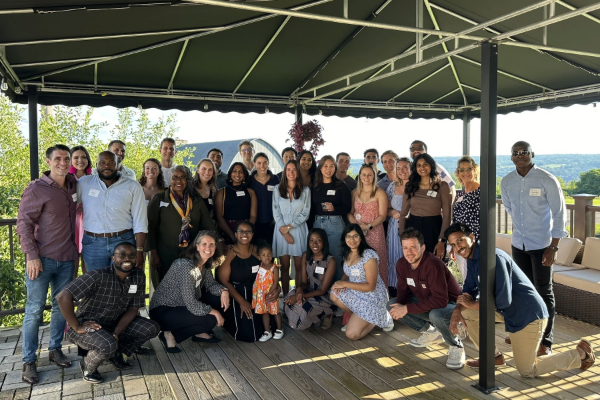
Park Fellows gather at the class of ’26 welcome dinner.
Business school is an incredible opportunity to define or redefine your career and future. For some, that means building a toolkit to one day start a business. For others, it means discovering a new industry or forging a path to a dream role. When people ask me why I love the Samuel Curtis Johnson Graduate School of Management, my answer will always be the enthusiasm, passion and drive of my classmates. They are truly inspiring. I say that not because they constantly succeed (though they often do), but because they constantly fight through pressure, adversity and setbacks to achieve their goals.
As rewarding and fulfilling as business school can be, it is challenging. Beyond the tough first-semester schedule, the program requires a level of self-reflection and personal realization that is uncomfortable. It is not just about learning business strategies or financial models; it is about understanding yourself, your motivations and your potential.
One afternoon late in the fall semester, I found myself in a moment of vulnerability. I was reviewing my resume for what seemed like the 10,000th time, following a mock interview that had left me feeling inadequate and uncertain. As I read through the details of my work experience (words I could recite from memory at this point), I began to needlessly question everything on the page. Is this relevant? Is this enough? Why would a firm care about these experiences?
The self-doubt was overwhelming. Each line on my resume, which had once represented achievements I was proud of, felt insufficient. In this moment of frustration, I called a family member to vent. Their response was simple yet profound: “You need some perspective.”
The power of perspective
A new perspective can be as simple as reading a resume with a fresh set of eyes or as complex as communicating with someone from a completely different cultural background. The beauty of perspective lies in its ability to challenge our current biases, assumptions and predispositions. It allows us to step outside of our limited worldview and embrace the possibility of alternative interpretations.
In the context of business school, perspective means recognizing that your worth is not defined by a single interview, a specific line on a resume or even your academic performance. It is about understanding your unique journey, your strengths and the value you bring that goes far beyond metrics.
The single most rewarding aspect of my first year at the Johnson School and my time in the Park Leadership Fellows Program has been learning about my peers’ life experiences, challenges, struggles, and achievements and recognizing the incredible diversity of perspectives that now inform how I view the world.
In my case, on that fall afternoon, perspective meant escaping my “tunnel vision,” reflecting on my accomplishments and my failures, and appreciating all the opportunities that lay before me. It meant saying, “Look how far I’ve come, and look at all of the people in my corner.”
I urge my fellow students and anyone who is in the midst of this sometimes lonely journey to practice self-compassion and to seek out new perspectives that are unencumbered by our immediate stresses.
Perspective is a powerful tool — use it!
I will caution, however, that perspective can be misused, especially when it is a means to feel superior to others:
- “At least I’m better off than they are.”
- “I’m glad she’s dealing with that and not me.”
- “It could be worse! Look at him.”
This is where true and effective leaders distinguish themselves. They recognize that perspective and empathy go hand-in-hand. It is not enough to have perspective; to be a true servant leader, you must use perspective for good.
The responsibility of perspective
In his essay “The Servant as Leader,” management researcher and former AT&T executive Robert Greenleaf argues that true leadership begins with a natural desire to serve others. It is not about accumulating power, but about empowering those around you. In one of my first class sessions as a Park Fellow, I had the chance to study Greenleaf’s work and to internalize his simple yet profound message.
Separately, in my first-semester Critical and Strategic Thinking class, taught by Risa Mish, professor of practice and the Day Family Senior Lecturer of Business Ethics, we studied the intricacies of forming sound analyses and arguments. We frequently heard a message that resonated with me: “Context is Queen.” In order to understand a situation, people’s actions, and their motivations, we have to view things in the context of where and when they are occurring.
What do the teachings of Greenleaf and Mish have to do with each other? Together, they convey the importance of perspective and the responsibility of leaders to use perspective for good.
Recognizing, with perspective, that a peer or colleague is struggling to keep up is the context (Queen!); acting on those observations and prioritizing that person’s needs is the bridge to servant leadership.
When I moved to Ithaca, I was pleasantly surprised by many things, but most of all the culture of social impact that permeates this town and the surrounding area. There is a great deal of need, but also an amazing collection of organizations working to serve those needs.
As I built an understanding of servant leadership, the importance of context, and the power of perspective, I recognized that I wanted to be a part of Ithaca’s altruistic culture. I did not have to look far before I found the Johnson Board Fellows, an experiential leadership program created to provide Johnson MBAs an opportunity for professional development through service on nonprofit boards of directors in the greater Ithaca area. I found what I saw as my calling on the executive board of this organization, supporting my MBA peers as they seek new perspectives and use their positions to better our community.
If you are at the Johnson School or considering Johnson, these opportunities for understanding and impact are all around us. The way I view the world and myself is vastly different than before I arrived here. I feel prepared to take on the challenges that I will face in my career and empowered to understand and support the people around me.
About the author

Tom Lenz is a second-year MBA candidate and a Roy H. Park Leadership Fellow at the Samuel Curtis Johnson Graduate School of Management at Cornell University. His professional experience includes roles in corporate development at AARP and business valuation at KPMG. Over the summer, he interned with Kearney’s private equity and principal investors practice in New York.
At the Johnson School, Lenz is the executive director of the Johnson Board Fellowship and treasurer of the Johnson Consulting Club. He also served as a volunteer coach with the First Tee of Greater Washington and a student fundraiser for Georgetown University, where he earned his bachelor’s in business administration. In his free time, he enjoys playing golf and watching movies.