At the helm: Johnson grad navigates a new era for Resolve Marine
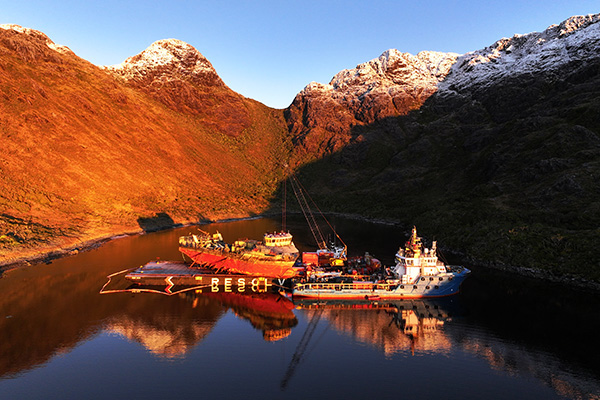
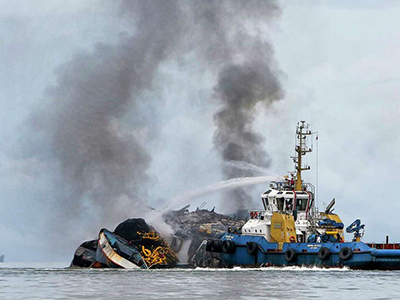
In 2024, Resolve Marine was called upon to remove a well boat grounded outside the Strait of Magellan in Chile. The removal process used a variety of salvage techniques, including a drag-up removal plan to raise the vessel off the seabed and onto a barge for transport.
Consider the following occurrences from the past two years:
- In June 2025, a cargo ship carrying over 3,000 cars from China to Mexico caught fire while in international waters near Alaska and sank in the North Pacific Ocean after crew members abandoned ship.
- In April 2025, a container ship and a bulk carrier collided on the Long Tau River in Vietnam near Ho Chi Minh City, resulting in the partial sinking of the bulk carrier. Fuel oil spilled from its tanks into the river.
- In July 2024, a 300-foot piece of a wind turbine blade from an offshore wind farm fell into the Atlantic Ocean near Nantucket, Massachusetts, bringing with it a scattering of broken foam and fiberglass shards.
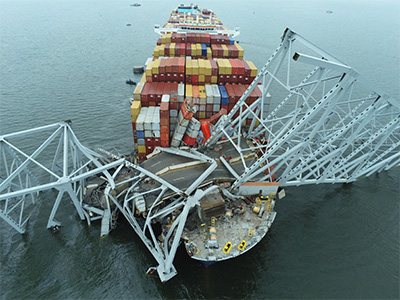
- In March 2024, the container ship MV Dali collided into the Francis Scott Key Bridge in Baltimore, causing the collapse of the bridge onto the ship. Chemical hazards consisted of known, unknown and mixed cargos that leaked from containers and tanks.
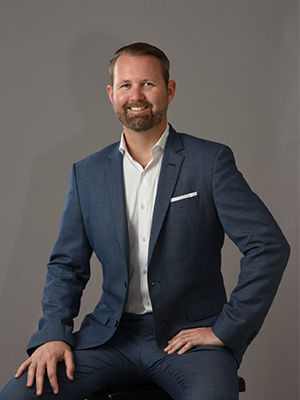
When these disasters happen, who arrives to deal with the situation? At the helm of one of the world’s leading marine emergency response firms is Joseph Farrell III, MBA ’16, who took over as CEO of Resolve Marine from his father two years ago. Today, he’s steering the family-founded company into a new era, building on decades of facing challenging maritime crises — and doing so with multiple Cornellians.
How it started with a single tug in 1980
In 1980, Farrell III’s father, Joseph Farrell Jr., a U.S. Coast Guard diver, founded Resolve Marine with a single tug. Originally from Massachusetts, Farrell Jr. returned from the war in Vietnam and, with his military diving background, secured a job as a diver retrieving prototype torpedoes and missiles for the U.S. Navy’s Atlantic Undersea Test and Evaluation Center (AUTEC) in the Bahamas.
A few years later, Farrell Jr. became an engineer on a tugboat. One day, a ship ran aground near where his tug was stationed, and Farrell Jr. offered to use the tug to refloat the stranded vessel. After the same thing happened a few months later, Farrell Jr. bought the tugboat and started his own marine salvage business, Resolve Marine.
As the company took shape, Farrell III grew up immersed in life on the ocean. Surfing and free diving were everyday pursuits, and he decided that he wanted a career centered on the sea. Having seen the ups and downs of salvage, Farrell III wanted to be equipped to work in the industry regardless of where the salvage industry went. He attended Massachusetts Maritime Academy for his undergraduate studies, where he received his 3rd Unlimited Engineers license and a degree in marine engineering. After graduate school at Florida Institute of Technology, where he studied naval architecture and ocean engineering, he began his career at his father’s company.
Apprenticeship at sea
Farrell III started out learning the business through hands-on experience. For most of the year, he was out on jobs, gaining practical knowledge in the field. It was an exciting role — one that took him around the world and placed him in high-adrenaline situations — and through it all, he saw great potential for the company.
On these jobs, Farrell III grasped the intensity of Resolve Marine’s work and the level of expertise required for each mission. The sea was unpredictable. Swells 20 to 30 feet high could threaten to wash entire barges ashore, turning an already difficult situation into something even worse. Failure to prepare for all the risks could bring about immense consequences.
By the time Farrell III graduated from Cornell’s Samuel Curtis Johnson Graduate School of Management, the company had doubled in size and opened offices all over the world. The company’s original system wasn’t built to manage the number and size of the projects or the complexities that arose in different countries. The accounting department couldn’t keep up. In essence, the company was getting too big, too quickly.
Strength in family and the Cornell network
In 2017, Farrell III called up the Johnson School’s Career Management Center, conveying his need for someone who could help Resolve deal with a problem of rapid growth. He was put in touch with Jim Wood, MBA ’16, who worked for Headwaters SC (later acquired by EY) as a practice leader specializing in governance, strategic growth and corporate development of multigenerational family enterprises. Wood’s expertise was exactly what Resolve Marine needed.
Wood brought in governance and helped establish a family board and an executive board. He introduced clear structures, such as having one family representative serving on the executive board to ensure alignment between family interests and business decisions while keeping discussions distinct. Under his guidance, meetings were organized with focused agendas, separating conversations about ownership and investment from those about day-to-day operations. This clarity helped reduce confusion and strengthen decision-making. Wood also oversaw the formalization of the ownership structure and the creation of a succession plan.
A few years after Wood came on board, Farrell III’s sister Lana Farrell, MBA ’20, also decided to join the family business following careers in nursing and marketing.
Seeing the impact that a Cornell MBA had on her brother, she decided to pursue the same degree. Upon graduating in 2020, she returned to Resolve Marine and focused on personnel. “We are a service industry,” she said. “At the core of what we do is our people.”
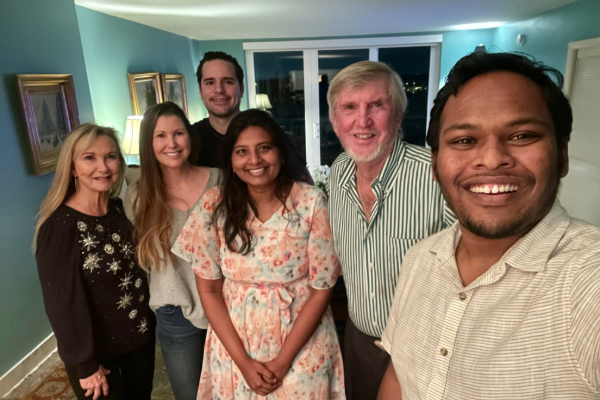
Soon after joining, she brought in a Johnson classmate, Prasad Batchu, MBA ’20, whom she knew through the Family Business Club and who had expressed interest in an open position that she had shared with her Johnson classmates. “It’s been really special having him with us,” Farrell said.
Batchu chose Resolve Marine for the opportunity to work directly with the CFO and gain a front-row view of what it takes to steer a business, including solving complex, multidimensional challenges and shaping core business processes. Soon after joining, he led an 18-month, company-wide strategic planning initiative.
Now in his fifth year at the company, he focuses on mergers and acquisitions and leading strategic initiatives for the executive team.
“What drew me to Resolve was the opportunity to apply rigorous strategic and financial thinking in a highly operational, real-world environment,” said Prasad, whose family operates a large poultry business in India. “My five years at Citigroup provided a strong foundation in risk management, capital allocation and structured decision-making. Complementing that, my exposure to my family’s poultry business in India shaped my appreciation for execution, cost discipline and the dynamics of founder-led family businesses built by small teams over decades of shared commitment. At Resolve, I have been able to integrate these perspectives by building scalable processes, executing mergers and acquisitions, and supporting the global growth of a long-established organization. Working closely with leadership has reinforced for me that long-term value creation is less about titles and more about earning trust, thinking holistically and committing fully to the organization you are helping shape.”
Farrell, meanwhile, is thriving as director of the Resolve Maritime Academy, the educational branch of the company that trains students on emergency response operations on land and on water. She also oversees the family’s real estate business.
The next chapter of Resolve Marine
At the end of 2023, Farrell III assumed the CEO role. Thanks to the governance structure Wood helped put in place over seven years, the handover was a smooth one. While Farrell Jr. stepped back from day-to-day operations, he remains active as chairman of the board. With a third sibling, Summer Farrell-Forsman, now working in a technical role, Resolve Marine has evolved into a second-generation family business.
“We’re positioned well right now,” said Farrell III. “We’re good at solving problems that are unexpected by clients. But because these are problems that are too infrequent for people to even think it’s going to happen, it’s hard to compare quality against other providers. The challenge is to show people that you’re the best.”
Going forward, Farrell III’s goal for Resolve Marine is to continue to grow and gain recognition as the leading response provider to maritime problems while also diversifying its business.
Navigating with purpose: Lessons in leadership and sustainability
The work carried out by Resolve Marine carries personal significance for Farrell III, who sees the impact of human actions on the environment and ensures that Resolve’s actions have the least possible impact on the environment. “We move thousands of tons of pollutants and unwanted debris out of the ocean each year,” he said. “Even if it means spending more money and time to do the job, we always work toward leaving the seabed in a better condition than when we got there.”
To current Cornell students involved in family businesses, he offers this advice: Respect the work of those who came before you and keep that legacy in mind when proposing change. He also suggests seeking outside perspectives to help frame ideas, just as his family did when they brought in Wood.
The world is constantly changing, and businesses must evolve to keep pace. For family enterprises like Resolve Marine, that evolution simply requires a little more thoughtfulness, plus a steady hand at the helm.