
From ideas to insight: Lessons from Cornell’s Sam Seltzer ’48 Mentors Forum
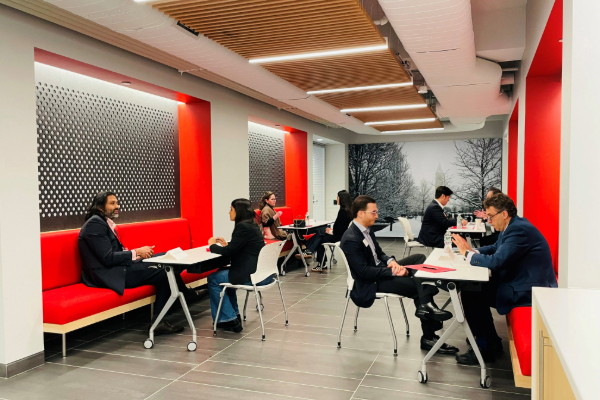
Mentees and mentors meet for 1:1 conversations on family business issues.
On Friday March 6, I participated in the Sam Seltzer ’48 Mentors Forum, hosted by the Smith Family Business Initiative in the Cornell SC Johnson College of Business. The full-day event took place in Cornell office space at 570 Lexington Ave. in midtown Manhattan. I came into the event with a very specific motivation: I wanted to test entrepreneurial ideas I have been developing in my family business context.
My interest in the event was personal. I come from a family business background, but my family sold our company three years ago. Since then, I have remained very interested in the logic, culture and long-term decision-making that make family businesses unique. When I first saw the event, I was not entirely sure whether my ideas would fit the format. After speaking with faculty, however, I was encouraged to participate, and I am very glad I did. I found not only a place where my ideas fit, but also an environment designed to challenge and refine them.
The day began with introductions led by Daniel Van Der Vliet, the John and Dyan Smith Executive Director of Family Business, and breakfast, which created a welcoming atmosphere and made it easy to start conversations. It would be a day of testing assumptions, receiving feedback, and learning from people who had built, advised, financed and led family businesses.
A day dedicated to real learning

One of the strongest aspects of the event was its structure. We first had a few rounds of small-group networking sessions, where conversations were short and fast-paced, lasting about 15 minutes each. These sessions worked almost like intellectual warmups: enough time to introduce ourselves, explain our ideas at a high level and receive immediate reactions.
The second stage was even more valuable. We had longer one-on-one conversations of roughly 40 minutes with individual experts. These deeper discussions allowed me to really engage with the practical implications of my ideas. In a single day, I was able to speak with more than 10 experts from investment firms, family businesses and consulting firms focused on family enterprises.
That density of interaction was remarkable. In a normal setting, it could take months to gather that level of feedback from such a wide range of perspectives. Here, it happened in one day. The event accelerated my learning by exposing me to how different stakeholders would react to the same entrepreneurial concept.
In a normal setting, it could take months to gather that level of feedback from such a wide range of perspectives. Here, it happened in one day.
Lessons from different mentors
The most valuable part of the event was the diversity of perspectives. Each mentor viewed my idea through a different lens, and together, they gave me a much more complete understanding of what it would take to make it work.
From one business owner, I learned about the personal journey of building and sustaining a business in an environment shaped by much larger corporations. What stood out most was the importance of decision-making discipline and of finding a niche where a smaller or more focused business can genuinely compete. His perspective reminded me that strategy is not only about size or scale. It is also about clarity, positioning and knowing where you can create distinct value.
From family business consultants, I learned something more communication-focused: The same idea must be explained differently depending on the audience. Investors and family business owners may evaluate the same opportunity through completely different frameworks. Investors may look for clarity, scalability, returns and structure. Family business owners may care more about legacy, trust, continuity and whether the proposal truly respects what they have built. That feedback allowed me to realize that I need to prepare different pitches for different audiences. I also learned that theory alone is not enough. In most cases, I will need to test my idea in practice, refine it and adapt it based on real-world reactions rather than relying only on conceptual frameworks.
From a seasoned business CEO, I took away perhaps the most enduring lesson of the day: the importance of purpose. He emphasized that strong family businesses are grounded in a clear sense of purpose and a culture that reinforces that purpose in daily decisions. Sometimes, that means walking away from opportunities that look attractive on paper but do not fit the company’s long-term values. That insight is especially powerful to me. It reframed sustainability not simply as financial durability, but as alignment of growth, identity and values.
Why the experience mattered to me
What made the event especially meaningful was that it connected my past experience with what I am trying to build next. Because I come from a family business background, many of the conversations resonated with me in a direct way. At the same time, they pushed me to think more rigorously about entrepreneurship, capital, stakeholder communication and long-term fit.
I also appreciated how engaged the mentors were. They were not offering abstract or overly polished answers. They were proactive, candid and willing to share views shaped by experience. That honesty helped me understand not only what sounds compelling in theory, but what matters when decisions are being made.
Final reflections
By the end of the day, the event had done exactly what I hoped: It pressure-tested my ideas and made them better. It gave me a clearer picture of how investors might view my concept, how family business owners might respond to it and how I need to adapt my communication depending on the audience.
Most importantly, it reinforced a principle that will stay with me: In the family business world, good opportunities are not defined by financial logic alone. They also need to fit purpose, culture and long-term sustainability.
The Sam Seltzer ’48 Mentors Forum was, for me, a rare opportunity to combine reflection, feedback and practical learning in a single day. I arrived with ideas I wanted to test. I left with sharper thinking, stronger conviction and a better sense of how to move forward.
About the author

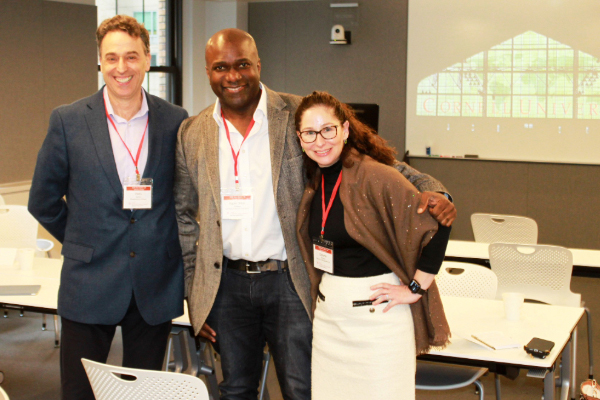
Brazilian-Italian MBA candidate at the Samuel Curtis Johnson Graduate School of Management, Luca Mosena, MBA ’27 brings a strong background in corporate development, mergers and acquisitions (M&A), and strategic growth. He has led acquisitions, divestitures, joint ventures and post-merger integration initiatives across healthcare, telecommunications and family-owned businesses in Brazil, with experience spanning valuation, due diligence, negotiations and capital allocation. Before Cornell, he held M&A and corporate development roles at Grupo Fleury and Vero Internet, and worked closely with his family business, Mosena Equipment, on growth, operational improvement and strategic transactions. Outside of work, Mosena is passionate about barbecuing, crafting cocktails, playing strategy games, swimming and learning new languages. He will further sharpen his finance and strategy toolkit through his MBA and a summer associate role in strategy consulting.