
Park Perspective: Manufacturing your own leadership style
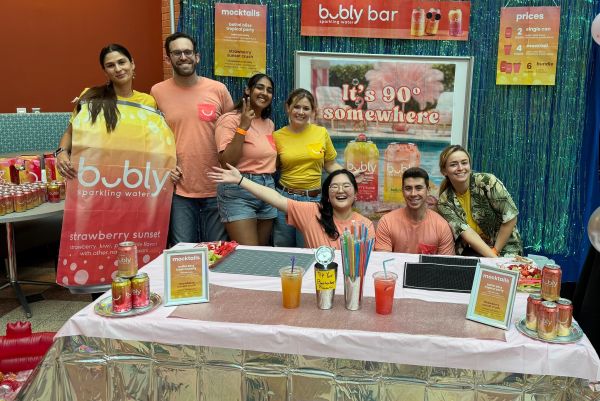
Zachery Badrawi, MBA ’27, second from right, with his teammates during the Battle of the Brands case competition hosted by the Corporate Leadership Club.
Like many MBA students, I came to Cornell’s Samuel Curtis Johnson Graduate School of Management to pivot careers. After half a decade managing projects as an automotive engineer, MBA orientation marked the first time since undergrad that I found myself in a professional setting wearing something other than my requisite Honda jumpsuit. While I was excited to leave the factory behind and work in a building with actual windows, my transition from manufacturing to brand management was a significant shift in professions. What I did not anticipate was how much the experience would shape my identity as a leader and problem solver.
From manufacturing to marketing
In the factory, if a car door was misaligned, I measured it, adjusted the install robot and watched the corrected car roll off the production line. Solutions were quantifiable, and physical results meant instant and indisputable feedback. Attending business school felt like the opposite. Problems required executive decision making. Cases were ambiguous; data was limited; and inherent subjectivity meant that my marketing strategy could look entirely different from my classmates’.
Compounding this was the fact that many of those same classmates also carried years of experience in the field I was trying to enter. While this created an incredible learning environment, it also shaped my initial perception of what a brand manager or business leader was supposed to look like. The more I bought into that image, the more I convinced myself my background was irrelevant. I stopped thinking like an engineer and started mimicking the frameworks, tools and language of my marketing peers. Instead of building on my existing leadership identity, I was replacing it, and in the process, I was becoming less confident and less decisive.
Analysis paralysis
It became clear that this strategy wasn’t working during my second semester, when I was given the opportunity to lead a marketing class project for a client. As project manager, I needed to guide my team of four in developing an innovative retail product proposal. Throughout the research process, we had collected an abundance of consumer preference data. I vividly remember staring at our results spreadsheet, none of the figures pointing to a clear answer, and wondering how I was supposed to translate it all into the “correct” answer for our client.
Learning to connect the dots
Around this time in my marketing research class, Young-Hoon Park, Sung-Whan Suh Professor of Management, delivered a lecture covering decision-making in ambiguity. He described data as “individual dots” and told us that as brand managers, “it is up to you to connect those dots to create an image.” The data guides us, but we are ultimately the ones who decide what to draw with it.
This started to shift my perspective. The Cornell MBA could teach me how to build and process data, but it couldn’t tell me who I was as a brand manager. I had to figure that out myself. My five years of engineering were part of that identity. My work had always involved diagnosing issues, identifying patterns and working under constraints. Why couldn’t I apply some of that here?
Two worlds meet
Thinking like both an engineer and a brand manager gave me a fresh perspective and helped me chart a path forward for the team. I discovered parallels between the factory floor and my MBA education. I now carry these concepts into any leadership role where decision-making is central:
- Take frequent walks. In manufacturing, I regularly relied on a Japanese concept called a “gemba walk.” Former Toyota chairman Fujio Cho distilled it into three steps: “Go see; ask why; be respectful.” The idea is for manufacturing leaders to physically leave their desks and walk the production line to build perspective and context around problems. In marketing, that could translate to talking to the consumer, testing the product or walking the retail aisles. For my marketing team, our gemba walk was a focus group. Through resources like the Business Simulation Lab, I sat with real consumers, asked questions and built context around our data. Accounting for different perspectives is a core part of a leadership mindset.
- Prioritize simplicity. Diagnosing a single root cause on a car made of 30,000 parts is overwhelming. To keep projects focused and productive, I always relied on Occam’s razor. The concept suggests prioritizing the explanation that requires the fewest unnecessary assumptions. For my marketing team, when our project data started generating more questions than answers, our instinct was to chase every outlier and irregularity. With limited time and resources, I refocused our efforts on investigating the clearest, most grounded read of the consumer data. In moments of ambiguity, being able to decisively set priorities keeps a team moving.
- Account for uncertainty. In my work as an engineer, countermeasures were a part of every project proposal. The team was expected to acknowledge potential failure points and have proactive solutions ready. I now know to apply this mindset in any environment. When our marketing project’s top two packaging designs polled almost identically with consumers, just choosing one design wasn’t enough. I needed us to justify why we didn’t choose the other option. As evaluators probed our decision, showing we had worked through the alternative gave them greater confidence in our recommendation. Accounting for risk and preparing for that uncertainty can be a critical decision-making skill.
Final reflection
I encourage every MBA student to reflect on their past, identify their unique tools and perspectives and find ways to exercise them in new settings. The Johnson experience isn’t designed to rebuild you as a leader. In fact, you were probably selected because you already were one. Whether you worked in a pharmacy, in a classroom or on a factory floor, the program expands on that foundation and teaches you to apply it in challenging business environments.
For me, this meant leaving the jumpsuit behind while holding on to my identity as an engineer. It is part of who I am, and it is the foundation of the brand manager and decisive leader Johnson is helping me to become.
About the author

Zachery Badrawi is a first-year MBA student in the Samuel Curtis Johnson Graduate School of Management. Prior to Johnson, he was a senior engineer at Honda, where he managed project teams in manufacturing and vehicle product development, contributing to multiple global automotive launches. At Johnson, Badrawi is pursuing an immersion in marketing and is vice president of education for the Corporate Leadership Club. He holds a bachelor’s degree in mechanical engineering from Lehigh University and will have an internship in brand management at Procter & Gamble during the summer of 2026.