
The rise and fall of Bolivia’s state-led growth model
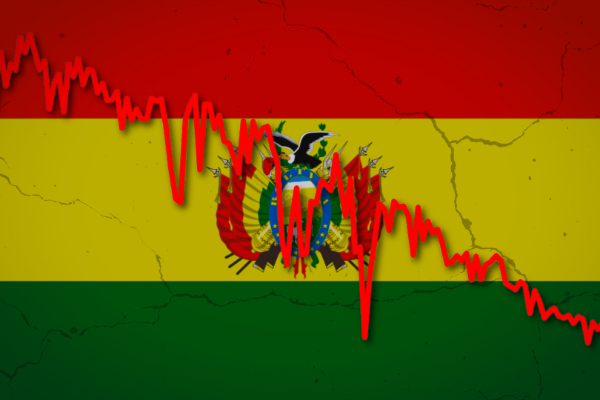
Illustration by Thomas Riveros depicting the change in oil and natural gas production in Bolivia from 1990 to 2025, represented in a line graph imposed over an image of the Bolivian flag. Sources: Instituto Nacional de Estadística; Estado Plurinacional de Bolivia.
In May 2006, Bolivia’s newly elected socialist president, Evo Morales, nationalized Bolivia’s hydrocarbon sector. This decisive political move was designed to break from the neoliberal policies of the 1990s and dramatically expand state control over natural resources.
Decree 28701 granted the state full “ownership, possession, and control” of hydrocarbons while charging Yacimientos Petrolíferos Fiscales Bolivianos (YPFB), the state hydrocarbon company, with responsibility for marketing and sales of gas. International firms were effectively reduced to contractors, receiving only one-third of gas rents.
The results were immediate. State hydrocarbon revenues exploded, peaking in 2014 at nearly $7.5 billion from natural gas exports. The state used those windfalls to invest in infrastructure and create social entitlement programs that helped reduce inequality and poverty. Despite the surge in state revenues, Bolivia’s new hydrocarbon model had serious long-term costs. By reducing firms to contractors and heavily taxing output, the policy discouraged private investment in exploration and prompted companies to focus solely on maximizing existing production. YPFB, now responsible for exploration, chronically underinvested, leading to a sharp decline in proven reserves and a production peak in 2014. From 1985 to 2005, before the Movement for Socialism (MAS) and Morales achieved political power in Bolivia, both YPFB and private firms regularly drilled new wells thanks to business-friendly neoliberal policies. But between 2006 and 2014, YPFB constructed only one new well, and private operators drilled just two. A 2021 panel study found that foreign direct investment was significantly higher in the 10 years before Morales took office than during his administration. Thus, while the state captured a greater share of hydrocarbon rents, it also shrank the size of the pie, penalizing producers so heavily that production declined.
The MAS government was also aided by external tailwinds. When Morales took office in 2006, global natural gas prices were soaring, peaking in 2008 at nearly $9 per million BTU. Oil prices did crash in 2015, but when they came roaring back in 2022, Bolivian production did not. Thus, the fall in hydrocarbon rents came not from external shocks but from an internal collapse in production.
Fiscal overextension
Had the MAS government adjusted spending in line with falling gas revenues, Bolivia might have maintained relative stability. Instead, expenditures on infrastructure, poverty reduction and education rose sharply, alongside mounting costs for gas subsidies and unprofitable state-run enterprises. This fiscal policy has generated persistent deficits since 2014.
A central driver of these deficits is Bolivia’s massive gas subsidy. By law, citizens can only purchase fuel from YPFB, with the state absorbing the difference between domestic and international prices. In 2022, the subsidy cost $1.8 billion — nearly 9% of total government spending. Although Bolivian fuel remains cheap, people still pay for it with their time, as hours long lines have become commonplace in recent years. Experts estimated that the wasted time cost the economy at least $19 million per week in lost productivity.
In addition to the costly subsidy, the government created a plethora of state-run companies that lose hundreds of millions of dollars annually. Among the roughly 55 state-run businesses is Quipus, a laptop manufacturer with glowing reviews like “Un teléfono de ese precio te funcionaría mejor” (“a telephone of this price would work better”). In 2023, 14 state-owned enterprises operating at losses generated a combined deficit of $219 million (at the parallel exchange rate) and collectively owed the central bank $3.2 billion. Many of these enterprises are redundant, crowd out private investment and contribute to Bolivia’s growing fiscal deficit.
For years, the government was able to patch up the problem by drawing down its massive foreign currency reserves, which in 2014 were over $15 billion, equivalent to nearly half of Bolivia’s GDP at the time. However, as of 2025, the total value of reserve assets was 60% of the value of total short-term external liabilities. Due to the elevated risk, investors demand massive default premiums, reaching 22% in April of 2025. With no reserves or international lenders to turn to, the government has been borrowing from the central bank, which prints money to meet those credit needs. In 2024, government debt made up 74% of the central bank’s assets. As a result of the money printing, inflation hit 25% on an annual basis in July, the highest it has been for nearly 40 years.
Looking forward
MAS has now fallen out of favor with the Bolivian people, with its presidential candidate winning just 3.2% of the vote in recent elections. The new president, Rodrigo Paz Pereira, speaks extensively on the need to cut government spending, liberalize the economy and refocus the state. In its first six weeks, the Paz administration has normalized gas imports, reduced subsidies, reopened negotiations with the CAF and IDB, lowered taxes, increased social spending, lowered trade barriers and amended laws to attract foreign investment.
About the author

Thomas Riveros ’27 is an undergraduate at Cornell University majoring in economics with a minor in business. He is passionate about finance, emerging markets and macroeconomics. He is the co-host of “Beating Sisyphus,” a podcast that brings on experts from different industries to discuss how emerging markets succeed under pressure.
All views expressed in articles published on the Cañizares Center for Emerging Markets webpage are those of the author(s) and should not be taken as reflecting the views of the Cañizares Center for Emerging Markets.