
Designing leadership: Japan and Korea through an emerging market lens
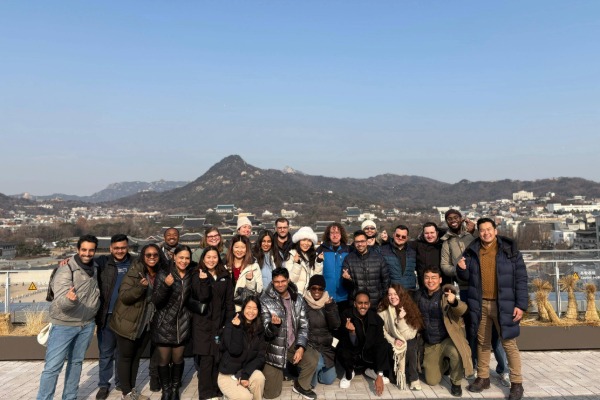
Caption: Cornell MBAs at the National Museum of Korean Contemporary History. Photo credit: Mark Milstein.
Before traveling to Japan and South Korea as part of the Japan-Korea trek with Mark Milstein, clinical professor and academic director of the Center for Sustainable Global Enterprise, I expected to notice differences in etiquette, communication styles, and workplace norms. Having come from an emerging market, I assumed the contrasts would be surface level: punctuality, formality and a heightened sense of order. What I did not anticipate was how profoundly the experience would challenge my assumptions about leadership itself — specifically, how authority, responsibility and trust are designed into systems rather than enforced through individuals.
The experience reframed how I understand management and leadership. Rather than viewing leadership as a function of constant oversight, adaptability or personal influence — traits often emphasized in emerging market contexts — I began to see leadership as an act of environmental design. In Japan and Korea, behavior appeared less driven by individual negotiation and more shaped by deeply embedded systems that clarify expectations and distribute responsibility.
Seeing structure as strength, not constraint
In many emerging markets, leadership often compensates for institutional gaps. Managers are expected to be highly involved, flexible and reactive, frequently stepping in to resolve ambiguity or inefficiency. While this can build resilience and adaptability, it can also normalize dependence on individuals rather than systems.
In Japan and Korea, structure was viewed not as restrictive, but as enabling. Hierarchy was visible, intentional and clearly defined. Authority was communicated through language, space, posture and process. What struck me most was not the hierarchy, but the ease with which people operated within it. Responsibility did not appear to require constant supervision. Individuals seemed to understand their roles and act accordingly, suggesting that accountability had been internalized rather than externally imposed.
This challenged my prior assumption that strong systems reduce flexibility or individual agency. Instead, clarity and consistency appeared to create space for people to focus on mastery, contribution and growth.
Korea: Intensity, transition, and humanized hierarchy
South Korea presented itself as a society shaped by urgency, historical trauma, rapid industrialization and an intense national focus on progress. Hierarchy and respect for seniority were clearly present, yet what stood out was how visibly these structures are evolving.
Authority did not feel distant or impersonal; it was often paired with relational warmth and approachability. Tradition felt alive rather than preserved, integrated into modern life rather than separated from it. In professional and social interactions, hierarchy existed alongside attentiveness and care. Respect was expected, but it did not require emotional distance.
Korea’s trajectory reflects the challenge many fast-growing societies face: maintaining discipline and coordination while responding to changing social expectations. Rather than dismantling hierarchy, Korean leadership appears to be softening its edges, retaining clarity while allowing for more human connection. This suggests that structure and empathy are not mutually exclusive but can coexist when leadership evolves alongside society.

Japan: Internalized responsibility and trust in systems
If Korea highlighted transition, Japan demonstrated internalization. One of the most striking aspects of Japanese society was the presence of order without visible enforcement. Public spaces were respected, norms were followed, and responsibility appeared to be self-regulated rather than imposed.
Over time, it became clear that this behavior was driven not by fear of punishment, but by trust in systems that consistently work. When expectations are clear and institutions are reliable, individuals do not need to act defensively. Responsibility becomes habitual rather than reactive.
For someone from an emerging market, where systems can be uneven and rule enforcement inconsistent, this was a powerful lesson. Responsibility was treated not as a personal burden, but as a shared outcome of well-designed environments. Leadership, in this context, operates through maintaining systems that people believe in.
Hiroshima: Leadership after crisis
Hiroshima was the most emotionally impactful experience of the trip and the moment that most clearly reshaped my thinking about leadership. The scale of destruction and loss was overwhelming, yet what stood out was not only the tragedy, but what followed. Hiroshima today is modern, efficient and thoughtfully designed — a city rebuilt with intention rather than spectacle.
This clarified a distinction I struggled to articulate: What can look like caution is often deliberate. Once alignment is achieved, execution is disciplined and precise. Hiroshima exemplified post-crisis leadership that prioritizes long-term responsibility over emotional reaction. Memory was preserved, infrastructure was rebuilt, and systems were designed to endure.
Rather than erasing the past, the city organized itself around it. This reframed my understanding of leadership in moments of disruption not as immediate resolution, but as sustained accountability over time.
From observation to intention
What stayed with me most after this experience was not a specific practice or cultural difference, but a growing awareness of what I have been conditioned to do as a leader and what I may need to unlearn. Having been shaped by environments where effectiveness often depends on personal involvement, improvisation and constant intervention, I had come to associate good leadership with visibility and control. Japan and Korea quietly challenged that assumption. I began to question not the value of adaptability, but its overuse. When leaders are required to constantly step in, resolve ambiguity or compensate for weak alignment, it can signal not strength, but fragility in the system itself. Observing societies where responsibility is widely internalized forced me to reconsider the role of a manager not as a problem-solver of last resort, but as someone accountable for the conditions that make problems less frequent in the first place.
This shift has influenced how I now think about authority, trust and growth. I am increasingly drawn to leadership that is less performative and more structural, where expectations are explicit, accountability is predictable, and progress is measured over time rather than through constant urgency. Going forward, I want to lead with greater intentionality about what I build, not just how I respond. Rather than relying on personal oversight, I aim to invest in clarity, alignment and institutional trust. The most lasting impact of this experience was not learning how others lead but recognizing how my own instincts have been shaped and how they can evolve.
About the author

Prerana Reddy is an MBA student in the Samuel Curtis Johnson Graduate School of Management and a fellow of the Cañizares Center for Emerging Markets. With a background in financial services spanning software development, AI engineering and analytics, she has contributed to data-driven products and platforms. Her experience sparked an interest in how technology, customer needs and business strategy intersect at the product level. She is passionate about customer-centric AI-enabled solutions and scalable enterprise systems with a focus on building thoughtful, globally relevant products.
All views expressed in articles published on the Cañizares Center for Emerging Markets webpage are those of the author(s) and should not be taken as reflecting the views of the Cañizares Center for Emerging Markets.