
Reorientation, not retreat: New pathways for emerging markets trade
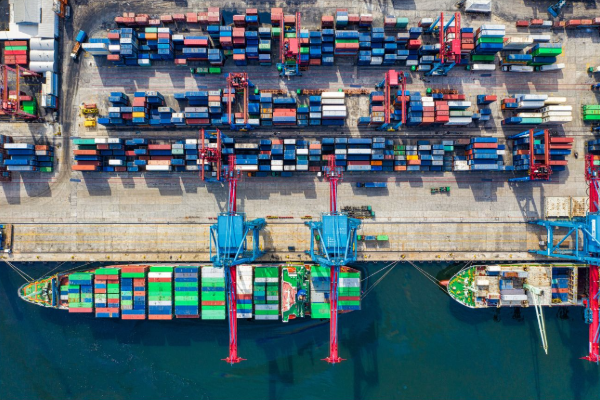
Birds-eye view of freight containers. Photo credit: Tom Fisk, Pexels.
U.S. tariffs are at their highest level since the 1930s. Since 2020, nearly 18,000 discriminatory trade measures have been introduced worldwide, and technical regulations affect two-thirds of global trade flows. In February, President Donald Trump announced the U.S. would impose a 15% tariff across the board. Industrial policy tied to national security has multiplied rapidly. These are familiar ingredients of trade retrenchment.
Yet global trade has not collapsed. In 2025, world trade reached a record $35 trillion, expanding by around 7% despite tariff escalation and geopolitical tensions, according to UN Trade and Development (UNCTAD). The International Monetary Fund (IMF) projects global growth of 3.3% this year, broadly steady despite policy shocks (IMF 2026). The evidence suggests the global economy is not retreating from integration, but reorganizing. Over the past 25 years, emerging markets have evolved from crisis-prone peripheries into central actors in trade, investment and governance.
A defining feature of this reorganization is the realignment of trade partnerships. China has overtaken Europe and the U.S. as the largest trading partner for more countries worldwide. China’s trade ties with emerging markets — particularly in Asia — continue to deepen, reinforcing its role in South–South networks. The U.S. remains pivotal in technology investment and advanced services, yet its relative importance as a goods trade partner has diminished. The center of gravity in global trade is tilting toward emerging markets.
Hence, South–South trade has become a major engine of global commerce. According to UNCTAD, between 1995 and 2025, merchandise exports among developing countries surged from $500 billion to $6.8 trillion. Today, 57% of emerging countries’ exports go to other emerging and developing markets — up from 38% in 1995. Asia’s regional value chains — especially in East and Southeast Asia — drive much of this expansion, with high- and medium-tech manufacturing accounting for roughly half of South–South trade.
Interregional trade outside Asia — particularly between Africa and Latin America — remains underdeveloped despite strong complementarities. Strengthening these linkages could enhance resilience as emerging markets increasingly rely on one another. South–South trade is not just expanding — it is stabilizing the system.
Brazil illustrates strategic adaptation in action. Despite tariff disruptions in 2025, the country closed the year with record exports, up $11.6 billion from 2024, even as shipments to the U.S. declined $2.6 billion. After tariffs took full effect in August, exports to the U.S. fell sharply — $3.7 billion below the previous year’s level. Brazilian producers quickly redirected trade toward China and other Asian markets, with China absorbing 37% of exports between August and December. Within months, Brazil’s export map shifted, accelerating diversification away from the U.S. market. The EU–Mercosur Partnership Agreement, signed in January but not yet ratified, further reflects this strategic shift toward deeper trade integration with Europe.
India is recalibrating its trade strategy, balancing the protection of sensitive sectors with deeper integration into technology-enabled global value chains. India is moving beyond its earlier “look east” approach toward deeper engagement with developed markets. Strong domestic consumption — about 60% of gross domestic product (GDP) — provides leverage in a fragmented global economy. The pact with the European Free Trade Association includes a binding pledge of $100 billion in foreign direct investment (FDI) over 15 years, underscoring trade policy as an industrial strategy. The EU-India Free Trade Agreement, negotiations for which concluded with success in January, illustrates India’s shift toward deeper global integration and a stronger role in global supply chains. India also plans to operationalize free trade agreements with the United Kingdom and Oman by April, followed by New Zealand.
Also, the structure of trade itself is evolving. Over the past decade, global services exports expanded by about 5.3% annually, more than twice the pace of goods trade. 2026 IMF data notes that services now account for 27% of global trade, increasing by 9% in 2025, reports UNCTAD. Digitally deliverable services represent 56% of global services exports, growing at an average annual rate of 7.1% over the past decade. Investment in information technology — led by the U.S. — has further generated positive spillovers, particularly for Asia’s technology exporters.
The global trading system is unlikely to return to full rules-based globalization or to complete fragmentation. Instead, the most plausible trajectory is — as described in a January report from Boston Consulting Group’s Center for Geopolitics — a “multi-nodal trade patchwork” structured around four major nodes:
- U.S. — pursuing an “America first” strategy
- China — prioritizing self-sufficiency while deepening trade with the Global South
- Plurilaterals, including the EU, members of the Comprehensive and Progressive Agreement for Trans-Pacific Partnership (CPTPP), the UK, and South Korea — committed to rules-based trade and deep agreements
- The intergovernmental organization BRICS+ (excluding China) — strengthening the sovereignty of emerging economies while expanding South–South trade
The global economy is not retreating; it is being reoriented. In a world shaped by rivalry and industrial policy, resilience depends on diversification, connectivity and adaptability. At the center of this shift is South–South trade. As emerging markets deepen ties across Asia, Africa and Latin America, they are becoming global demand engines.
For emerging markets, the mandate is clear: Economic growth is an imperative, and for that, strengthening South–South trade corridors, investing in digital and services competitiveness and deploying trade policy strategically to attract capital and upgrade industry are becoming central priorities. In this evolving landscape, South–South integration is no longer merely complementary; it is becoming the backbone of a more resilient and balanced globalization.
About the authors

Shailja Bang Shah is the head of research at Portulans Institute. She specializes in thematic research and managing composite indices. She co-authored the EMI D-ESG Country Ranking 2022 and focuses on sustainable development in emerging markets. She previously worked at J.P. Morgan in geopolitical and macroeconomic research.

Lourdes Casanova is a senior lecturer and the Gail and Rob Cañizares Director of the Cañizares Center for Emerging Markets in the Cornell SC Johnson College of Business; she also is a co-author of the EMI annual reports.

Anne Miroux is a faculty fellow at the Cañizares Center for Emerging Markets and a co-author of the EMI annual reports. She has 30 years’ experience at UNCTAD.