
Be Bold: Decades of scholarly and practical wisdom in emerging markets
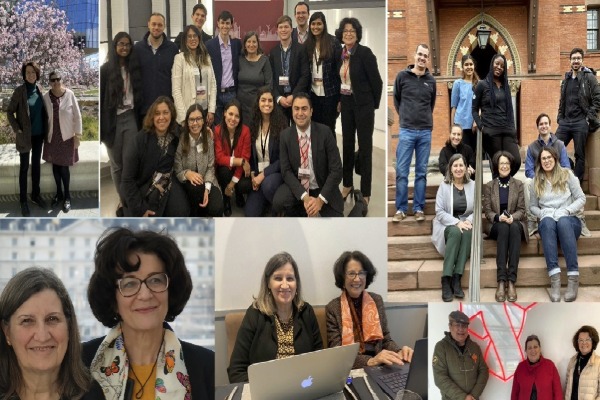
A collage of photos of Anne Miroux and Lourdes Casanova with fellows from the Cañizares Center for Emerging Markets. Photo credit: Lourdes Casanova.
What does it take to study the most overlooked parts of the world? For Lourdes Casanova, director of the Cañizares Center for Emerging Markets and a member of the Global Future Councils of the World Economic Forum, and Anne Miroux, a faculty fellow at the Cañizares Center, it takes an unflinching willingness to challenge prevailing frameworks.
In the most recent episode of the podcast Beating Sisyphus, produced by the Cañizares Center for Emerging Markets and led by Thomas Riveros, the two scholars reflected on their careers, their collaboration and the transformation they have witnessed in economies once dismissed as peripheral.
Casanova came to the field through a deeply personal experience. Born in Spain when it was itself a developing country with a GDP per capita lower than Argentina’s, she watched her home nation transform, carried forward by companies that were small and local one decade and global the next. That experience gave her the instinct that the standard framework taught in business schools were insufficient for understanding what she was seeing; it also gave her the conviction that the companies doing the most interesting things were in Silicon Valley, but also in São Paulo; Nairobi, Kenya; Delhi, India; and beyond. Miroux arrived at the same conviction but through a different background. Spending three decades at the United Nations, where she led for several years the team producing the World Investment Report and served as head of the Secretariat of the U.N. Commission of Science and Technology for Development, she had a front-row seat to the policy dimensions of global development. She studied, from these international institutions, emerging economies as they began to assert themselves in ways that demanded an entirely new vocabulary.
Their paths converged around a landmark 2006 United Nations report on foreign direct investment from developing economies. Emerging market multinationals were still marginal in most business school curricula, and the idea that firms such as Petrobras of Brazil, América Móvil of Mexico and Chinese companies like Haier and Huawei deserved the same analytical attention as their European and North American counterparts remained, in many academic circles, relatively novel.
From that starting point, Casanova and Miroux kept finding each other — at the Global Agenda Councils (now Global Future Councils) of the World Economic Forum, in collaborative publications and eventually at Cornell. Throughout their careers, they have found that Miroux’s background of policy and macroeconomics and Casanova’s hands-on company-level fieldwork proved to be a productive intellectual combination.
The scale of the transformation they have spent their careers documenting is difficult to overstate. In 1999, China and all other emerging markets combined held just six companies in the Fortune 500. In 2025, China accounted for 124, according to their Emerging Market Multinationals Report 2025. In 1999, 85% of inward foreign direct investment flows went to developed countries, with less than 10% reaching the world’s largest emerging economies. Today, those leading emerging markets receive roughly 30% of global flows. These shifts represent a fundamental reordering of the global economy, driven, as both scholars have argued across their research, by three interconnected forces: the rise of China, which pulled many partner/neighboring economies upward with it; the advance of digitalization, together with the spread of smartphones and the massive expansion of internet access, which unlocked markets and information previously out of reach; and the deepening of South-South trade and investment.
Yet neither Casanova nor Miroux is naively optimistic about what comes next. The journey from low-income to middle-income and then high-income status is neither automatic nor irreversible. This very struggle, the endless uphill push, gives the podcast its name. Many emerging economies have reached a middle-income plateau, and the challenge of continuing to push from there — of maintaining the political will and institutional capacity to keep sustaining their growth — is one that both scholars take seriously.
Throughout the conversation, there is a tension between two equally important virtues: humility and boldness. Humility, Miroux explained, means approaching any economy or company with an open mind and resisting the temptation to impose frameworks built for one context onto another. Emerging market companies, Casanova observed, have often innovated precisely because they had no choice. Unable to price their products the way a Silicon Valley firm might, companies operating in lower-income environments learned to produce more for less with less, developing a kind of cost discipline and resourcefulness that Western business education has been slow to recognize. And yet, they agree that humility alone is not enough. When asked what they would tell their younger selves, both scholars converged on the same phrase: Be bold. Challenge what you think you know. Go into the uncharted territory. Casanova extended this imperative to academia itself — pointing to the rapidly changing landscape of communication; the decline of the dense academic report; the rise of video, data visualization, and AI — as an arena where scholars must adapt or risk speaking only to themselves.
That forward-looking energy carried into the final stretch of the conversation, where Casanova and Miroux described their current research into how governments across Southeast Asia, India and China are positioning themselves in the era of AI. What they found defied the expectation that new technology would simply widen the gap between rich and poor countries. Vietnam is building out training infrastructure. India, with its deep engineering talent base, is developing its own large language models and investing heavily into data centers. That determination, as Casanova put it, is to not miss the train this time. It describes the historical consciousness animating policymakers in these countries, who remember what it means to be left behind and are resolved not to repeat it.
That is the spirit — urgent, clear eyed and excited about what remains unknown — that makes the work of the Cañizares Center so timely. The world’s center of economic gravity has shifted. The scholars who saw it coming earliest are still pushing the boulder.
Listen to Casanova and Miroux’s insights
About the author

Daniel Young Kim is an undergraduate student in the Charles H. Dyson School of Applied Economics and Management and an active member of the Emerging Markets Institute Club (EMIC). His interest centers on the relationship between public infrastructure and private enterprise, with a particular focus on the high-growth corridors of Southeast and East Asia. Driven by a desire to shape the future of regional development, Kim analyzes how cross-sector collaboration can bridge the infrastructure gap in emerging economies.