From Verona to Parma: Lessons in stewardship from Italy’s oldest family enterprises
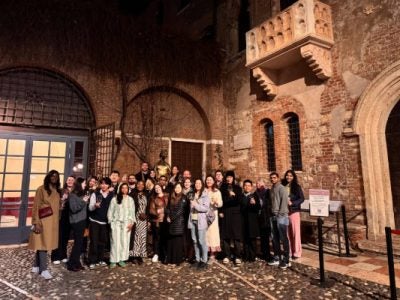
A private after-hours visit to the Balcone di Giulietta offered a moment of reflection.
The Smith Family Business Initiative’s 2026 Italy trek brought me and a group of Cornell graduate students to Verona and Parma, Italy, for a weeklong immersion in one of the world’s most enduring ecosystems of multigenerational family enterprises. Family-owned firms account for a large majority of companies in Italy and play a central role in national employment. Italy stands out globally for the longevity of its firms, with multiple companies ranking among the world’s oldest continuously operating businesses.
Led by Daniel Van Der Vliet, the John and Dyan Smith Executive Director of Family Business at the Cornell SC Johnson College of Business, the trek offered a rare opportunity to study how Italian families have preserved identity, governance and purpose across centuries while adapting to globalization trends, sustainability demands and succession challenges. Throughout the week, one Italian phrase captured the spirit of what we witnessed: “Dalle Stalle Alle Stelle Alle Stalle” — “From the stables to the stars and back to the stables.”
Verona: Heritage, identity and stewardship
We opened the trek in Verona, a UNESCO World Heritage City with entrepreneurial roots stretching back more than two millennia. Our welcome dinner at Olivo, a family-owned restaurant run by Michael Cortelletti, MBA/MMH ’99, set the tone for the week. Over regional dishes, we were introduced to the values that would shape our experience: continuity, stewardship and the lived reality of family enterprises.
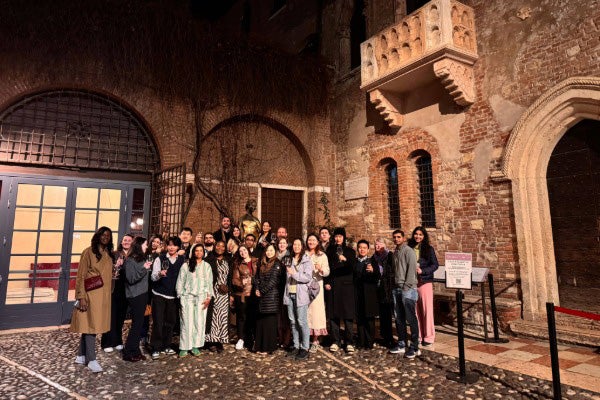
Later that evening, we were granted a private visit to the Balcone di Giulietta, a boutique hotel also owned by Cortelletti. Standing in the quiet courtyard after hours, illuminated and empty, I felt the symbolic weight of custodianship. Behind every landmark and every story, there is a lineage of caretakers who preserve it for the next generation. That idea would echo throughout the trek.
Speri Winery: Academic foundations in a living classroom
Our first full day began at Speri Viticoltori, where Van Der Vliet led a session on the fundamentals of family business. Learning about governance, succession and stewardship inside a seventh-generation winery made the concepts tangible.
As we moved into the learning tour, I was delighted to see that one of our guides was Chiara Speri, a leader within the family viticulture and winemaking business. In a field that remains predominantly male, Speri’s presence and expertise stood out.
Speri led us through the vineyards and cellars, and we learned about the family’s teamwork-based succession model, where multiple generations work side by side and earn legitimacy through contribution rather than birth.
Sartori Winery and the heart of family hospitality
On our second day, we visited Sartori Winery, another family enterprise rooted deeply in Verona’s winemaking tradition. We were welcomed by the current family owner, Andrea Sartori, who led us through the estate. One of the most memorable moments was stepping into the small historic chapel on the property. With a warm smile, he told us that if anyone ever wished to get married there, he would be happy to officiate the ceremony himself. The gesture captured the spirit of Italian family businesses: intimate, personal and grounded in genuine connection.
The visit continued in a garden ballroom, where Sartori’s daughter delivered a short presentation on the wines we would be tasting. She walked us through the characteristics of each varietal and the family’s approach to winemaking before guiding us through a curated tasting paired with regional cheeses. The experience highlighted how family enterprises blend tradition, hospitality and storytelling to create a sense of place that extends far beyond the product itself.
Distilleria Nardini: Authenticity as strategy
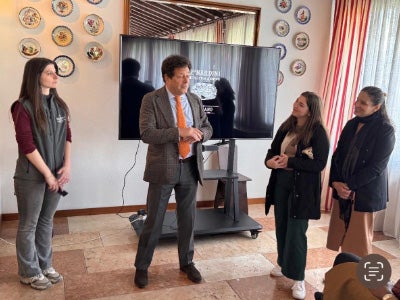
We then traveled to Distilleria Nardini, Italy’s oldest operating distillery, founded in 1779. Meeting with Antonio Guarda Nardini, I saw how geographic authenticity can serve as a competitive moat. Bassano del Grappa is not only the birthplace of the distillery, but also its identity.
As part of coursework, students were asked to deliver a briefing on the company or place we were about to visit. Presenting on site created a powerful connection between academic preparation and real-world application. During the visit to Distilleria Nardini, my classmate Sadie Mecham and I presented our student briefing directly to Nardini. Presenting on a 245-year legacy to the person responsible for carrying it forward reinforced the trek’s emphasis on preparation and stewardship.
Parma: Governance, innovation and next-generation leadership
In Parma, the focus shifted toward governance, scale and innovation.
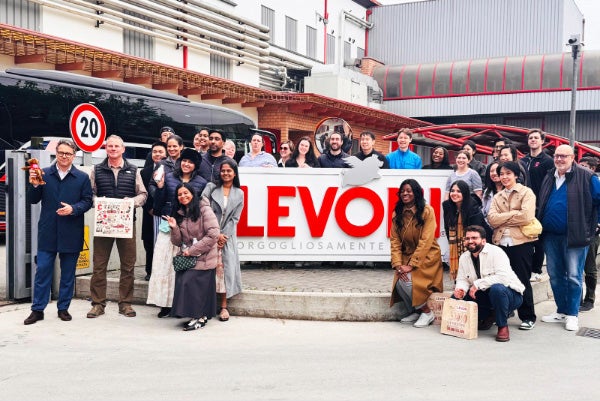
At Levoni, we examined the legal structures of Italy’s società benefit (benefit corporations), which embed social purpose directly into company bylaws. Having recently become a benefit corporation, Levoni demonstrated how it was able to use legal design to protect mission and family cohesion across generations.
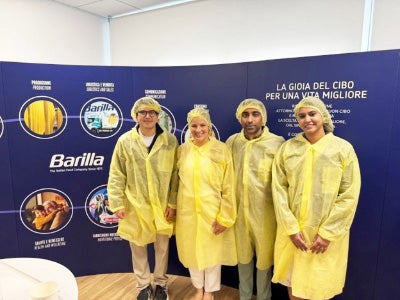
At Barilla, we explored how a global brand can remain privately held while being professionally managed. During our visit, we were surprised by a visit from Gualtiero Barilla, a member of the fifth generation. Educated in the United States and a holder of an MBA, he shared how he has been reconnecting with the business and working on a collaboration with Dallara, an Italian race car manufacturer. His perspective showed how Barilla is evolving in ways that resonate with younger generations.
At Dallara, we saw succession treated as a competency-based process, a pattern mirrored at the next two companies we visited, Davines and Bertinelli.
Davines and Bertinelli: Values, sustainability and generational continuity
Our final day included visits to sustainability-focused hair care products manufacturer Davines and the cheese producer Azienda Agricola Bertinelli.
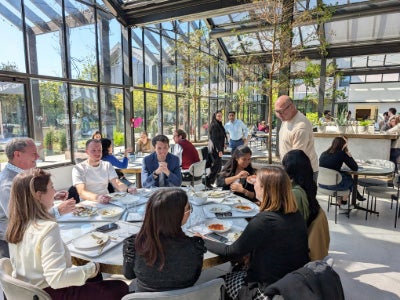
At Davines, a Certified B Corporation and beauty company known for regenerative sustainability, we met the owner, a pharmacist by training, who demonstrated how deeply the company lives its values. The campus includes green spaces for employees and a cafeteria with a Michelin star chef serving clean, thoughtfully prepared food. We had the pleasure of eating lunch there, and the owners joined us, offering an intimate look at their leadership philosophy rooted in humility and community.
At Bertinelli, a vertically integrated Parmigiano-Reggiano producer, we were able to connect with CEO Nicola Bertinelli and the previous generation of leaders. Hearing two generations speak about stewardship, evolution and identity added a powerful layer of continuity to the experience.
We ended the day with a farewell dinner with Van Der Vliet, reflecting on the lessons of the week and the themes that would stay with us long after leaving Parma.
Experiencing Italy beyond the classroom
The trek was not only about company visits and academic learning. We also had time to experience the cultural richness of Italy. One of our classmates organized a hands-on cooking class where we learned to prepare regional dishes. Later in the week, a group of us attended a performance of the ballet “Cinderella” at the historic Teatro Regio di Parma.
A transformative learning experience
The Italy trek was a living laboratory for understanding how families build institutions that outlast generations. For me, the week underscored a central truth of Italian business philosophy: Tradition is not about preserving the ashes but rather is about keeping the flame alive.
As we returned to campus, we carried with us a deeper appreciation for stewardship and purpose-driven governance in family enterprise. Just as importantly, the trip reminded us that leadership development often emerges outside formal settings, through curiosity and community in new places.
About the author

Melissa Linares is a nurse practitioner specializing in oncology and hematology. A 2026 graduate of the Cornell Executive MBA/MS in Healthcare Leadership program, she was a fellow of the Cañizares Center for Emerging Markets. She is the president and co-founder of the Executive Nurse Leadership Network and served as co-chair of the Cornell Emerging Markets Institute Club. She is also the founder of Lina Concierge MedSpa and the AesthetIQ Pro AI-enabled clinical decision support system (CDSS) tool.
Article Information
- Categories
-
- Blog Posts