Why I returned to the classroom to learn investing
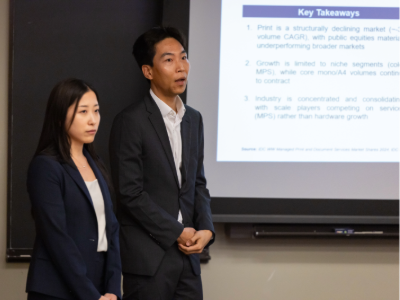
Kihyun presenting alongside Industrials sector teammate Joomi Kang. Photo credit: Chris Kitchen.
On a sunny afternoon in September 2025, my head was noisy the entire walk from Sage Hall to my downtown Ithaca home. That day was The Cayuga Fund’s first class where Chris Meredith, visiting senior lecturer, explained how The Cayuga Fund’s quantitative model operates. As soon as I got home, my wife and I talked at length about how decades of academic research and rigorous back-testing had been integrated into a single coherent model and how it fit together the puzzle pieces of value, growth, and other factors I had known only fragmentarily. That evening, I realized the reason I came to the Samuel Curtis Johnson Graduate School of Management, and the reason I applied to the Cayuga Fund, was for moments like this.
The model could be built, but philosophy was lacking
Before attending the Johnson School, my first career was as an equity analyst covering steel and metals. Later, at a semiconductor company, I worked in corporate development (mergers and acquisitions), investing in semiconductor and technology companies and gaining exposure to private markets. I built discount cash flow models on deals such as the Kioxia merger and acquisition (an $18 billion acquisition) — but I still felt my investment philosophy was lacking.
Why I applied to The Cayuga Fund
When I was applying for the Johnson MBA program, The Cayuga Fund interested me the most. Equity portfolio management is an area where both theory and practice matter, and I wanted to learn from people with deep experience in both academia and industry like Scott Stewart, clinical professor, and AJ Edwards, visiting lecturer.
In managing actual Cornell endowment funds, every decision flows directly into portfolio performance. For any Cornell student serious about investing, The Cayuga Fund is the best environment to grow and learn.
Industrials team and the Credit Research Challenge
This spring, I took on the lead role for the industrials team. The semester’s major project was The Cayuga Fund’s Credit Research Challenge. While credit research shares similarities with equity analysis, its unique demands such as scenario-based debt payment waterfall analysis for distressed companies posed a different kind of challenge. In the case of Xerox Holdings that we analyzed, there existed a HoldCo, an OpCo, and a joint venture with a third party. These entities held more than ten bonds with different maturities and collateral packages. Analyzing the maturity structure, seniority, and collateral priority required a thorough review of the covenants. Through this analysis, we identified a bond with a high risk-adjusted expected return. This whole process was an unfamiliar area for every team member, but thanks to the dedication of team members, we gained valuable experience in distressed company analysis.
Challenges faced working on the Quantitative Team
During my year in The Cayuga Fund, I served on the quantitative functional team, where I learned how to improve The Cayuga Fund’s quantitative model. Wrestling with FactSet, Capital IQ, and Bloomberg data, forming hypotheses, and back-testing them was a challenge. Having mainly used Excel, I was not accustomed to Python, and my efforts to find alpha in macroeconomic data repeatedly failed. At times, I wondered if I should have started over and majored in computer science. I benefited from guidance from The Cayuga Fund alumnus Jayendran Rajamony, MBA ’02. The collaboration with the Cornell Duffield College of Engineering gave me positive momentum. The purpose of the collaboration was to improve the existing Cayuga quantitative model. The Cayuga quantitative team, including myself, explained the logic and factors of the current Cayuga quantitative model to the engineering team. They then developed a tool that dynamically back-tests these elements through coding. After this collaboration, I independently originated new ideas and devised a new quantitative tool via coding, and I shared my research results with my Cayuga Fund colleagues by presenting the ideas in class.
One lesson I will carry with me
During my year in The Cayuga Fund, I learned that the essence of equity investing is a pattern recognition game, which I interpret as finding mispricing through fundamental analysis or through quantitative models. A recurring theme Stewart emphasized in class remains memorable to me. To generate profits through fundamental analysis, two conditions must be met. First, an investor must be able to think differently from the market. Second, that different view must ultimately prove to be correct. To achieve this, it is necessary to first understand the pattern between a company’s fundamentals, such as revenue and earnings, and how its stock price moves. When mispricing occurs in the market, one must act on it to generate returns. Quantitative investment involves identifying patterns in data by using methodologies such as regression and machine learning. One must keep in mind that financial market data has a low signal-to-noise ratio, and complex methodologies carry the risk of overfitting, meaning they explain past data well but have poor predictive power. Furthermore, even when a quantitative strategy has been effective in the past, if it becomes widely known and many market participants adopt the same approach, it may no longer remain profitable. For this reason, quantitative investment requires continuous effort. What remains is the discipline to form a view, test it honestly, and have the courage to be publicly wrong. That is the lesson I will carry with me long after the last class.
About the author
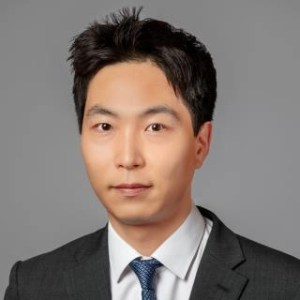
Kihyun Han, MBA ’26 is a candidate in the Two-Year MBA program at the Samuel Curtis Johnson Graduate School of Management. He is the head of the industrials sector for The Cayuga Fund and a member of the quantitative functional team. On campus, he is the treasurer of the Korean Business Association. Prior to the Johnson School, he was in the corporate development department at SK Hynix, a semiconductor company in Korea, focusing on strategic mergers and acquisitions, and he will return there upon graduation.
Article Information
- Categories
-
- Blog Posts