
‘Buy now, pay later’ model extends to travel
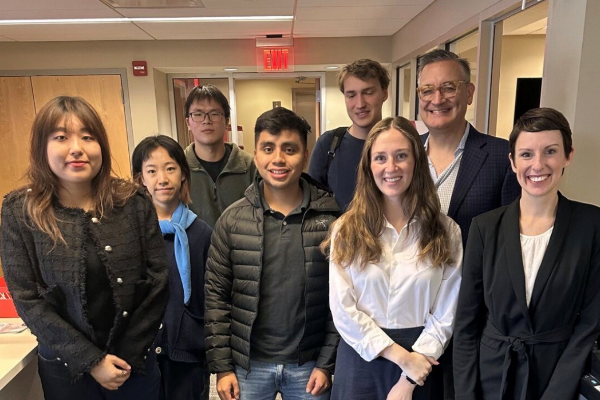
Tom Botts posing with a group of students after a coffee chat while serving as an Entrepreneur in Residence. Photo credit: Provided.
After more than 20 years in hospitality and travel — joining entrepreneurial startups like Hotwire, co-founding Hudson Crossing and working with established brands such as Miraval Resorts (sold to Hyatt) and Starwood Hotels & Resorts — I found myself drawn back to what energizes me most: building. That pull led me to a very early-stage startup called Uplift.
Uplift (now Flex Pay by Upgrade) was founded on a simple but powerful entrepreneurial insight: travel is meaningful, but access to it isn’t equal. By allowing consumers to pay for travel over time, Uplift aimed to remove a key barrier and unlock demand. For me, joining Uplift meant pivoting from traditional travel suppliers and distributors into financial technology — but it was a pivot rooted in leverage. Every lesson I’d learned across decades in travel became an asset as we worked to build what would become the largest travel-focused “buy now, pay later” platform in the industry.
Like most startups, our early success depended on getting the fundamentals right. We obsessed over product-market fit, building a solution specifically designed for the complexities of travel. Integrating with legacy booking engines, global distribution systems, inventory partners and call centers wasn’t glamorous, but it was essential. This focus on solving industry-specific problems allowed us to differentiate ourselves from much larger, better-funded competitors.
Equally important was assembling the right team. We built a world-class group of travel professionals who didn’t just understand the industry — they had lived it. That credibility allowed us to engage partners not as vendors, but as peers. In entrepreneurship, trust compounds quickly when the people across the table know you’ve been in their shoes.
With the right product and team in place, we scaled, creating a multibillion-dollar business supported by partnerships with some of the most respected names in travel, including Carnival Cruise Line, Sabre Hospitality, United Airlines and Southwest Airlines. Each partnership reinforced the idea that thoughtful innovation, when aligned with industry realities, can create real and lasting value.
But beyond metrics and milestones, the most meaningful outcome was impact. We talk internally about “opening the aperture” — expanding who gets to experience travel. By giving people the flexibility to pay over time, we help families reunite, enable once-in-a-lifetime trips and make the world feel more accessible. One executive recently told us, “Adding Flex Pay is one of my proudest achievements in my 47 years at United Airlines. We’ve received letters filled with gratitude from customers who were able to be together when it mattered most.” Those moments remind you why the hard work is worth it.
Of course, the entrepreneurial journey was anything but linear. There were lost deals, internal conflicts, capital challenges, and moments when quitting felt like the rational choice. What kept me moving forward was clarity of mission. When the purpose is strong enough, it becomes an anchor during uncertainty.

What began as Uplift is now Flex Pay by Upgrade, following our acquisition just over two years ago by the larger fintech. While integrating two similarly named brands came with its own challenges, the business is stronger for it — and we now look ahead to a potential initial public offering in the next 12 to 18 months.
Yet the most important thing hasn’t changed. Entrepreneurship, at its core, isn’t just about building companies — it’s about solving meaningful problems in a way that scales. By combining a world-class team, purpose-built technology and deep partnerships, we’ve created a profitable, durable business that expands access to something deeply human: the ability to connect, explore and experience the world. That’s the kind of company worth building — and rebuilding — again and again.
For entrepreneurs in hospitality, the lesson is clear: Enduring businesses are built at the intersection of industry fluency and real human need. Innovation doesn’t always mean reinventing travel itself — it often means rethinking access, removing friction and modernizing the systems that quietly shape guest experiences. The most successful hospitality startups aren’t those that chase trends, but those that deeply understand the ecosystem, respect its complexity and solve problems in ways that scale. When entrepreneurs pair domain expertise with purpose — and stay anchored to that purpose through inevitable setbacks — they don’t just build companies; they expand what’s possible for the people their industry serves.
About the author

Tom Botts, P ’26 is a senior executive, investor, and advisor in the travel industry, bringing extensive expertise in e-commerce, revenue management, and technology across the airline, hotel, and online intermediary sectors. He currently serves as president of Flex Pay at Upgrade, a multi-billion-dollar consumer lending fintech. His previous company, Uplift, was acquired by Upgrade in 2023. Botts holds a bachelor’s degree in logistics and marketing from the University of Missouri. He also serves on the advisory board of the Pillsbury Institute for Hospitality Entrepreneurship in the Cornell SC Johnson College of Business.