Cornell Business Impact Symposium: Making sustainability work
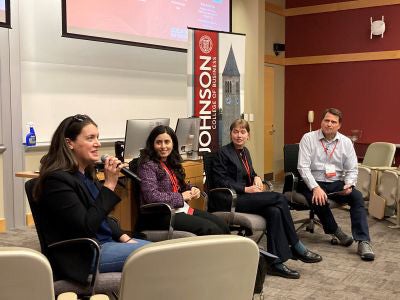
From left: Tess Williams of Viridi; Sarah Mousa of Shamsina; Eleanor Glenn of AtmosOne AI; and faculty member Brian Bauer. Photo credit: Monica Touesnard.
At the 2026 Cornell Business Impact Symposium in April, student organizers gathered business experts from many sectors to share their honest insights about sustainability — not just what works, but what doesn’t. This year’s theme, “From Promise to Performance: Sustainability Under Pressure,” reflected a shift I have seen across industries. Sustainability is no longer about setting targets. It is about delivering results under capital limits, policy shifts, supply chain disruption and changing market demand. As co-chair of this year’s symposium, I wanted our speakers from startups, large corporations, agriculture systems and impact investing to share not their polished success stories, but the unvarnished truth about what it took to get there.
Evolving startups: Ideas adapting amidst challenges
From the startup panel, one message was clear: Ideas change once they meet the real world. Founders spoke about how their solutions evolved after engaging with customers, regulators and infrastructure constraints. Technology alone does not have impact, they said. Adoption, trust and economics determine whether a solution survives. One key highlight from the panel was how we have to both pursue our curiosity and find balance between flexibility and control.
Sustainability survival: Aligning with business values
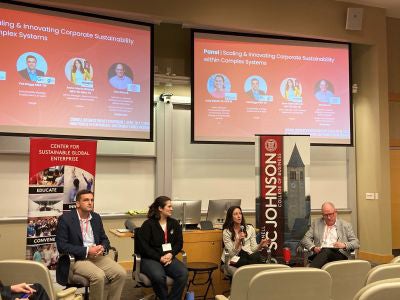
From the large companies panel, we heard that sustainability inside organizations is a constant negotiation. It competes with cost, speed and operational priorities. Initiatives that move forward align with business value, integrate into core operations and have strong internal champions, they said. Sustainability teams must speak the language of finance and operations, not only impact.
In large corporations, teams map where emissions, energy use and risk sit in the business; then they prioritize based on cost, feasibility and impact. AI surfaced as both a solution and a challenge: It helps manage complex systems, but it also increases energy and resource demand. That tension is now part of the sustainability conversation.
One insight stayed with me: Programs that require people to change behaviors often fail. Programs that align with how the business already operates are more likely to scale.
Agriculture: Sustainability depends on viability
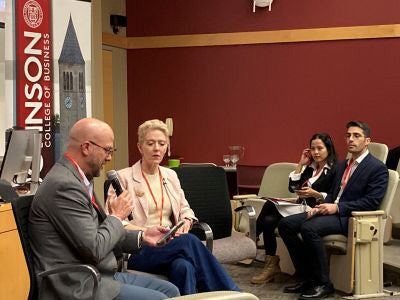
A fireside chat on agricultural business revealed that sustainability in food systems is deeply tied to viability. Farmers face land constraints, climate risk and economic pressure. If farms are not viable, sustainability goals cannot be achieved.
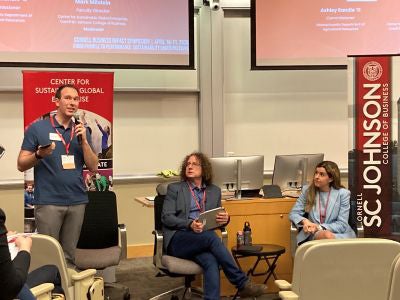
Across all sessions, a few themes stood out: Every decision balances impact, cost and risk. Scale is the true test. Many ideas work in pilots, but far fewer work across systems and markets. Progress depends on coordination across policy, business and technology. Execution requires trust. Change happens when incentives align and people believe in the solution.
Looking forward
One of the most meaningful decisions we made this year was how we recognized our speakers. Instead of giving Cornell-branded merchandise, we contributed to Livingseas Foundation Asia in their honor to support coral reef restoration in Padangbai, Bali. It was a small step, but it aligned with the values we wanted to represent.
For me, this experience reinforced one belief: Sustainability does not move forward because of better ideas. It moves forward because people make those ideas work under real conditions. That is the work ahead.
About the symposium
Co-hosted by the Center for Sustainable Global Enterprise and student organizations including Cornell Sustainability Consultants, the Energy Transition Club, the Nexus Project Team, the Johnson Food and Agriculture Club, Impact Investing at Cornell, and the Sustainable Global Enterprise Club, the Cornell Business Impact Symposium focuses on the impact of the private sector on social and environmental challenges. At panels, fireside chats and coffee chats, students engage with professionals, expand their professional networks and learn about career opportunities. The symposium also includes the finals of the Cornell Undergraduate Impact Investing Pitch Competition.
About the author

Tika Diagnestya of Jakarta, Indonesia, is a first-year MBA student in the Samuel Curtis Johnson Graduate School of Management, focusing on embedding sustainability in technology and innovation. Prior to her MBA, she worked in the sustainability and consulting industry, managing sustainability and impact projects. In February, she was a finalist at the Americas regional final of the Global Sustainability Challenge at Stanford University’s Doerr School of Sustainability.
Article Information
- Categories
-
- Blog Posts