Entrepreneur in Residence Spotlight: Jason Spillerman ’92, P ’25
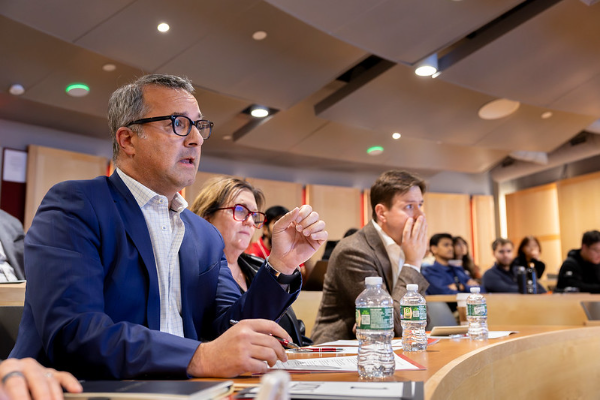
Jason Spillerman ’92 judging the 2025 Hospitality Pitch Deck Competition. Photo credit: Simon Wheeler.
As a student, Jason Spillerman ’92, P ’25 was intent on becoming a doctor. Originally a biology major, he transitioned to communication and went on to earn a master’s degree in medical pharmacology at Drexel University. Decades later his eldest son, Garrett ’25, would also be a communication major, graduating summa cum laude.
While taking a break from medical school, Spillerman served as an executive assistant at MRA International, a management consulting firm. “One thing led to another, and I never went back,” he says.
Today, as a principal and co-founder of Vibrant Development Group, Spillerman focuses on destination real estate projects, specializing in creative programming for retail, dining and entertainment-based concepts.
At the Cornell Peter and Stephanie Nolan School of Hotel Administration, he serves on the advisory board of the Leland C. and Mary M. Pillsbury Institute for Hospitality Entrepreneurship and as an Entrepreneur in Residence.
Here, he discusses his career and his new role in the Pillsbury Institute.
Tell us about that first job that changed the course of your career.
MRA did a very specific type of management consulting: real estate development with a focus on retail, dining and entertainment. Their clients included Disney, the National Football League, and MGM Grand. To a science kid who had grown up in Northeast Philadelphia, this was fascinating. Much to the chagrin of my parents, I gave up on the path of becoming a doctor and went into consulting.
I joined the practice and made partner five or six years later. In 2005, wanting to control my own destiny, I left with one of the other partners to form Vibrant Development Group. That now takes about 50% of my time. The other 50% is devoted to Vibrant Ventures, a boutique private equity fund we established to invest in hospitality-based businesses. To date, we’ve invested in 28 restaurant and entertainment concepts.
What notable projects have you worked on?
About 90% of our work is in the gaming industry, where we advise casino companies on strategies for developing retail, dining and entertainment and spas within their resorts. We have some amazing clients — including Bally’s, which I believe is the fastest-growing gaming company in the world. We’re the owner’s rep on all dining and entertainment for Bally’s $1.7 billion casino resort being built in downtown Chicago on the northern fork of the Chicago River. It’s the largest casino-based project in the United States and will open in 2027.
When I was at MRA, I worked on The Quarter at the Tropicana Casino & Resort in Atlantic City — a thematic interior streetscape with a Latin Quarter type of Old Havana feel to it, double-loaded with restaurants, cafes and retail. That was a pioneering development. It was the first example of third-party uses in Atlantic City, where previously, casinos had owned and operated all the establishments on their properties. The $300 million addition, which opened in 2004, changed the landscape of dining and entertainment in Atlantic City and was a huge financial success for the Tropicana.
I’m also super-proud of National Harbor — a live, work, play environment on the Potomac River in Prince George’s County (Maryland), just outside Washington, D.C. I was engaged by the Peterson Cos., whose owner, Milt Peterson, was a mentor throughout my career. I had the privilege of working with Milt for the better part of 20 years and seeing National Harbor go from a completely undeveloped site to a $3 billion-plus mixed-use real estate destination with some 3,000 hotel rooms. There’s something there for everyone.
What do you attribute your success to?
A lot of hard work. And a great business partner.
We’re a small company. My partner and I are very hands-on with clients, and I think they appreciate that. Most of all, we do not cut corners. We subscribe to integrity, to strategically assessing opportunities and to structuring deals with mutuality of interest for all parties.
How did you become involved with the Pillsbury Institute?
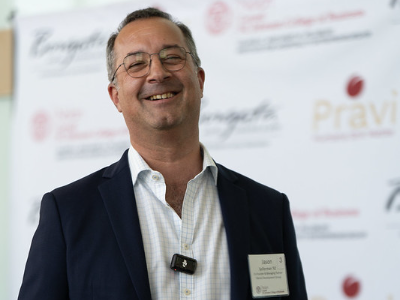
I was invited to join the advisory board while my son was attending Cornell. After my first board meeting, I became a judge for the Pitch Deck Competition. Then I helped mentor some teams for the Hospitality Hackathon with Hilton. And then I became a judge for the Hospitality Business Plan Competition. In the midst of all that, I signed up to be an Entrepreneur in Residence. And boy, I got a charge out of that.
I owe a lot of my success and who I am and what I’ve become to my time at Cornell, so it’s a way for me to give back. I’m very fortunate that Cornell is still a part of my life and that I’ve been able to reengage with it on this new level.
What’s been the best part of that experience?
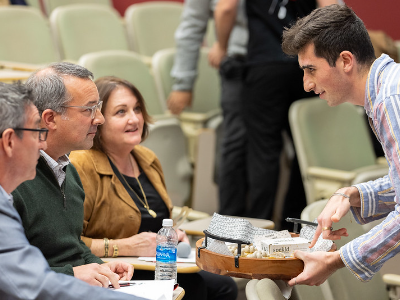
I love the Pitch Deck Competition because I feel like I’m a judge on “Shark Tank.” I’m so invigorated by these young entrepreneurs and their sophistication.
I love the Entrepreneur in Residence program, too. When I’m up there, the days are packed — I have back-to-back sessions with the students. I enjoy helping people and helping students start hospitality-based businesses, so I find it very rewarding.
The number one thing I tell students is to be ready to change plans and change course. If you want to be an entrepreneur, you have to be prepared to fail and pivot. I’m a perfect example. I thought I was going to be a doctor. I didn’t know I would be creating and investing in businesses.
Guest lecturing is another aspect of the experience that I enjoy — and the roundtables, which bring together a great collection of people from various professions for idea exchange. In 2024, I hosted a food and beverage roundtable at National Harbor.
Why is it important for industry to engage with students? How does the Pillsbury Institute provide opportunities for such engagement?
Industry connections give students invaluable exposure to current market trends, emerging challenges and strategic insights that cannot be captured through classroom learning alone.
The Pillsbury Institute delivers this vital engagement through an array of touchpoints, including office hours with Entrepreneurs in Residence, fireside chats, case studies, guest lectures, industry roundtables and specialized events. Each format serves a distinct purpose, from personalized mentorship to hands-on problem-solving opportunities.
This multifaceted approach helps advance students’ entrepreneurial goals while ensuring they graduate with industry-relevant experience — transforming classroom learners into industry-ready professionals who understand not just what to do, but why and how to do it in the real business world.
Any thoughts on the institute’s 20th anniversary?
I thank Leland and Mary for their investment and fortitude in creating the institute. I think it’s an incredibly valuable resource for the students and the university, and I’m extremely proud to be a part of it.