Hackathon provides industry exposure for students, fresh ideas for Hilton
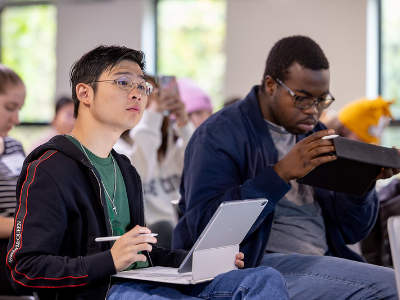
Student Participants listening to presentations
The Leland C. and Mary M. Pillsbury Institute for Hospitality Entrepreneurship has myriad ties to industry. Key among them is a partnership with Hilton that makes possible the Hospitality Hackathon, an annual event in which students interact with industry leaders while providing Hilton with insight into how the next generation views the future of travel.
The competition, which the two organizations have jointly presented since 2019, runs over a weekend each fall. During the three-day event, about 100 students from across campus, working in teams, dive into data to solve challenges faced by Hilton.
“The hackathon started as a way for us to engage on campus and bring fresh perspectives to real-world problems,” says Jess Petitt ’05, senior vice president of strategy, insights and full-service brands for Hilton.
Initially, participants were asked to consider questions relating to product innovation and food and beverage. Once Petitt assumed leadership of the event, in its second year, it evolved into a technical challenge.
The event kicks off Friday evening, “when teams form and we lay out the business problem, share the data set and send them on their way for about 36 hours to attack the problem and devise a solution,” he says.
While developing their product or idea, teams receive support from industry and faculty mentors. They learn new ways to solve problems and use data — and hone their presentation skills — with assists from experts such as Andrew Quagliata, a senior lecturer at the Cornell Peter and Stephanie Nolan School of Hotel Administration; tools such as the experience management platform Qualtrics; and professional services firms such as Deloitte. On Sunday, each team gives a four-minute “Shark Tank”-style pitch to the judges and responds to questions.
“Our goal is to challenge students’ problem-solving capabilities,” Petitt says. “We judge them on their technical capabilities, but also on how they articulate and story tell.”
Along with cash prizes for first ($2,000), second ($1,000) and third ($500) place, best visualization ($500) and best pitch ($500), Hilton provides prizes ranging from “spa and wellness amenities from our hotels to sheets and towels to pillows, which are always a favorite,” he says.
The theme of the 2025 competition, held Oct. 17-19 at the eHub in Ithaca, was “Delivering Exceptional Experiences for the Hotel Guest of the Future.”
Based on Hilton’s guest survey data, messaging data and digital capabilities usage statistics, teams were asked to first identify how Hilton could enhance its digital tools to improve the guest experience, then either upgrade an existing digital product or create a new one addressing that opportunity.
The winning team, Made4U, analyzed hotel reviews and found that 41% of negative comments dealt with billing issues — higher than any other guest touchpoint. Its solution was the Digital Departure Dashboard, a feature they developed for the Hilton Honors app that would allow guests to track charges throughout their stay.
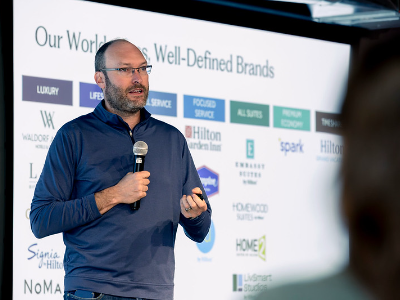
With participation from 104 students representing eight schools across campus, the event was the biggest one yet.
Students have a lot to gain from the hackathon, Petitt says. “They become acquainted with real- world business challenges — the questions we ask ourselves on a daily basis,” he says. “They learn to work on cross-functional teams under a time constraint. And they gain exposure to industry folks who may be hiring or have expertise in a subject they’re interested in.” Team members have gone on to secure internships and jobs at Hilton.
“This is the world students will enter when they leave campus,” he says. “Any opportunity to engage with the types of people you will be working with after you graduate, I think, is time well spent.”
For Hilton, he says, “students bring a fresh perspective. Having 100 other people look at the same problems we do adds diversity to our thought process and makes us think about things differently.
“And it’s not just the presentations — it’s the time we spend on Saturday roving around, talking to teams, hearing how they think about things. That makes a big difference.”
The insights gained have led to “nuanced shifts” in Hilton’s digital experiences, breakfast offerings and messaging approaches.
“I love the energy that students and faculty and staff supporting the event bring to the conversation,” he says, noting he’s impressed by the energy students invest in both attacking the problem and delivering their pitch.
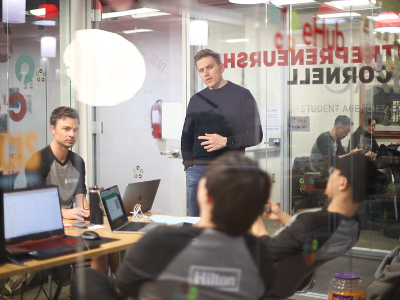
When the Hilton contingent — made up of Nolan School alumni — visits campus, “we have dinners together and use it as an opportunity to connect as a team,” says Petitt, who, as an advisory board member of both the Pillsbury Institute and the Center for Hospitality Research, has returned to campus twice a year for the past 20 years.
Although Hilton has sponsored hackathons at a handful of other institutions, he says, the breadth of Cornell’s resources and expertise set it apart.
“Cornell has the top hotel school in the world, along with other top programs,” he says. “The caliber of talent makes it stand out, as well as the execution. The Pillsbury Institute has been a fantastic partner in helping us execute this in a really professional way.”
Article Information
- Categories
-
- Blog Posts