Budding entrepreneurs learn through experience
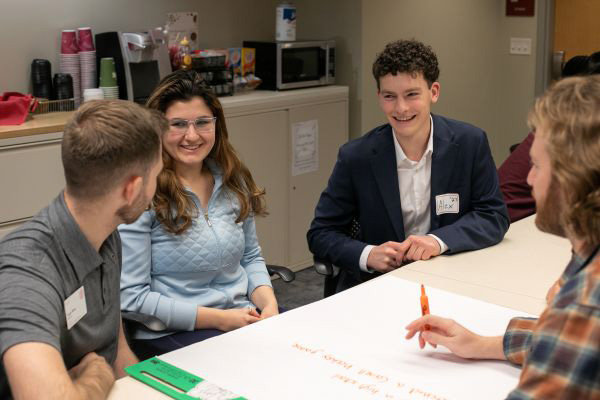
Offerings by the Leland C. and Mary M. Pillsbury Institute for Hospitality Entrepreneurship (PIHE) complement coursework from the Cornell Peter and Stephanie Nolan School of Hotel Administration to create singular learning experiences.
Through the institute, students compete for cash prizes in the Hospitality Pitch Deck Competition, the Hospitality Business Plan Competition and Hospitality Hackathons; receive mentoring and guidance from entrepreneurs in residence (EIRs); and have opportunities for networking, professional development and internships.
Here are three of their stories.
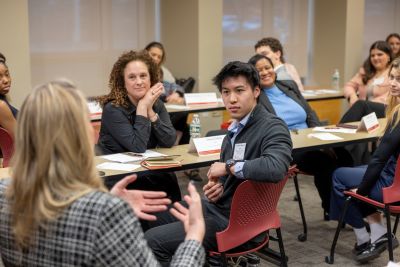
Alexander “Alex” Justin Cheung ’27 has been involved with the Pillsbury Institute since transferring to Cornell as a sophomore. After first being drawn to it as a quiet place to study, he began participating in PIHE events “and spent so much time there that they offered me a job.”
Now a student employee, he provides administrative support, keeps snacks plentiful and serves as a point of contact for visitors.
In that capacity, “I can more freely introduce myself to EIRs and other speakers and have ‘smart’ conversations with them,” he says. “They enjoy knowing that a student employee can help them during their stay, and it feels easier — more natural — to make a connection then.”
As a teaching assistant for the class Experiential Networking, Cheung got to know Jonathon Zink, COO of the Hotel Investment Group by Northstar, which co-produces the Hotel Investment Conference Asia Pacific (HICAP) in Singapore and the Americas Lodging Investment Summit (ALIS) in Los Angeles. Last fall, Cheung was a student ambassador for HICAP. When Zink asked him to reprise the role a few months later at ALIS, the Pillsbury Institute stepped in to cover his flight and hotel expenses. “That was amazing of them,” he says.
From that experience, Cheung, who plans to go into real estate investing, gained general knowledge of hotel investments and the industry. “But more importantly,” he says, “I met accomplished people and other student ambassadors — people who are ambitious and driven in the same industry I am.
“This is a small industry,” he says. “The more people you meet early in your career, the more likely you are to be successful. When you maintain connections for five, 10, 20 years, they pay dividends later on.”
Ultimately, Cheung hopes to franchise his family’s business, Sum Ramen, or open a New York City restaurant with his younger brother, Matthew ’29.
From the Pillsbury Institute, Cheung receives niche mentorship specific to his goals.
Entrepreneur in residence Dan Leyva ’14, founder and CEO of Taco Azul in Boston, “has helped us a lot” with Sum Ramen, he says. “As we were working to introduce a special menu item, I took his advice and did small-scale testing to get feedback. And that snowballed into one of the most popular dishes on our menu.”
Cheung has also received guidance from hospitality tech entrepreneur Brandon Barton ’03 on systems technology and Jason Spillerman ’92, P ’25, owner of Vibrant Development Group, on expanding businesses and creating new restaurants.
This summer, Cheung has an internship with Deutsche Bank as a commercial real estate analyst.
“As somebody going into corporate finance, which is quite the opposite of entrepreneurship, I believe the institute does a fantastic job of promoting intrapreneurship and developing a mindset of innovation — even within a bigger company or an industry like corporate finance, which is so regimented,” he says. “They adapt to your career goals and help you figure out how to succeed in whichever path you choose.”
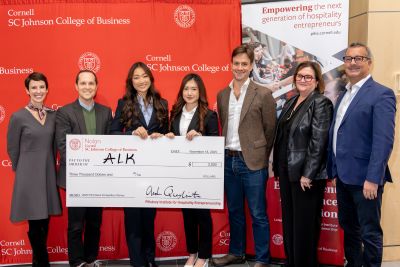
Wei “Miya” Deng, MMH ’26 involvement with the institute began shortly after starting the Master of Management in Hospitality (MMH) program.
Last fall in the Pitch Deck Competition, she and Katelynn Wiseman, MMH ’26, won first place (and $3,000) for ALK — a concept that reimagined the traditional hotel bar by introducing cocktails infused with kava, CBD and other natural ingredients to give nondrinkers a “functional high” while socializing with friends who were drinking.
Based on feedback from the judges, Deng, Wiseman and new team member Aiden Chen, MMH ’26, refined the concept to target airports rather than hotels, many of which already have their own bars. “It was a really rewarding process to iterate on the idea and push our creativity,” Deng says.
Their subsequent pitch, for Reland, a luxury airport lounge concept offering wellness sessions for long-haul travelers, won second place in the Hospitality Business Plan Competition this spring.
“Our next step, hopefully, is to move from concept to pre-seed readiness,” Deng says. She credits the Pitch Deck Competition judges with “helping us take our ideas further and see things we hadn’t realized.”
One of those judges was Ellen Yui, P ’14 and ’16, founding principal of YUI&Company, a communications consulting firm. (Yui was also their mentor for the Business Plan Competition, which, Deng says, “made the experience especially meaningful.”)
From Yui, they learned the value of branding. “She taught us that anyone can copy your product, but no one can copy your heart.”
Although Deng does not have a business background (her bachelor’s degree is in industrial design), the competition led her to consider entrepreneurship. To advance that journey, she meets frequently with EIRs.
“I’ve received great support and encouragement from the Pillsbury Institute,” she says. “They give students the spirit of entrepreneurship.”
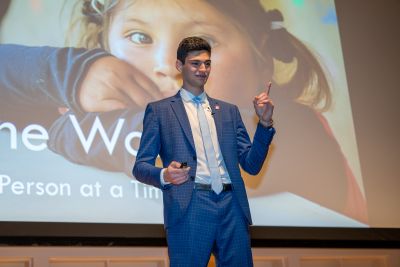
Lucas Suero ’26 won the 2023 Business Plan Competition (and its $25,000 prize) as a freshman for Citizens of the World, a nonprofit that introduces young adults to a life of philanthropy.
Citizens of the World was the first nonprofit to compete and to this date is the only nonprofit ever to win.
Suero was gratified by the win because “it showed that people could pursue a nonprofit as a real, viable business.”
His win marked two other firsts for the competition: He was the first solo entry to win the competition, and he did it as a freshman — another first.
“With Citizens of the World, we created a service-learning program where volunteers went into communities, and we exposed them to social issues prevalent in these communities and allowed them to discover where they were passionate about helping,” he says.
“Looking at those interests, we then helped them build and fund plans to effect long-term change.”
At the time of the competition, Citizens of the World was in its third year (though not yet fully formed). It had made three trips — one to Guatemala and two to Peru — and raised $250,000.
“The Pillsbury Institute helped me pitch it on a bigger scale and bring money in so that I could make bigger things happen,” he says. “To date, we’ve raised $610,000 from donors to conduct and implement the volunteer plans.”
The funds have been used to build a school and an orphanage; develop a program for students with physical and learning disabilities; and support food insecurity initiatives.
“After I won the competition, people changed the way they pitch ideas — because it was no longer, ‘How can I make the most profitable business?’ but something that also helps. I was really proud of that because I think more people need to be more giving. The shift toward a more sustainable future is important to me, and I’m happy to see it continue.”
Another point of pride was being able to make a difference for hundreds of students in South America, says Suero, whose family is from Peru.
“I feel an innate responsibility to give back to Peru, to my people, to my home,” he says, “and so I have a long-term commitment to service. As I continue [on in my career], I think making a positive difference in this world will always be important to me.”
Along with the Business Plan Competition — which he also entered as a sophomore, coming in fifth — Suero has taken full advantage of the EIR program. “Any time an EIR visits, I try to arrange a meeting in their first available slot,” he says. “EIRs are some of the most accomplished, incredible people who will give you free advice on basically anything. If you’re starting your own business, these are the people you want to talk to because it’s like meeting with a consultant you’d pay $500 an hour for.
“I can’t thank Pillsbury enough for everything they’ve given me,” he says. “Without Pillsbury, I wouldn’t be close to where I am today. A lot of the success I’ve had at Cornell and in my young career has been because of them and the mentors they’ve provided.”