Using machine learning to predict and prevent child malnutrition
A new system could forecast malnutrition hotspots before they occur and help humanitarian organizations target preventative aid.

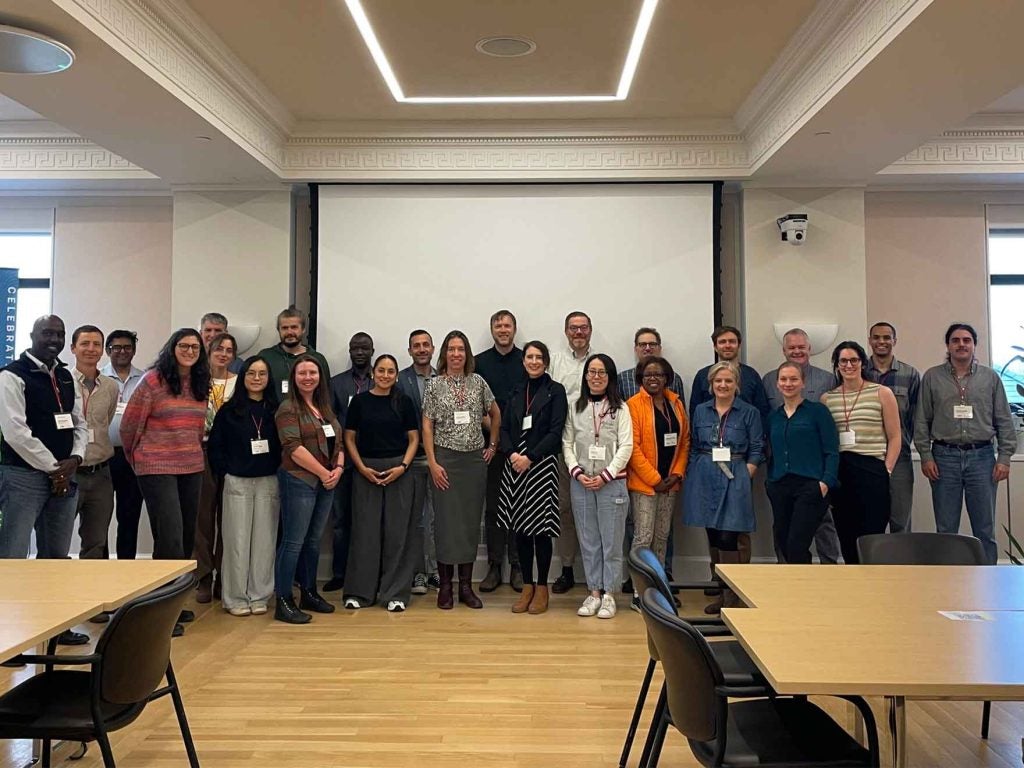
Susana Constenla-Villoslada, M.S. ’19, at Google's AI Collaborative: Food Security in 2025.
Image credit: Susana Constenla-Villoslada/Provided
Millions of children suffer from food insecurity each year, but a new forecasting tool could help governments prevent malnutrition spikes before they happen.
“Especially now, after sharp cuts to humanitarian assistance budgets around the world, it is more important than ever to direct scarce resources to places and people where it is most needed and can have the biggest bang for the buck,” said Chris Barrett, the Stephen B. and Janice G. Ashley Professor of Applied Economics and Management at the Charles H. Dyson School of Applied Economics and Management.
Researchers from the Cornell SC Johnson College of Business and UC Berkeley School of Information are piloting a machine learning system that can forecast malnutrition hotspots up to 3 months before they appear, helping humanitarian and governmental organizations send preventative aid to people in need. Susana Constenla-Villoslada, M.S. ’19, presented the system at the Data Science to Build Resilience and Improve Humanitarian Response Thought Summit on May 12.
“Child wasting is a clinical condition that has a 45% rate case fatality if untreated,” said Constenla-Villoslada, a Ph.D. candidate at University of California, Berkeley studying econometrics and machine learning for international development. “The kids that don’t die might have long term developmental consequences throughout their life, and if we don’t do anything about this issue, we are compromising the next generation. It reinforces cycles of poverty.”
The research stems from a long-term collaboration with Kenya’s National Drought Management Authority (NDMA), a governmental agency in charge of drought monitoring and response in the arid parts of the country. The model’s, built using the NDMA’s consistent drought monitoring data, was informed by the NDMA’s operational needs and local expertise.
“The people really moving the needle are the people on the ground doing these interventions,” Constenla-Villoslada said. “We’re supporting a collective effort of people that are trying to tackle these issues.”
The research team’s strongest predictive model draws from multiple public data streams, using both environmental and socioeconomic predictors to forecast the prevalence of malnourished children in a given community. The model utilizes primarily satellite imagery to generate rainfall and vegetation health anomaly proxies, which are predictors of child malnutrition prevalence.
“Public data streams like these satellite image products are super useful for us since they are high frequency,” said Constenla-Villoslada. “We can use them as predictors of these important variables like child wasting, so we have to protect that public good.”
The model also draws from publicly available conflict data (fatality count and incidence numbers) and the NDMA’s data on monthly child measurements to generate malnutrition prevalence outcomes.
Many prediction systems in weather and finance trigger alerts based on one event, but human outcomes are much more complex, resulting from multiple intersecting factors. The research team found that machine learning expanded their predictive capabilities by drawing out complicated relationships from multiple variables.
“It’s a combination of issues, but our results show that conflict and drought are main drivers of spikes in child malnutrition,” said Constenla-Villoslada. “These spikes take a lot of time to return to normal values, so it’s important to tackle hotspots before they happen.”
The research team backtested the model using past data to simulate present day forecasting, seeing if predictions would align with what actually happened. One month ahead of a crisis, roughly half of its alerts corresponded with real crises, and six months ahead, one third of alerts did.
The model’s accuracy heavily depended on both data frequency and continuity. From 2006 to 2009, when data collection sites were stable, the model could detect up to 77% of impending hotspots. But in 2016, when Kenya changed the location of many sentinel sites, the model’s sensitivity sharply declined for the next two years.
The model has also performed well in real-life scenarios. When their system predicted that malnutrition was on the rise in the Golbo ward of Marsabit county, in-person reports from unrelated organizations confirmed these conditions.
The research team has transferred this technology to their partner organizations in Kenya, who are currently exploring the best ways to utilize the data.
“The NDMA is using the forecast model — retrained on updated data from the version we published — to trigger anticipatory cash transfers to mothers in wards where child malnutrition is elevated,” Barrett said. “We’re working with them to evaluate that program rigorously.”
The team’s next goal is to develop a large language model inside the forecasting dashboard to explain data implications to audiences with varying levels of technical understanding.
“There are an estimated 10 million children in the Greater Horn of Africa that are malnourished. At this point in time, it’s unacceptable,” Constenla-Villoslada said. “The idea is to empower these governments to strengthen democracy in these places so that systems can take care of the citizens more efficiently.”
The rest of the research team was Nelson Mutanda, NDMA, Clinton Ouma, NDMA, Yanyan Liu, senior research fellow at the International Food Policy Research Institute and Linden McBride, Ph.D. ’18.
In this article
Featured People

Susana Constenla Villoslada
Assistant Research Professor

Christopher B. Barrett
Stephen B. and Janice G. Ashley Professor of Applied Economics and Management; Faculty Director of the Cornell Collaboration for International Development Economics Research
Article Information
- Categories
-
- AI & Technology
- Global Development & International Business
- Tags
-
- Research With Impact
- Top Story
- Faculty Areas
-
- Applied Economics and Policy
- Schools & Departments
-
- Dyson School