What’s keeping schoolchildren from eating local foods?
Bottlenecks and tradeoffs in food procurement pathways shared in a new USDA report and at Climate Week NYC.
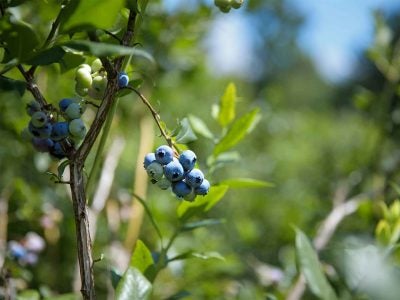
Blueberries at a pick-your-own farm. Image credit: Lindsay France/Cornell University
To get locally-grown food onto a schoolchild’s lunch tray, communities need supply chains that sort, process and package local farm products. They don’t always exist.
Becca Jablonski, visiting associate professor at the Charles H. Dyson School of Applied Economics and Management, part of the Cornell SC Johnson College of Business, contributed to a new report from the U.S. Department of Agriculture’s Economic Research Service (USDA ERS) that analyzed farm-to-school food procurement pathways. As part of Climate Week NYC, Jablonski will also present an interactive dashboard illustrating food procurement tradeoffs to administrators, researchers and policymakers from 2:35-3:35 p.m. on Sept. 24.
Schools participating in the USDA ERS report spent an estimated $1.8 billion on local food in 2022 and 2023. With more than half of U.S. schools participating in farm-to-school activities, it’s become the most frequently enacted regional food policy. This practice has shown economic benefits to farmers, schools and the communities surrounding them, but research is still limited.
“We do have evidence that locally-owned businesses tend to reinvest more heavily in their regional economies,” Jablonski said. “So, when schools spend a larger portion of their inputs in the local economy by purchasing from those local farmers, those local farmers tend to spend money in the local economy. For example, they may hire local labor or purchase inputs locally. All of those things collectively have important spillover effects.”
But even if local farmers and schools both want to enter a food procurement deal, there are many factors that can keep schools from committing. Schools are highly regulated and have limited food budgets. They often don’t have the labor power or necessary infrastructure in school kitchens to take fresh, whole produce and turn it into school lunches.
Canned, frozen and premade products offer better convenience and storage options, making the product more accessible to school food administrators. But if there are no mid-scale supply chains that offer those differentiated products and identify their local sources, administrators have no way to meet their needs with local options.
“Many times, we think about the importance of supporting farmers, so we focus on policies that directly support farmers in some way,” Jablonski said. “Crop insurance is an example, and very important, but we also need the requisite supply chain infrastructure for farmers to take advantage of market opportunities.”
To build a more robust and sustainable supply chain, policymakers need to understand the entire system and tradeoffs associated with different ways policies are implemented. The supply chain dashboard Jablonski will present at Climate Week NYC aims to do just that. Produced in partnership with the NYC Mayor’s Office of Food Policy and researchers from Colorado State University, the interactive tool makes complex food systems and procurement tradeoffs clear and accessible.
It includes a number of environmental metrics prioritized by NYC, including greenhouse gas emissions and water quality, integrating local data and decision-making factors throughout the supply chain. This is intended to show the feasibility of values-based food procurement policies — defined by the NYC Mayor’s Office as policies that factor in economic, social and environmental outcomes — helping decisionmakers create a more sustainable food system.
“For example, New York City sells a product they call Jamaican beef patties, and they’re taking out some of the beef and putting in some beans,” Jablonski said. “So, it still has some meat, but it’s a combination of meat and beans.”
By providing clear insight into complicated systems, the dashboard will support the Food Forward NYC policy plan, a 10-year food strategy that began in February 2021.
“We have very complex food systems, and the reality is that tradeoffs occur. So, before we decide to do these things, we really want to understand what ramifications of these different decisions will be,” Jablonski said. “With this dashboard we’ve created — which I believe is the first of its kind — we can show policymakers and decisionmakers what some of these tradeoffs may be across the different areas that they want to achieve progress in.”
Co-authors on the USDA ERS report were D. Adeline Yeh, Ashley Spalding, Christine Sauer, Pratyoosh Kashyap, Ashley Chaifetz and Zoë Plakias. Contributors to the City Food Policy dashboard include Jasmine Dillon, assistant professor of animal science; Allison Bauman, senior research associate from the Dyson School; and Miguel I. Gomez, the Robert G. Tobin Professor of Food Marketing from the Dyson School.
In this article
USDA ERS
Local Food Procurement Pathways: Key Drivers of Farm to School Participating Authorities Buying Directly From FarmersFeatured People
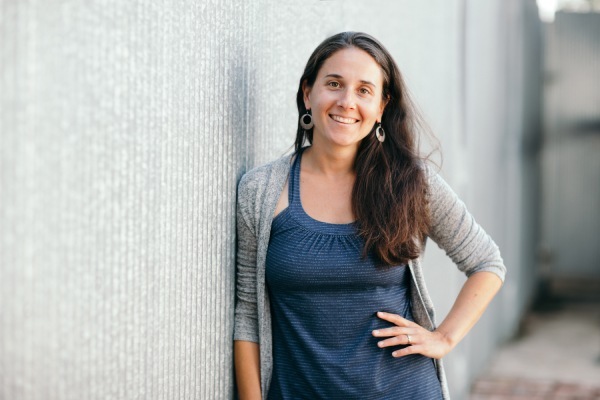
Becca Jablonski
Visiting Associate Professor
Article Information
- Categories
-
- Food & Agriculture
- Tags
-
- Top Story
- Research With Impact
- Business leadership
- Faculty Areas
-
- Applied Economics and Policy
- Schools & Departments
-
- Dyson School