Students consider how to honor their values with defiance
At the Dyson Dean's Distinguished Lecture September 18, professor Sunita Sah spoke about how to speak up when moral values are challenged.
When a group of English boys yelled “go back home” at Sunita Sah’s 4’10” mother, she stood straight and tall in her sari and asked what they meant.

That moment left a deep impression on Sah, a 7-year-old child at the time, who’d once thought being good meant complying with others. It also inspired her to write “Defy,” the 2026 Dyson Summer Read, a book that argues defiance is not petty contrarianism, but an act of moral courage. Now a professor at the Samuel Curtis Johnson Graduate School of Management, she shared this concept with undergraduates as part of the Dyson Dean’s Distinguished Lecture Series, held on Sept. 18 in Warren Hall.
“In this series, students, faculty and staff all come together to reflect on our experiences and how they relate to the book,” said Jinhua Zhao, the David J. Nolan Dean of the Dyson School. “By doing this, we wish to build a shared vocabulary, to advance our collective thinking and to demonstrate to our students from the outset that the school is serious about learning and the pursuit of knowledge.”
To Sah, defiance is not an inherent personality trait. It’s a muscle one strengthens through repeated exertion.
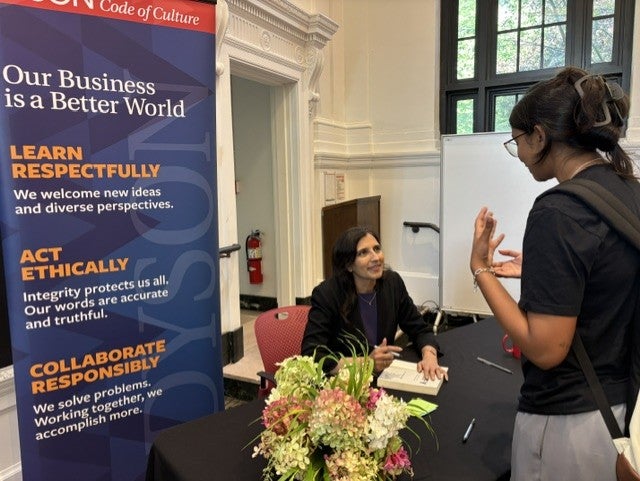
“The most painful moments in life are not when others betray us, but when we betray ourselves,” she said. “If we think defiance is only for the brave or the extraordinary, we excuse ourselves from doing the work. Understanding that it is a skill and something that we train for, just like we train for anything else, is crucial.”
During a Q&A session with Sarah Wolfolds, associate teaching professor at the Dyson School, Sah offered guidance to the audience. When they feel tension, Sah said, they should consider if the situation goes against their values and whether it’s both safe and effective for them to act.
“What does a person like me do in a situation such as this?” Sah prompted.
“In high school, there was a girl that I really looked up to,” said Claire Cen, a Dyson School freshman, reflecting after the lecture. “She had gotten into her dream college. She told me that she only slept for three hours a day, drank an energy drink every day and that’s the only way I could get things done. Immediately, I had the feeling Professor Sah described in the book — a feeling that this isn’t right and that it doesn’t go with the values that I hold for myself.”
Cen would often hear that friend’s voice in her head when choosing between sleep or studying for an exam. Despite that, she acted in accordance with her values.
“I never took her advice in that way,” Cen said. “I had to actively remind myself even though it led to success for her, it wasn’t the path that would be best for me.”
Some student attendees were newer to practicing defiance.
“I was a very obedient kid. A lot of the things that I did, I would do in compliance with my parents, school or anyone around me, because that’s what I was taught was good,” said Ben Williams, a Dyson School freshman.
Much like Sah as a child, defiance never came to Williams naturally. When engaging with Sah’s book and lecture, he realized it was an important skill to cultivate.
“It shifted my perspective to understand defiance not in a negative context, but in a context that puts your inner values first,” he said. “If I could go back and tell my younger self something, I would say to focus on identifying whether or not a behavior goes in accordance with what you truly believe. If it doesn’t align with that, then think twice.”
Freshman Annie Zhang anticipated the need to practice defiance in the future.
“Sometimes, when you are on the edge of defiance, know that many around you may be thinking the same way,” she said. “But if everyone chooses to go with the herd, that can lead to irreversible consequences that no one can fix.”
Featured People
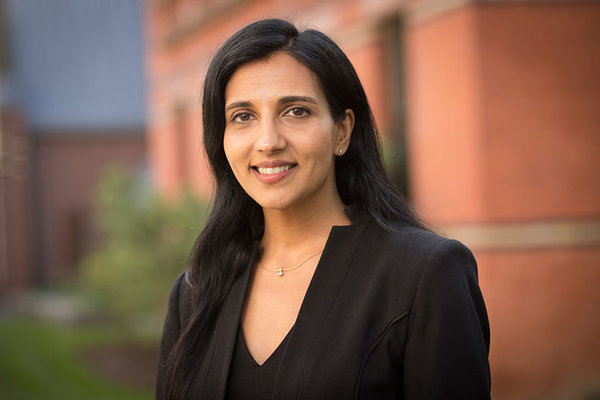
Sunita Sah
Professor
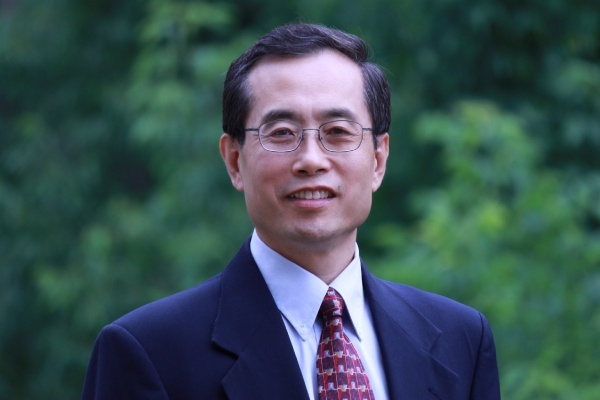
Jinhua Zhao
Professor; David J. Nolan Dean of the Charles H. Dyson School of Applied Economics and Management
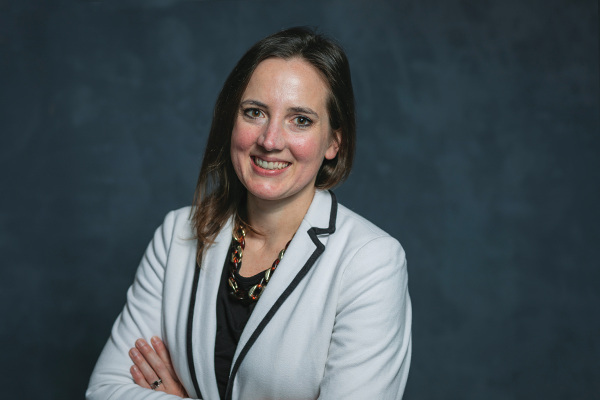
Sarah Wolfolds
Associate Teaching Professor; Academic Director of the Grand Challenges Program; Director of Undergraduate Studies for the Dyson School
Article Information
- Categories
-
- Management, HR & Leadership
- Tags
-
- Ethics
- Organizational Behavior
- Business leadership
- Top Story
- Faculty Areas
-
- Management and Organizations
- Schools & Departments
-
- Johnson School
- Dyson School
-
- BS Applied Economics and Management