People over profit: The case for business reform
At the 2026 BenDaniel Lecture in Business Ethics, speakers dissected the values baked into business school curricula and the U.S. market.
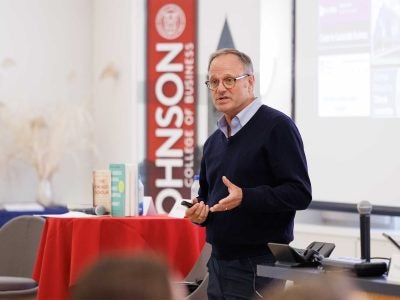
Andrew Hoffman delivers the 2026 BenDaniel Lecture in Business Ethics. Image credit: Devin Flores/Cornell University
Profit is the ultimate aim of the U.S. market, according to Andrew Hoffman. What would society look like if business prioritized human wellbeing instead?
Hoffman, professor of sustainable enterprise at Michigan Ross, was invited to discuss the purpose of business schools at Cornell, as part of a discussion happening on campus and around the world. After delivering the 2026 David J. BenDaniel Lecture in Business Ethics at Warren Hall in early October, Hoffman’s lecture was followed by a discussion with a panel of Cornell SC Johnson College of Business faculty.
Following opening remarks from Provost Kavita Bala, Andrew Karolyi, Charles Field Knight Dean of the SC Johnson College, introduced Hoffman.
“Andy calls it sparring, I call it intellectual provocation. Ultimately, it is an honest, full-throated conversation about the value of business education,” Karolyi said. “We may not yet know all the answers, but I do know that every time I have such a conversation with Andy, I gain IQ points. That is why the views must be heard and the debate must be had.”
In his keynote, Hoffman outlined what he considers to be the fundamental flaws of U.S. business schools to an audience of business educators, students and leaders.
“If you really want to have people listen to you, you’ve got to make them uncomfortable,” said Hoffman. “So, this book and my remarks are meant to make you uncomfortable and then get you to think.”
Hoffman believes that business schools have a responsibility to provide future financial leaders with a stronger ethical framework.
“If we take an ethics course and drop it in a curriculum that says maximize ROI and do whatever you can to make as much money as you can, then it’s not going to work,” he said.
In his lecture, Hoffman referenced a study that analyzed businesses in the U.S. and Denmark. When business school graduates took over management, worker wages declined by 6% in the U.S. and 3% in Denmark. Neither profits nor revenues differed between the two samples.
“They did what they were taught to do. They made the system more efficient,” he said. “They did what they were taught to do. They screwed people.”
To Hoffman, a market that prioritizes profit and growth inevitably exploits workers and the natural world. He thinks shifting business school curricula to include lessons on income inequality and sustainability will not be sufficient to change the way this market operates. Instead, the systems must be reconstructed around an entirely new value system.
“Climate change, in its true sense, is not an environmental issue,” he said. “It is a systems breakdown. That system is capitalism. We have grown, as a species, to enormous numbers and our technology to such power that we are an animating force in the environment. So merely fitting climate change into a system that is causing these problems simply won’t work.”
The value systems embedded in business school reflect capitalist values, Hoffman argued. He pointed to college rankings, which use postgrad salaries as the primary metric for measuring an institution’s worth.
But Hoffman believes the current form of “exploitative capitalism,” which puts shareholder profits before community stakeholders, is not the only possibility for a capitalist system.
“Colin Meyer, the former dean of the Saïd School at Oxford, says the purpose of business is to solve society’s problems profitably,” he said. “That is a much better definition of management than making money for the shareholder. So, how do we bring that to the education process?”
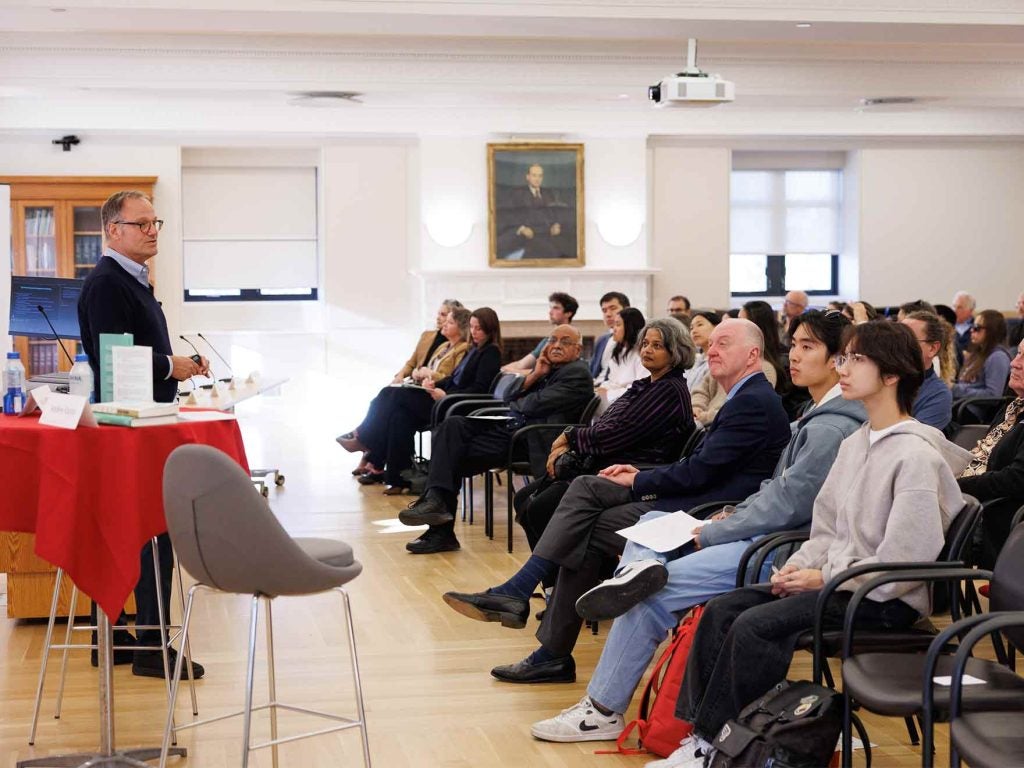

Following the keynote was a panel discussion among Suzanne Shu, dean of faculty and research; Elizabeth McClean, associate professor; and Ceridwyn King, the Dimond Family Dean of the Cornell Peter and Stephanie Nolan School of Hotel Administration.
McClean agreed that the problem is systemic. If students are encouraged to pursue ethical, sustainable and humanistic work that fulfills them, they’ll likely make less money, which drops their institution’s standing in college rankings.
“This exposes an uncomfortable question that I think is worth digging into,” said McClean. “When educating students according to our stated purpose, we produce outcomes that make us look less successful according to the system in which we operate.”
Shu saw a potential opportunity to adjust academic incentive structures.
“What if the rankings don’t rank based on salaries, but on life satisfaction?” she said. “What if we measured happiness five years out from your business school degree?”
Following the faculty panel, students and other audience members were welcomed to share their thoughts on business school and market reform.
“Capitalism is not a fixed system,” Hoffman said. “We are in a period of flux right now, and a new variant will emerge. We can study that as a predictive tool to try to figure out where it will be. We can also take our place in the conversation to guide it into what we think it should be.”
In this article
Featured People
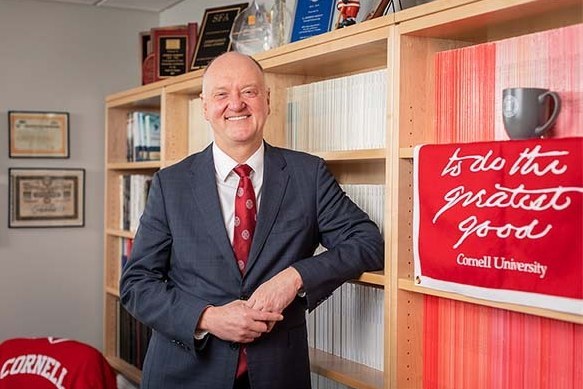
Andrew Karolyi
Professor; Charles Field Knight Dean of the Cornell SC Johnson College of Business; Fellow of the Academy, International Academy of Management

Elizabeth McClean
Associate Professor

Suzanne Shu
John S. Dyson Professor in Marketing; Dean of Faculty and Research; Faculty Research Director of the Center for Behavioral Economics and Decision Research
Article Information
- Categories
-
- Policy & Advocacy
- Tags
-
- Ethics
- Top Story
- Thought Leadership