My first time in Ghana: Discovery, learning, and reflection
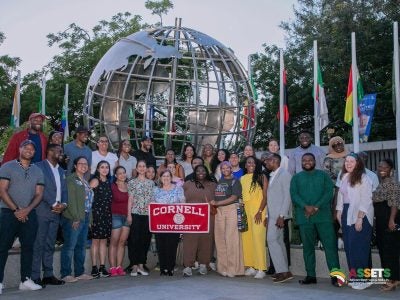
Ghana Trek 2026 participants.
By Makenley Jean, MBA ’27
Stepping out of Kotoka International Airport in Ghana, I felt like I was entering a rhythm I somehow recognized. The warm, heavy air wrapped around me, feeling both new and familiar. It was just after 7 a.m., and the sun was shining, similar to the morning I left New York City. But here, the sunlight felt stronger. At 84 degrees, the heat didn’t just brush my skin; it settled in, making me adjust with each step.
Right away, I noticed the energy outside. Taxi drivers called out, engines hummed, and conversations filled the air. Moving through the crowd, everything felt lively and steady. Even though it was my first time in Ghana, it felt familiar. As the day went on, that feeling grew into quiet joy and gratitude. I saw things that reminded me of Haiti, like the warmth of the people, their daily routines and the strong sense of community. In those moments, I began to understand why Africa is called the “Motherland” — not just an idea, but something you can truly feel.
After these first impressions, I began to think about the bigger reasons for my visit. Before coming here, most of what I knew about Africa came from a Western education that focused on slavery and scattered histories. While studying at the Samuel Curtis Johnson Graduate School of Management, I grew more interested in Africa’s business and trade networks. This trip to Ghana let me move beyond old stories and experience its energy.
Our schedule brought us to places that deepened my reflections. One of our first stops was Black Star Square, which set the tone for the trip. Standing there, I felt the importance of Ghana’s independence and its role as a symbol of hope for Africa. The space had a quiet strength not because of its size, but because of what it represents: self-determination, ambition and a national identity focused on the future. It made me think about leadership not just in organizations, but in how a country shapes its own path.
My reflections deepened when we visited Cape Coast Castle. Walking through its halls was a sobering experience that challenged me in unexpected ways. I had studied the transatlantic slave trade before, but learning about it in person made it real in a way I couldn’t ignore. This visit showed me how often we keep history at a distance, treating it as something abstract. Experiencing it felt immediate, emotional and unsettling, and it changed how I think about the present.
I realized that the economic and social issues we came to study are closely tied to history. These layers still matter today. The link between history, business and human strength stood out to me.
With this background, our company visits and talks felt more meaningful. People often describe Ghana’s economy by its main sectors, like agriculture, manufacturing, fintech and natural resources. Seeing them up close revealed a more nuanced picture.
I saw firsthand how Ghana’s businesses are reaching international markets, from local entrepreneurs like Global Mamas to growing companies like Ekumfi Juice. Global Mamas helps women start and grow their own businesses, while Ekumfi Juice is expanding and hopes to supply large retailers like Walmart. Together, they show the power of community and the drive to succeed globally.
I also visited Farmitecture, a venture focused on vertically integrated farming. While this idea isn’t new in developing regions, its use in Ghana feels especially important. Poor infrastructure and unpredictable weather are already straining the agricultural system; solutions like Farmitecture aim to make food production more reliable and sustainable.
Another highlight was exploring Ghana’s services sector, one of the fastest-growing areas in Africa.
Key challenges that consistently emerged across the businesses I visited:
- Investment is limited in essential services within Ghana (and arguably across the continent). For example, XpressGas highlighted logistical challenges with propane deliveries at times due to poor road infrastructure.
- The fintech market is crowded, with many companies offering similar services, mostly mobile payments. There is a real need for diversification, including insurance (especially for farmers); affordable long-term loans for small businesses; home mortgages; and easy-to-access investment products.
- Trade systems continue to prioritize resource extraction over intra-African commerce.
- Language barriers, particularly between English and French-speaking countries, create additional friction.
Whether we were visiting sites, talking with companies or listening to guest speakers, one idea kept coming up: Context matters. My assumptions were challenged again and again. I started out focused on efficiency, best practices and scaling up, but in Ghana, adaptability, local knowledge and resilience often matter more. Solutions that seem perfect in theory can fail if they don’t fit the real situation.
This changed how I think about solving problems. Before the trip, I usually tried to define the problem, use a framework and find the best solution. That approach still matters, but now it feels incomplete. This experience taught me that it’s just as important to really understand the problem in its context. That means listening more, questioning what I think I know and being open to solutions that don’t always fit the usual models.
Most of all, this trip showed me that leading in a global setting takes humility. You have to accept that no single approach or viewpoint has all the answers. It also means being ready to change not just your strategies, but your way of thinking.
I came to Ghana expecting to study an emerging market, but I left with a much deeper respect for its people, its history and the forces shaping it. I also felt more excited about the future. Places like Ghana aren’t just part of the world’s future — they are helping to shape it. That’s more powerful than anything I could have learned in a classroom.
Article Information
- Categories
-
- Blog Posts