Cornell convenes leaders to explore AI’s impact on business
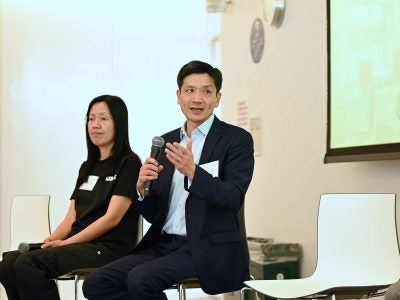
Presenters at the Academic-Industry Workshop on the Business of AI.
Image credit: Sandeep Chitla
Cornell faculty and industry leaders gathered June 3 at the Tata Innovation Center on Roosevelt Island to examine how artificial intelligence is reshaping business, and to identify where research and practice can move forward together.
The Academic-Industry Workshop on the Business of AI, hosted by the Cornell SC Johnson College of Business, was an interactive forum combining formal presentation with longform discussion. Session topics spanned finance, education, startups, consumer markets and healthcare.
“Artificial intelligence is redefining how decisions are made across every sector of the economy,” said Vishal Gaur, the Anne and Elmer Lindseth Dean of the Samuel Curtis Johnson Graduate School of Management. “By bringing together researchers and industry leaders, we can accelerate our understanding of responsible AI deployment at scale.”
Each session paired Cornell faculty with practitioners from organizations including AllianceBernstein, Shopify, Amazon, Marriott International and emerging startups, demonstrating how advances in machine learning are translating into operational and strategic decisions.
“As businesses move towards implementing agentic AI in production systems, there are both opportunities and challenges,” said Mani Sethuraman, associate professor of accounting at the Johnson School. “Success depends on corporate leaders emphasizing strong governance, transparency and trust to deliver sustainable value.”
One session explored how machine learning is reshaping risk assessment and decision-making in financial markets, while raising concerns about explainability and regulation.
“Financial institutions are increasingly relying on AI to interpret complex, fast-moving data,” said Andrew Chin, chief AI officer at AllianceBernstein. “We need to ensure those systems are both robust and interpretable, so that human decision-makers can trust and validate their outputs.”
Participants also predicted that AI-driven startups would have a lower barrier to entry, but could suffer from a lack of scalability, funding and ethical consideration. To avoid these roadblocks, they agreed that interdisciplinary teams spanning industry and academia would be necessary.
Similarly, deploying AI in healthcare services could greatly benefit patients, but would require careful evaluation from clinicians, researchers and industry partners.
“AI has huge potential to improve patient care, but only with human oversight,” said Fei Wang, associate dean for AI and data science at Weill Cornell Medicine.
The conversation also explored AI applications in consumer markets, where research and data analysis is being increasingly automated.
“Consumers increasingly expect seamless, personalized experiences,” said Sandy Jeong, field chief technology officer at Shopify. “AI enables that at scale, but it also requires businesses to be thoughtful about how they use data and maintain brand positioning and, ultimately, customer trust.”
Building AI into corporate workflows has also disrupted which white-collar skills are considered valuable — for new graduates, knowing how to operate generative AI could become more valuable than the ability to gather and analyze data.
“Higher education has a critical role to play in preparing students to use intelligent systems effectively, while also understanding their limitations,” said Thorsten Joachims, vice provost for AI strategy in the Cornell Ann S. Bowers College of Computing and Information Science.
Each session dedicated significant time to open discussion, encouraging participants to identify opportunities for joint research and partnership. To ensure that AI’s impact is both meaningful and responsible, Gaur and other Cornell leaders intend to sustain conversations between academia and industry, catalyzing future collaboration.
In this article
Featured People

Vishal Gaur
Professor; Anne and Elmer Lindseth Dean of the Johnson Graduate School of Management
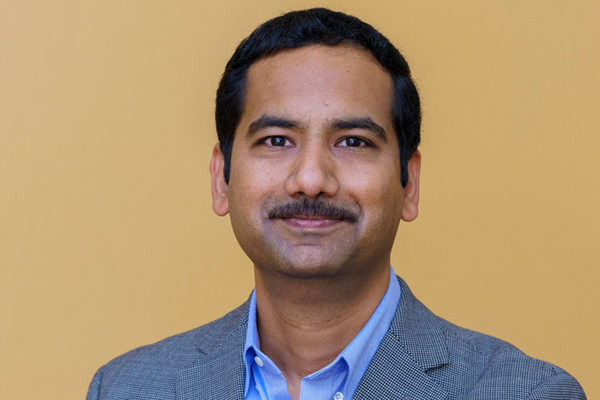
Mani Sethuraman
Associate Professor; MBA Class of 1976 Professor in Management
Article Information
- Categories
-
- AI & Technology
- Tags
-
- Thought Leadership