Defibrillators prevent cardiac deaths, but only if they arrive in time
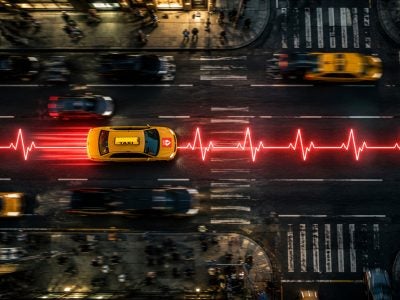
Image credit: Steve Kern
If cardiac arrest victims don’t receive a defibrillator shock within a few minutes, lasting brain damage becomes likely. More than half of the time, responders aren’t that fast.
With the goal of speeding up automated external defibrillator (AED) deployment and improving survival outcomes, researchers measured deployment efficiency with a stochastic spatial model, a mathematical framework that uses geographic location and random probability to measure real-world outcomes. The study, inspired by Singapore’s AED-on-Wheels program, a mobile AED deployment system that sends trained volunteer drivers in AED-equipped vehicles directly to patients, was posted as a working paper on SSRN on July 21.
“Prior empirical evidence suggests that the rate of timely volunteer arrival is less than 40%,” said Jingwei Zhang, assistant professor in the Charles H. Dyson School of Applied Economics and Management, part of the Cornell SC Johnson College of Business. “It’s not just for defibrillation, but also for general emergency response, including CPR and other needs. So, the rate is very low, and that is one of our key motivations.”
Most AEDs are located at high-traffic public locations, such as airports, malls and gyms, for responders to access and deliver. This is known as the static deployment method, the traditional and most widely used system for AED delivery — mobile deployment is still an emerging delivery approach.
Both mobile and static deployment networks were studied in various urban settings to advise cities with limited AED budgets on where to allocate their funds. Researchers saw the best results when cities focused on building one type of response network, either all-mobile or all-static, up to a point.
“One might expect a hybrid system that combines static and mobile AEDs to work best,” Zhang said. “However, in our model, we actually found there is an economy of scale when building up the static system. That means the more AEDs you install in the static system, the more effective each AED is. But once the network becomes dense, adding more AEDs provides less additional benefit.”
Once the benefits of further expanding either the static or mobile network begin to level off, the researchers suggested supplementing weak response areas with the alternate deployment method. Although mobile deployment didn’t show the same economy of scale, each AED-equipped vehicle showed a constant benefit.
Static models were particularly effective in cities with large and dense populations, and mobile models were recommended for cities with lower budgets, since fewer AED units could provide consistent value to bigger areas when placed in vehicles.
“We look into a wide spectrum of urban characteristics including population, and most importantly, how busy the ride-hailing systems are in each city,” Zhang said. “In our calibrated example for New York City, for example, I would say the major driver leading to the static system preference is the dense population. That means there will be more volunteers to respond to the notification.”
The effectiveness of mobile AED deployment was impacted by how often people were utilizing taxis carrying the devices. If a taxi driver received a cardiac arrest alert in the middle of a customer’s trip, they wouldn’t be able to respond — since AED delivery work is on a volunteer basis, the model gave their business precedence.
Expanding the AED-equipped vehicle fleet would help alleviate the pressure created by high vehicle utilization in densely-populated cities. Zhang thinks private-hire vehicles like Ubers could provide some of that relief.
“One prominent real-world example of mobile AED deployment is the AED-on-wheels program in Singapore, which uses taxis,” Zhang said. “But because taxis and ride-hailing vehicles can play a similar role for AED delivery, we think that maybe in the future, ride-hailing platforms such as Uber can collaborate with the city government healthcare sector to implement such initiatives.”
Cities should also consider how to recruit and train new volunteer responders, Zhang said. The research team is currently modeling simple volunteer behavior, analyzing interactions between volunteer responsiveness and participation. As a potential direction for future research, she would like to explore different incentive program designs to find how cities can best motivate new volunteers to sign up.
“I hope more cities will consider using ride-hailing fleets as a way to deliver AEDs,” Zhang said. “They could also use this method to deal with opioid overdose or other medical situations that requires timely delivery of a medical device. For these situations, I think our model can be of use.”
The study’s co-authors are Zeyu Lin, a Ph.D. student at University of Toronto; Weiliang Liu, assistant professor at the Chinese University of Hong Kong; and Marcus Eng Hock Ong, professor at the National University of Singapore.
In this article
Working Paper
Moving Lifelines: Fixed Sites or Mobile Fleets for Volunteer-Enabled Emergency Medical Device Delivery?Featured People

Jingwei Zhang
Assistant Professor
Article Information
- Categories
-
- Healthcare & Wellness
- Tags
-
- Top Story
- Research With Impact
- Insights
- Faculty Areas
-
- Operations, Technology, and Information Management
- Schools & Departments
-
- Dyson School