A new financial era requires an updated system
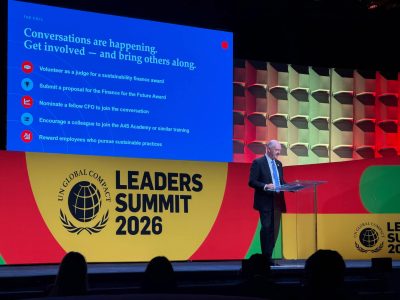
Dean Andrew Karolyi took the stage at the UN Global Leaders Summit 2026 in New York City. Image credit: Mary Lorson.
Balancing the day-to-day needs of a globally connected financial system with the sustainability goals society must achieve is no small feat.
Andrew Karolyi, Charles Field Knight Dean of the Cornell SC Johnson College of Business, spoke at the UN Global Compact Leaders Summit 2026 about the importance of financial system change to align corporate decision making with sustainability goals. Karolyi was one of five speakers in the Capital and Markets as System Levers keynote session at the New York Marriott Marquis on Wednesday, Sept. 23, during Climate Week NYC. Hundreds of business leaders, government officials and nonprofit organizers from around the world were in attendance.
“Today’s operating system was built for a different era. An era in which environmental costs often remained externalized. An era in which social impacts received limited attention. An era when long-term resilience could sometimes be sacrificed for short-term efficiency,” he said. “Today, that world no longer exists.”
Karolyi focused on three actions that universities, corporations, investors, regulators and society can take to evolve the outdated financial system and move “sustainability from aspiration to implementation.”
According to Karolyi, these actions are convening, training and rewarding.
“We can redesign the systems that guide the capital itself,” he said. “And that’s why I believe chief financial officers, chief investment officers and finance teams occupy some of the most consequential positions in the global sustainability movement, not because they’re closest to the money, but because they sit closest to the rules.”
His solution begins with convening — breaking through the often siloed areas across the financial sector. Karolyi pointed out that the UN’s Sustainable Development Goals recognize the importance of convening, or partnership, to solve the complex problems facing the world.
“The most successful transformations occur when leaders come together to learn, compare experiences, challenge assumptions and accelerate adoptions of best practice,” Karolyi said.
He urged the leaders in the audience to tap into the communities that already exist, such as Accounting for Sustainability, a nonprofit.
These laboratories of collective learning “accelerate experimentation, spread innovation and perhaps most importantly, reduce the loneliness of leadership because transformation is difficult,” Karolyi said.
Next, Karolyi recognized his role, and the role of business school leaders everywhere, in training environmentally-conscious professionals.
“The finance leaders we educate today will determine how trillions of dollars are allocated for tomorrow. Universities like mine, we cannot stand on the sidelines,” he said.
For Karolyi, training needs to be viewed through a different lens. It isn’t an individual activity but an organizational infrastructure to support long-term solvency. The companies that build sustainability competence across finance functions will have strategic advantages in managing uncertainty, identifying opportunities and creating long-term resilience.
“The future will belong to the organizations that learn faster than the change itself and that requires investment in people,” said Karolyi.
In speaking to his final recommended action, Karolyi emphasized that every system produces what it rewards. Rewards can multiply behaviors — recognition changes incentives, and incentives create system change.
“When organizations see their peers succeeding, new ideas spread faster,” he said. “New standards emerge, new norms develop and systems begin to evolve.”
Karolyi was the sole speaker to take the stage from a university administration lens, a point of view that was important to the event’s overall mission, according to David Steingard, head of Principles for Responsible Management Education (PRME), a UN-supported initiative focused on sustainability, ethics and social responsibility in global business education.
“The PRME community is very grateful to Andrew that he is so committed to PRME and he multiplies the force for good in the global business ecosystem,” said Steingard. “Andrew’s presence from a prominent PRME college really cements the importance of our work.”
Other speakers at the keynote included Toni Ballabriga, global head of sustainability intelligence and advocacy at BBVA; Lakshita Ganesh Kumar, a college student at the University of Connecticut and a North American regional leader for PRME, an institute of the UN Global Compact; Jay Heinbach, vice president of communications and external relations at the World Bank Group; and Martha Sazon, the CEO of Mynt Inc.
Speaking to a room full of finance experts focused on sustainability, Karolyi didn’t shy away from his role as a leader within an Ivy League university.
“Universities can help convene, universities can train, universities can help recognize success, but ultimately the future will be shaped by the choices you make inside your organizations,” he said. “You’re helping determine what capital values, and when we align what markets value with what society needs, we unlock one of the most powerful levers for change available to us.”

In this article
Featured People

Andrew Karolyi
Charles Field Knight Dean of the Cornell SC Johnson College of Business
Article Information
- Categories
-
- Energy & Sustainability
- Global Development & International Business
- Policy & Advocacy
- Tags
-
- Environment & Climate
- Globalization
- Top Story
- Thought Leadership
- Business leadership