The 30-day entrepreneur
Richard A. Baker ’88, businessman and Baker program namesake, led an entrepreneurship boot camp for future leaders in real estate and the built environment.
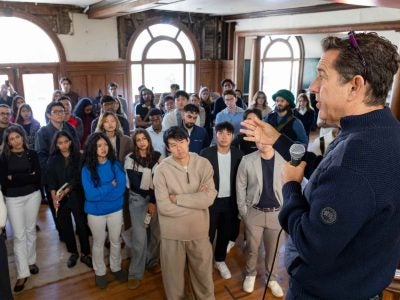
Richard Baker '88 speaks to gathered students. Image credit: Simon Wheeler
By the end of Richard Baker’s two-day boot camp, students walked away with a 30-day action plan for their first real estate deal.
Designed to be compact yet comprehensive, this fall marks the first time Richard A. Baker ’88, visiting professor of practice and benefactor of the Baker program along with Lisa Baker, has taught within the Paul Rubacha Department of Real Estate, jointly led by Cornell’s SC Johnson College of Business and the Department of Architecture, Art, and Planning (AAP). Around 100 students from different disciplines, departments and degree programs piled into Milstein Hall for the two-day intensive on market analysis and underwriting strategies for leveraging acquisition debt.
Baker is best known for his high-profile deals with retail entities such as Hudson’s Bay Company, Lord & Taylor and Saks Fifth Avenue. Yet he’s taking a purposeful step back from the retail business and entering a new chapter of his life — one focused on preparing the next generation of entrepreneurs for impactful careers that positively shape the built environment through knowledge transfer.
“I’ve made a lot of money, and I’ve given away a lot of money,” Baker said. “That’s not what this is. I have a new idea, which is a challenge to myself. I want to give 100,000 people $10,000 worth of knowledge. This is an opportunity to give away $1 billion of knowledge. Of course, there will be no tax deduction and no plaque, but what an opportunity.”
While intensives of this caliber are often reserved for business students and professionals, Baker tailored the content for students across Cornell AAP’s disciplines, offering rare and invaluable insights for architecture and planning majors into the market-driven side of the built environment.
“The etymology of ‘entrepreneurship’ comes from a French verb: to undertake or to do something,” said Jose Castillo, architecture department chair, during his opening remarks. “Entrepreneurship is not only a word for the business community. Undertaking is a challenge we face every day as architects, as city planners and as real estate developers.”
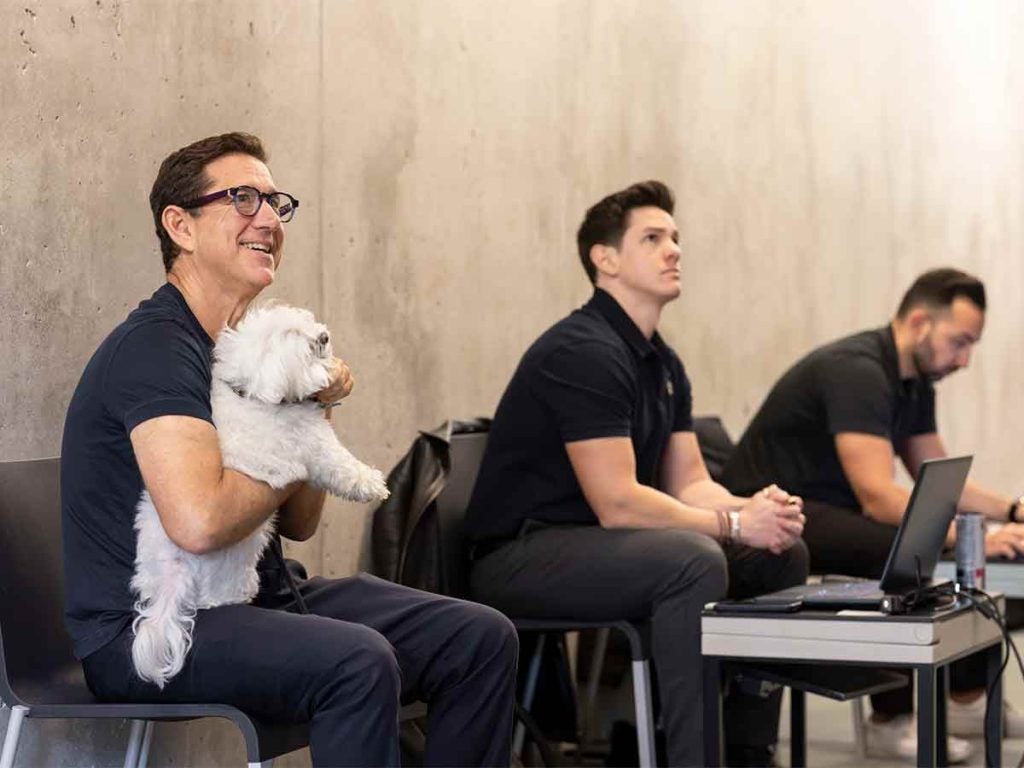


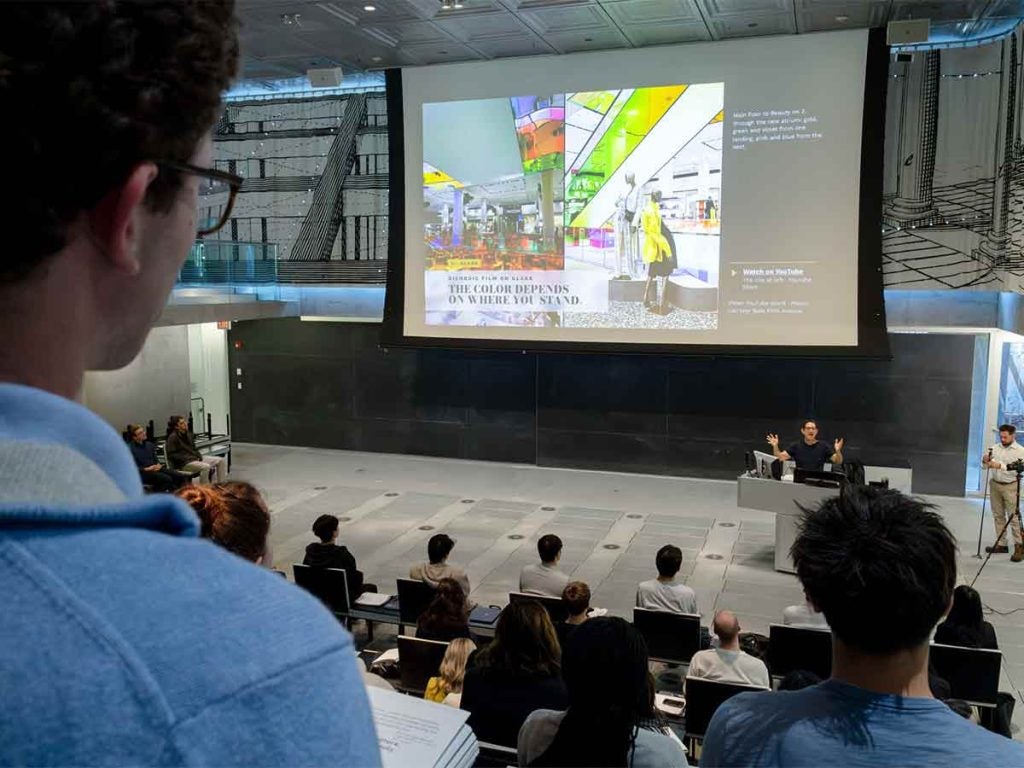
Baker led the session with his personal history in entrepreneurship.
“In high school, I had a catering business,” he said. “I realized that I had 50 guys in my class who all owned jackets and ties. Other caterers in town figured out that I had this army of guys, and they used to hire me to set up and close down these parties.”
He used this hospitality experience as a launchpad, attending the Cornell Peter and Stephanie Nolan School of Hotel Administration. After graduating, he joined his family’s real estate business and partnered with Walmart, working to build over 50 Walmart-anchored shopping centers on the East Coast.
Following that, Baker spotted a different kind of opportunity. Retail businesses were faltering during the rise of e-commerce, and the real estate that brick-and-mortar stores operated in was becoming more valuable than the actual business.
“What if I could buy the businesses, harvest the real estate and create value in a business that was going away anyway?” Baker said. “I kept these businesses going for many, many more years than anyone would have imagined, but in the end, my premise came true and most of them went out of business. Still, we created a lot of value that way.”
He encouraged students to seek entrepreneurial opportunities in their own community, even if they aren’t starting out with any money.
“Say you’re a manager of a McDonald’s making $60,000 a year,” Baker said. “Why can’t you buy the pet store in your community? Have the seller lend you the money for three years, pay it back with income, then end up owning a business where you make $150,000 a year instead.”
Baker is an advocate for “entrepreneurship as job replacement,” which he said he believes can mitigate some job losses caused by AI adoption. This worldview is expounded upon in his book, “Jungle Bear: The Revenge of the Entrepreneur and the Deconstruction of Corporate America,” which he shared with the class.
Over the course of the weekend, attendees had the opportunity to deliver pitches on their current real estate deals, deals under consideration or existing deals they want to learn from, receiving feedback from Baker in real time.
“It was exciting for me to see how eager architecture and planning students were to integrate real estate and entrepreneurship into their educational experience,” said Cody Danks Burke, director of the Baker program. “This event was a great example of our approach to real estate education at Cornell: we bring together all aspects of real estate and the built environment in a way that no other university does.”
Students were asked to consider whether their skill set suited a real estate operator, investor or developer role, and from there, to figure out what kind of project they could take on, outlining a one-month plan to achieve it.
“Entrepreneurs are positive people, because they believe they’re going to win,” Baker said. “Now, no matter what’s going on in my life, no matter how bad or challenging it is, I am grateful. If you’re going to be an entrepreneur, this is part of the process.”

In this article
Featured People

Richard A. Baker '88
Visiting Professor of the Practice
Article Information
- Categories
-
- Management, HR & Leadership
- Tags
-
- Entrepreneurship & Venture Capital
- Real Estate
- Faculty Areas
-
- Real Estate
- Schools & Departments
-
- Rubacha Dept. of Real Estate
-
- Baker Program in Real Estate (MPS Real Estate)