Sheep grazing in solar fields offers farmers economic, ecological gains
As solar grazing expands, new research helps sheep farmers increase profitability and benefit the environment.
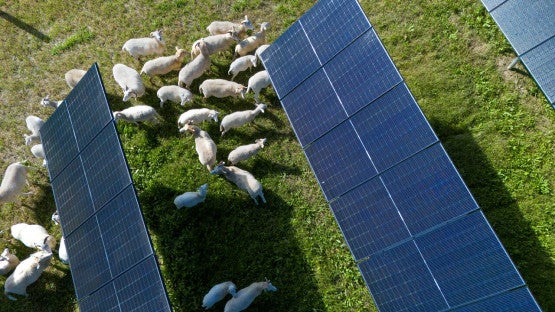
A Cornell research team has developed a tool that helps farmers whose sheep graze in solar arrays to make better decisions about their operation. The team described the tool in “Flock Management for Solar Grazing,” which published Sept. 28 in Manufacturing & Service Operations Management.
After a chance encounter with Caleb Scott, Ithaca-based sheep farmer and founder of United Agrivoltaics, Vincent Slaugh, assistant professor at the Cornell Peter and Stephanie Nolan School of Hotel Administration and first author of the paper, began thinking through the economics and logistics of solar grazing. He recruited Linwei Xin, associate professor of operations research and information engineering, and Shane Henderson, Charles W. Lake, Jr. Professor in Productivity, both in the Cornell Duffield College of Engineering, to work on the topic.
Together, they developed a spreadsheet-based model that helps sheep farmers to optimize procurement and sales decisions, based on factors like target flock size, costs, anticipated revenues, and expected vegetation in particular solar sites; if a farmer doesn’t have enough sheep to keep the grass down, they’ll have to cut it some other way. It also helps solar developers understand growers’ needs and develop contracts that are more profitable and sustainable for all parties long-term. United Agrivoltaics has already incorporated the tool into its onboarding process.
Slaugh sees opportunity for U.S. shepherds to grow their operations – especially with solar contracts offering a steady source of income and animal feed. Current domestic sheep production for meat and wool doesn’t come close to meeting domestic demand; about half of all lamb and mutton consumed in the U.S. is imported, primarily from New Zealand and Australia.
“If we grow the sheep industry, will the American diet eventually include more lamb? Could that be a side effect of the solar energy revolution? I think the answer is very likely yes,” Slaugh said. “And then when that happens, we’d expect processors and supporting industries to come back, for banks to be willing to give more loans, and for supply chains to follow. All of that grows the economy, and rural economies in particular.”
Kochendoerfer, who grazes 700 ewes on solar installations in New York and Vermont, said that economy is already growing.
“I work with a lot of farms that are now scaling up because of solar,” Kochendoerfer said. “There is a new wave of sheep farmers who are capitalizing on this access to good land. With solar grazing, you get paid to graze as opposed to having to pay to graze. That leads to sustainable, meaningful economic income that these farmers can use to expand, build a barn, buy equipment or hire someone. It’s enabling a lot of folks to build sound, viable agricultural businesses.”
A second research paper by a team of researchers in the College of Agriculture and Life Sciences demonstrates that, In the right numbers, sheep grazing increases populations of beneficial insects like bees and lady beetles compared to mowing around solar panels.
Funding for these research projects came from the Cornell Atkinson Center for Sustainability, the National Institute for Food and Agriculture and the National Science Foundation.
This Cornell Chronicle article was written by Krisy Gashler, a writer for the College of Agriculture and Life Sciences.
In this article
Manufacturing & Service Operations Management
Flock Management for Solar GrazingFeatured People

Vincent Slaugh
Assistant Professor
Article Information
- Categories
-
- Energy & Sustainability
- Tags
-
- Research With Impact
- Environment & Climate
- Top Story
- Faculty Areas
-
- Operations, Technology, and Information Management
- Services Management
- Schools & Departments
-
- Nolan School