AI is a tool at our command, not a replacement for critical thinking
Cheryl Strauss Einhorn ‘91 and two SC Johnson College faculty members discussed the importance of human judgement when using AI.
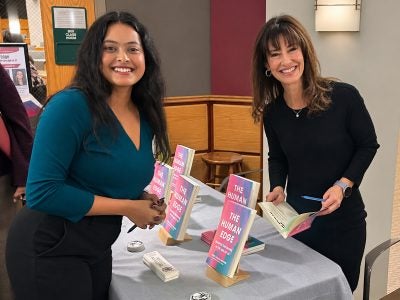
Cheryl Strauss Einhorn ‘91, right, smiles as she signs books at the Johnson School-sponsored event on November 11, 2026. Image credit: Kathryn Seely
How does AI complement our human skills without overpowering our abilities? How does society walk the fine line of upskilling with tools without losing our human essence?
Cheryl Strauss Einhorn ‘91, an author, investigative journalist, CEO and eCornell instructor, spoke about these themes at a Johnson School-sponsored event on Wednesday, November 11, 2026 in Sage Hall. Einhorn was in conversation with Johnson School faculty members Risa Mish and Laura Georgianna discussing her recently published book, “The Human Edge: Smarter Decisions in the Age of AI.” Vishal Gaur, Anne and Elmer Lindseth Dean of the Johnson Graduate School of Management, introduced the speakers.
“If you cannot think well independently of AI, you cannot think well with it,” Mish said when opening the conversation.
Einhorn, Mish and Georgianna’s discussion concentrated on the tension between AI proficiency and the need to maintain independent thinking. “There is a temptation, a great one, in a very busy world to use AI in a not so thoughtful manner,” Mish said.
Einhorn’s central message is to think first, then use AI.
“Before you sit at the tool, ask yourself these three questions. What problem am I solving? Why am I coming to the tool? Why am I solving this problem?” Einhorn said. “What are those key contextual factors that are going to make or break the decision?”
Thinking first allows the tool to provide something for the human to react to, which is really powerful, according to Einhorn. The tension comes in when human objectivity and analysis of the AI output is lacking.
“You are purpose-based,” Einhorn said. “It is only pattern-based.”
The purpose-focus lens from Einhorn’s book resonated with Georgianna.
“Our intuition, our emotions, our values. These are things that we can bring to bear [that] the AI can’t necessarily replace,” Georgianna said.
Centering humanness when using the tool by keeping specific questions or problems in mind and narrowing inquiries within AI creates better outputs, according to Einhorn. However, even the best AI outputs need to be critically evaluated for bias, inaccuracies and missing information.
“The greater specificity you use it with, the more specific the answer is going to be for you and the less time it will be on the tool as well,” Einhorn said.
Speaking to an audience of mostly MBA students, Einhorn worked to dissuade students of the common misconception that AI is going to take all the jobs.
“I think it’s a real opportunity… to be thinking about what skills and tools you have that the machine can’t have,” Einhorn said. “Where do you perform better than the machine and how can you demonstrate that? With your critical thinking skills, with really being able to develop judgment, with the way that you interrogate the output.”
These uniquely human elements; defining the problem, metacognition and interrogating outputs are muscles. Einhorn cautions that over reliance on AI, making a habit of turning to the tool without reflecting on your own thinking, can result in atrophy.
“You’re the one who has to live your life and you need to be the chief decider in your own lives,” she said.
To combat overuse of AI tools, Einhorn suggests keeping a tally of how often you’re turning to it. To her, the biggest risk of AI is the loss of confidence that you actually are a problem solver who can move successfully through the world.
Accountability and transparency are gauges for effective, not problematic, AI use, according to Einhorn.
“You want to be able to say to somebody, ‘Here’s what I’m thinking about, here’s how I used AI in this problem, here’s how I pushed back on the tool, here’s how it changed my thinking and here’s what I did next,’” she said.
Georgianna reiterated this point as the event wound down.
“If, for some reason, you are not completely comfortable expressing or sharing with those that you’re interacting with where you used AI, […] you should stop and reflect on how you were using AI,” she said.
In closing, Gaur asked who in the audience thinks AI should be banned from the classroom and thanked the brave few who raised their hands. He acknowledged that this is the dilemma facing MBA higher education.
Reflecting on the event afterward, Gaur said, “On the one hand, we want our students to learn AI tools and be skilled at them. And on the other, we also want them to be able to exercise judgment and think without AI. Our faculty are very attuned to these conflicting objectives in designing our curriculum.”
Additional reporting contributed by Alison Fromme.

In this article
Featured People

Risa M. Mish
Professor of Practice; Day Family Senior Lecturer in Business Ethics

Laura Georgianna
Teaching Professor; Executive Director of Leadership Programs at the Johnson Graduate School of Management; Donald F. Douglas Director of the Roy H. Park Leadership Fellows Program

Vishal Gaur
Professor; Anne and Elmer Lindseth Dean of the Johnson Graduate School of Management
Article Information
- Categories
-
- AI & Technology
- Inside SC Johnson
- Tags
-
- Artificial Intelligence & Generative AI
- Ethics
- Community Insights
- Faculty Areas
-
- Management and Organizations
- Operations, Technology, and Information Management
- Schools & Departments
-
- Johnson School
-
- Cornell MBA