Behavioral biases are an unseen business cost
Tianshu Lyu, new assistant professor at the Nolan School, investigates the psychological component of business decision-making.
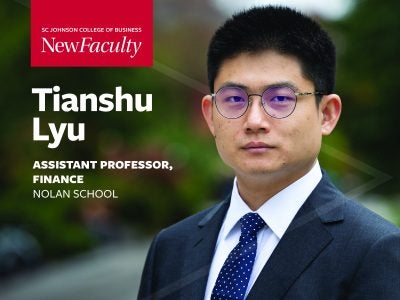
Before we can educate businesspeople to make smarter, sustainable decisions, we need to understand what drives suboptimal, bias-driven decision-making.
Tianshu Lyu’s work strives to do exactly that. Lyu, a new assistant professor of finance at the Cornell Peter and Stephanie Nolan School of Hotel Administration, part of the Cornell SC Johnson College of Business, brings expertise in behavioral finance, corporate finance, innovation and entrepreneurship. He came to SC Johnson College after finishing his Ph.D. at the Yale School of Management and plans to use Cornell’s academic resources to expand his body of behavioral finance research.
Lyu’s work has identified common psychological factors that impede clear, rational decision-making. In one study, he found that investment managers are swayed by both positive and negative news stories about their firm.
“There’s an asymmetry to this, because managers tend to be overly sensitive to bad news,” he said. “It creates this feedback loop: Managers are getting very concerned about the bad news when the firm is constrained, so they become overly pessimistic. So, this feeds into their future investment decisions, which has consequences for firm growth.”
Many conceptualize their investment decisions as wholly logical, driven by data, but Lyu’s work suggests these decisions are more emotional than we think. In general, he thinks behavioral biases are an under-recognized economic force, leading to unforeseen and far-reaching consequences.
“My research tries to show how costly [biases are],” he said. “This could lead to either a lack of innovation in the economy, or a general lack of investment and profitability that drives economic growth.”
His research is also concerned with innovation in entrepreneurship. In one paper, he examined investors’ biases towards innovative technologies. He found that when people don’t understand emerging technologies or the benefits they could provide, it disincentivizes investors to back things that could become breakthrough innovations.
“If we think about the progress of AI models right now, those models were developed five or 10 years ago, but it’s only now that we’re seeing high valuation of those companies,” he said. “So, when managers see novel technologies that are undervalued by the market, they get discouraged and tend to follow the market trend instead.”
Lyu seeks further involvement with the Entrepreneurship at Cornell community, hoping his research can assist Cornell founders. He also plans to leverage Cornell’s interdisciplinary research community to break new ground in his research.
“I have a couple of papers developing about how the private markets interact with government policies,” Lyu said. “I know the college has collaborated with the Brooks School of Public Policy, and I look forward to doing that too. My current projects come from my goal to connect finance with policy making.”
In his free time, Lyu plans to explore Ithaca’s natural beauty. He enjoys hiking and snowboarding in particular and is eager to use his Greek Peak pass this winter.
In the future, he also looks forward to exploring new questions raised by AI in his field of study.
“Does AI exhibit behavioral bias or does it actually correct human behavioral bias?” Lyu said. “There’s already a lot of interesting work on human interactions with AI, and I want to engage my students with these new developments, because if they go into industry, they’ll need to interact with AI.”

In this article
Featured People
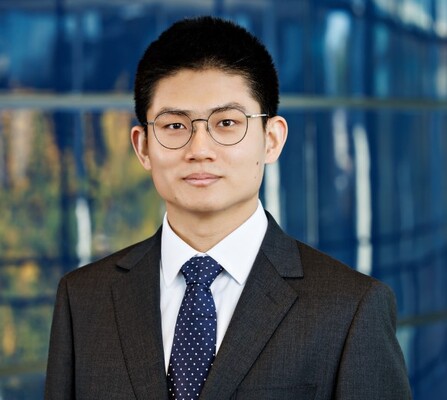
Tianshu Lyu
Assistant Professor
Article Information
- Categories
-
- Accounting, Economics & Finance
- AI & Technology
- Tags
-
- Hotelie
- New Faculty
- Artificial Intelligence & Generative AI
- Faculty Areas
-
- Finance
- Schools & Departments
-
- Nolan School