AI impacts Cornell-hosted international real estate case competition in NYC
In a world of AI, the biggest takeaways at the Cornell International Real Estate Case Competition remained human.
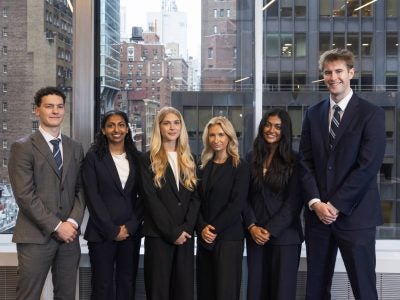
Members of Cornell's case competition team pose together in NYC. Image credit: Austin Kick '22
Decades-long real estate education traditions are evolving as AI is incorporated, but the human advantage remains.
The 18th annual Cornell International Real Estate Case Competition (CIRECC) was held Friday, Nov. 6, 2026, in New York City. The competition drew teams from Australia, Sweden and across the United States, including California and New Jersey. This year’s top honor went to the Queensland team, Auctus Partners. Second-place winners were A Dollar For A Dime from Princeton, New Jersey.
AI and its impact were major undercurrents at this year’s CIRECC case competition. Darren Wang ’12, a Cornell Peter and Stephanie Nolan School of Hotel Administration alum and one of the case writers, understood that AI would be used across teams, and he even used AI tools to extract and aggregate raw numbers when writing the case.
AI use wasn’t curbed for the competition, but the competition format evolved in response to AI, according to Wang. After the traditional preliminary rounds in the morning, the finalists from each room were given additional information to incorporate in the afternoon session. Each team of finalists gave their presentation and then spoke for an additional three minutes on the new data.
“The intention was, you had what you thought was happening, and now something has changed. We need a quick decision on how we want to proceed,” Wang said. “We knew that even in those 20 minutes, if they pull out a laptop, they can probably get some sort of framework, but we wanted to give them a short enough period of time that it would at least somewhat restrict their ability to have it all done for them [by AI].”
Second-year participant and Cornell team co-captain, Esha Patel ’27, acknowledged that her team used AI, but that they were not as AI-heavy as other teams she encountered at the competition.
“I feel like the slippery slope is if you don’t understand real estate and you do a real estate case competition and you make AI do your entire thing, you don’t understand anything that’s going on,” Patel said.
Peng (Peter) Liu, the Cornell team coach, likened AI to an open-book test. He believes that the comprehensive nature of the case competition accounts for AI assistance.
“You can be assisted by AI, but you have to be the owner of it. Understanding, interpreting, communicating, justifying those facts, those decisions, the logic behind it,” he said.
AI is just the latest way to enhance productivity, according to Liu. He said that he sees AI as a leveler enabling teams to focus more on the question and answer portion of the competition. That portion of the competition is where teams prove their understanding of the case by defending and validating their conclusions, Liu said.
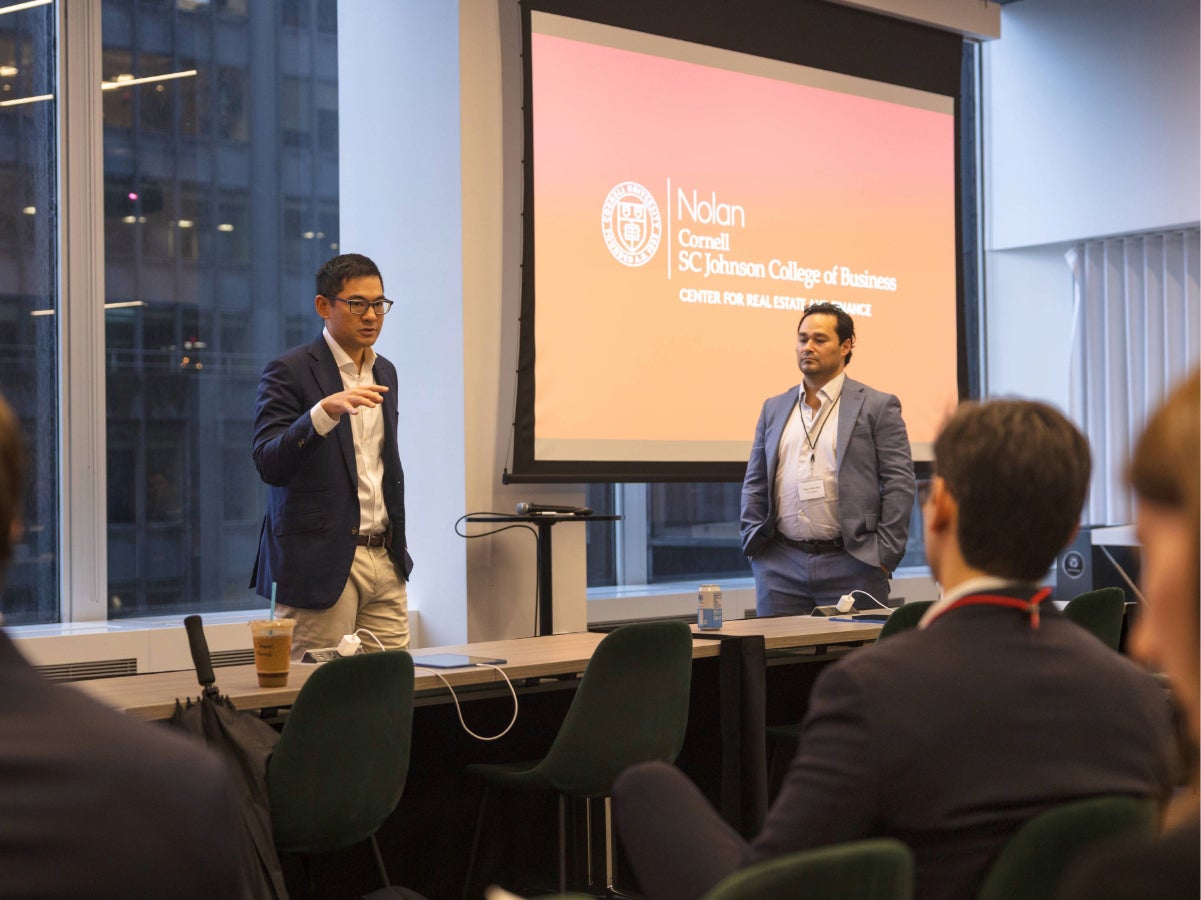
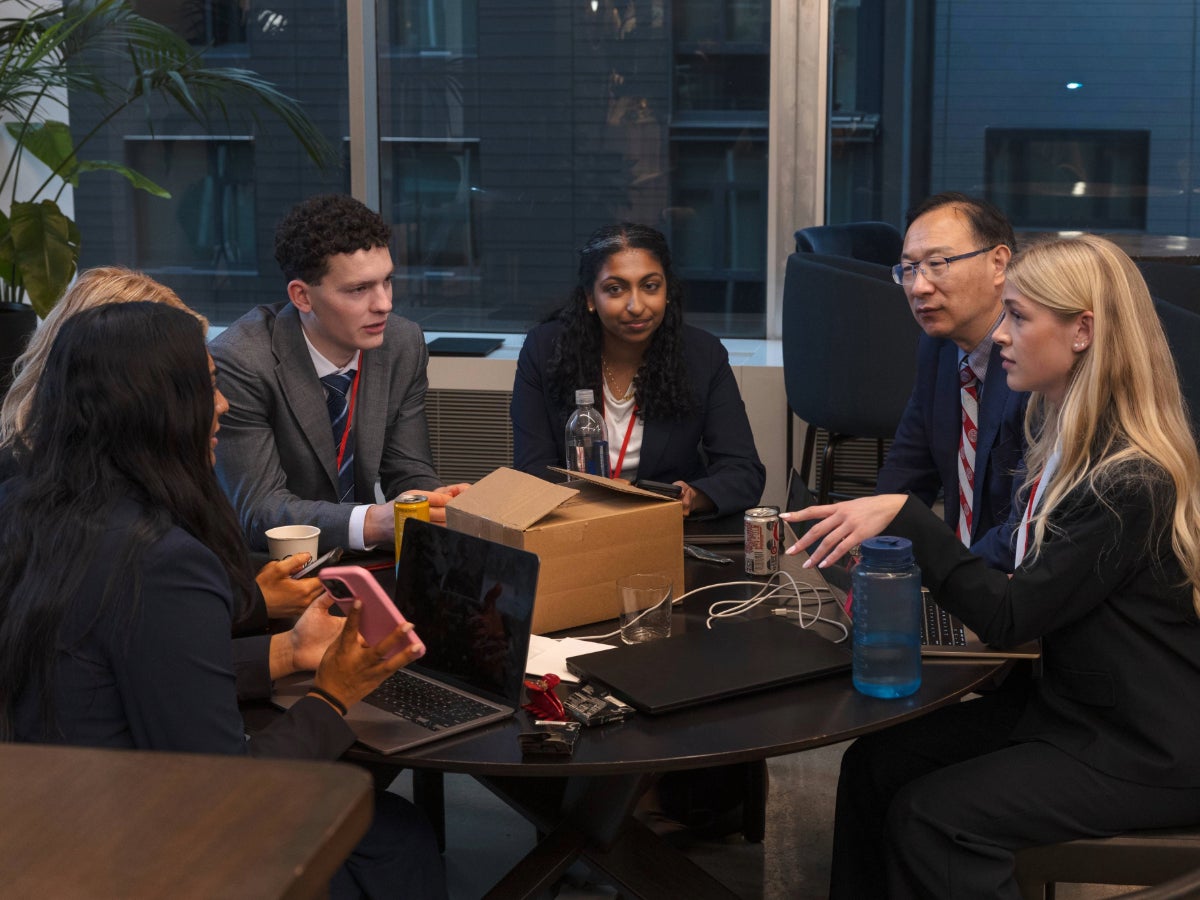
Reflecting on her experience last year at CIRECC compared to this year, Patel is not sure how organizers at this case competition, and others, would even control AI use, and she questions how competitions need to change to accommodate the technology.
“If there are no limitations to using AI, it’s kind of just who’s the best at prompting, which I don’t think does anything for the students’ education and learning for the industry of real estate,” Patel said.
AI aside, Patel finds immense human value in events like CIRECC.
“Doing cases is the best way to take two weeks to get a deep dive on any asset class and actually understand it from soup to nuts,” she explained. “I think it does a lot for understanding real estate, but also on the presentation and professionalism side, it’s an unbelievable experience.”
The chance to improve professional skills, gain confidence and network with peers from around the globe elevates the Nolan School education, according to Patel.
She marveled at the networking opportunities at the reception the night before the competition.
“We keep hearing it’s all relationship-driven and who you know, and it’s a big networking industry, and I think we see that at the hotel school,” Patel said. “But when you’re thrown into this environment where it’s literally 120 students from other universities […] you really see how well the Nolan School prepares you for this and how cool the opportunity is to network.”
The tone the next morning at the competition was noticeably different. Patel said the air was tense, but that the Cornell team doesn’t let the competitive nature rattle them.
“Every team is very segregated. They’re practicing, they’re quiet, they’re whispering, they’re making sure that they’re all prepped,” Patel said. “And I think our team has always pivoted away from the competitive aspect and is more focused on just producing our best work, and I think we all felt proud of what we put up there.”
Alexander Wright ’27, Patel’s co-captain, agreed that being in the city, networking with a diverse collection of real estate students and answering on-the-spot questions from the judges was incredibly rewarding.
“I’m most proud that our team worked through every part of the deal together to create a strong product to present,” he said. “Working through this case was an opportunity for our team to face a challenge together and work through the entire deal process, from ideation to specific business plan execution.”

In this article
Featured People

Peng (Peter) Liu
Singapore Tourism Board Distinguished Professor in Asian Hospitality Management; Academic Director for Cornell-Peking MMH and MBA; Faculty Research Director, Cornell SC Johnson Center for Real Estate and Finance; Deputy Area Chair of the Applied Economics and Policy Area; Editor, Journal of Real Estate Portfolio Management
Article Information
- Categories
-
- AI & Technology
- Tags
-
- Artificial Intelligence & Generative AI
- Hotelie
- Real Estate
- Business leadership
- Faculty Areas
-
- Applied Economics and Policy
- Finance
- Schools & Departments
-
- Nolan School
-
- BS Hotel Administration