How the Cayuga Fund helped me develop an investor’s mindset
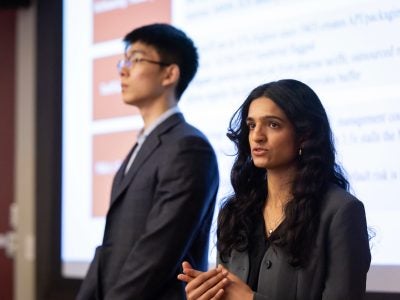
Phalguni Miraj (right) and Tom Zhang present to the Cayuga Fund class. Image credit: Chris Kitchen.
By Phalguni Miraj ’26
The Cayuga Fund was one of the most rewarding experiences of my time at Cornell. It is a rare opportunity in college to move beyond theoretical finance and step into the role of an investor, managing a portion of Cornell’s endowment. Through lectures from Scott Stewart, clinical professor and academic co-director of the Parker Center for Investment Research; visiting lecturer A.J. Edwards; and visiting senior lecturer Christopher Meredith, as well as insights from guest speakers and alumni, I gained a deeper understanding of how investors think about risk, portfolio construction and decision-making in practice.
I joined the Cayuga Fund seeking a way to bridge the gap between classroom learning and real investment responsibility. While I developed a strong interest in asset management and private equity through coursework and internships, I wanted to experience applying those concepts in a live portfolio setting. The Cayuga Fund felt like a blend of a classroom and a real investing role because we applied concepts while managing capital.
Applying investment theories in practice
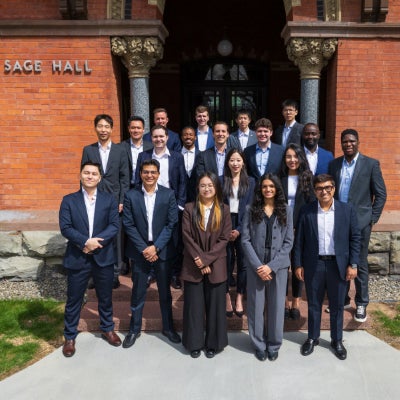
As an energy, materials, utilities and telecom sector lead, I was responsible for covering a diverse set of industries, many of which I had not previously studied. Our sector faced the challenge of balancing the fund’s fossil fuel-free mandate with its benchmark against the Russell 2000, which includes significant exposure to traditional energy companies. I worked through this challenge by identifying companies adjacent to fossil fuel exposure and adjusting subsector weights to better align the portfolio with benchmark characteristics.
I also was a member of the performance team, where I contributed to analyzing returns using attribution models such as Brinson and MSCI Barra factor analysis. Through this work, I became familiar with how allocation decisions, stock selection and factor exposures affected performance versus the benchmark.
The Cayuga Fund strengthened my ability to think independently and take accountability for investment decisions. As a sector lead, I was responsible for leading due diligence on top-ranked stocks, identifying data- or news-driven adjustments and contributing recommendations during the rebalancing process. Because our recommendations affected a live portfolio, I became comfortable defending my views and communicating clearly with teammates.
Lessons beyond the classroom
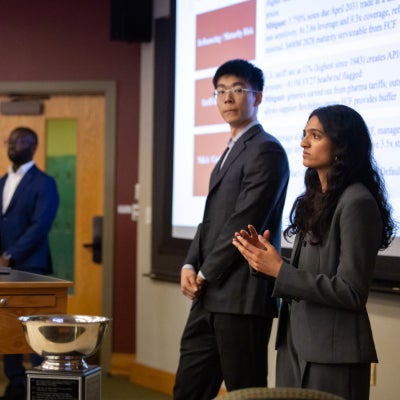
Working on the Cayuga Fund, I valued the combination of fundamental and quantitative investing approaches. Combining these approaches helped me think about investing broadly instead of relying only on traditional valuation frameworks. Equally valuable was the opportunity to work alongside highly motivated peers, where constant idea-sharing and open discussion elevated the quality of our investment thinking.
The experience strengthened my interest in pursuing a career in investment management and private equity. The skills I developed, ranging from financial analysis and portfolio construction to teamwork and investment communication, apply to both public and private market investing. More than anything, the Fund changed the way I think about investing by pushing me to be more curious, disciplined and oriented to the long term, all of which I will carry with me into my career and my personal investing journey.
About the author
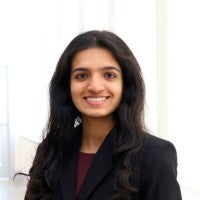
Phalguni Miraj ’26 is a graduate of the Charles H. Dyson School of Applied Economics and Management in the Cornell SC Johnson College of Business. As a member of the Cayuga Fund in the Parker Center for Investment Research, she was the head of the energy, materials, utilities and telecom sector and a member of the performance team. In the summer of 2025, she interned in the private equity group at Goldman Sachs, where she returned full time after graduation. She previously completed private equity internships at Arsenal Capital Partners (health care team) and North Haven Capital. On campus, she was a teaching assistant for the course Entrepreneurial Finance and Private Equity. She also was a mentor for the Society for Women in Business and was the president of Asha at Cornell, a nonprofit supporting education for underprivileged children in India.
Article Information
- Categories
-
- Blog Posts