From silence to conversation: Cornell’s pre‑college family business course
By Carol Wittmeyer and Daniel G. Van Der Vliet
This summer, the Smith Family Business Initiative offered two courses for high school students: Future Founders: Leadership & Innovation Toolkit, taught by Brad Treat, visiting lecturer, and a follow-up course, Family Business Foundations from Generation to Generation, taught by Carol Wittmeyer, a Cornell Family Business Fellow, and Daniel Van Der Vliet, the John and Dyan Smith Executive Director of Family Business at the SC Johnson College of Business.
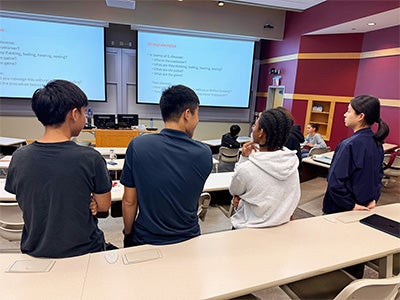
Offered through the School of Continuing Education’s Pre-College Studies Program, the courses were designed for high school students who are critical stakeholders in family businesses yet rarely receive the frameworks and peer support to think strategically about this dimension of their futures. The Family Business Foundations course brought high school students from around the world for a three-week residential program to develop skills to begin conversations about succession, expectations, future roles and shared vision.
A rigorous curriculum grounded in real cases
People in family businesses often associate the word “conflict” with business discussions; however, among students gathered for the Family Business Foundations course, the word did not appear at all. Instead, they offered responsibility, wealth, generation, heritage, collaboration, governance and legacy. This perhaps reflected a positive mindset within a cohort seeking to improve communication and family engagement.
Over three weeks, students worked through frameworks via real case studies. Perry’s Ice Cream showed how the fourth-generation business formalized governance, transforming ambiguous succession into a predictable process. Stewart’s Shops illustrated how a family business can transition ownership to its employees. In a mock called “O’Bannon,” teams advised families on immediate CEO transitions. An accountability matrix activity provided students with a tool to help families and businesses define roles and welcome the first non-family president. Throughout these cases, students learned a critical lesson: Clear communication about expectations, roles and governance structures prevents misunderstandings that can damage businesses and families.
Wisdom from the field: Bringing cases into the classroom
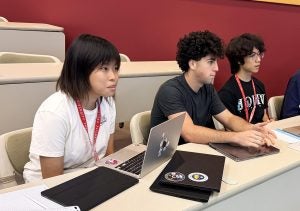
The classroom came alive when students heard from people who had navigated the questions they were beginning to ask themselves.
Holly Isdale ’86, a family office CEO and SFBI Family Business Fellow, emphasized that in family business, integrity and kindness are foundational, not optional. They attract talented employees, build loyalty and create trust for difficult conversations that are essential in every family enterprise. Reagan Stitt, a KPMG associate and a member of the family that owns Cutco, a third-generation cutlery business in upstate New York, highlighted the importance of both internal and external experience. Working within a family business provides firsthand understanding of its culture and context, while experiences outside the business offer opportunities to see different approaches and learn from other organizations. When students asked her for college advice, Stitt encouraged them to join business consulting clubs, maintain family business connections and communicate openly about navigating both worlds. Michael Wittmeyer (the instructor’s son), meanwhile, shared his high school entrepreneurial journey and how he scaled JM Bullion to more than $1.5 billion prior to an external sale. What resonated most with the students was his message about perseverance — refusing to quit when survival felt precarious. Together, the speakers offered students practical lessons on building trust, gaining perspective and persevering through challenges.
Field experiences: Values and communication in action
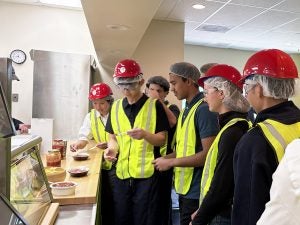
Students also stepped outside the classroom and saw family business values in action through visits to two family-owned companies.
At Giovanni Foods, CEO Lou DeMent emphasized the importance of core values, endless curiosity, openness to feedback, and treating people with respect and integrity. He emphasized that maintaining transparent, honest communication with employees and family members is essential to living these values. During their tour of the manufacturing facility, students met with employees and DeMent’s children and witnessed these values in action. DeMent also shared his story about his father’s unexpected death and highlighted the importance of emergency succession planning. He offered students a final insight: “Innovation is not a one-time event; it’s a culture that must be maintained.”
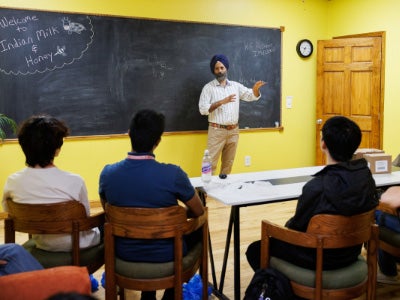
At Indian Milk and Honey, founded by Amrit Singh and Ipshita Pall, students witnessed how family values become embedded in every operational decision. The Singhs’ guiding principle to “say what you do and do what you say” is fundamentally about communication and integrity. Students learned that values aren’t abstract; they are the DNA of the business, transmitted through clear, honest and consistent operations that align with those values.
Student transformation: From silence to conversation
Students left the course ready to have conversations they had been avoiding. Some began asking, “Can I integrate what I love into my future career?” as they considered entrepreneurial ventures. Others whose families avoided discussing the business realized the cost of silence and committed to changing that pattern. The course broadened their view of what a future in family business could look like. Along the way, they found peers with similar experiences and questions and departed with greater clarity and momentum toward more open family dialogue.
“Taking this course was one of the most meaningful experiences in my academic journey. It was the first time I truly understood family business at a deeper level, from the three-circle model to how a family genogram reveals family dynamics. The most valuable lesson was learning how to communicate with family in the right way.”
— Gilbert Tu, student
Why early family business education matters
While family businesses dominate the global and U.S. gross domestic product (GDP), business curricula often ignore this reality. However, high school students are well-positioned to engage with this education — but with important caveats. At this stage, students have limited experience and may be years away from making meaningful decisions about their own roles in a family business. At the same time, knowledge of family business education remains limited: Compared to the Future Founders course, which had 44 students enrolled, the Family Business Foundations course only had 13 students. The opportunity, then, is not simply to introduce family business concepts earlier, but to build awareness and interest while giving students a foundation they can draw on as they gain experience and eventually face these decisions themselves.
“This course was an experience I would not trade for the world. Family business education is not always given the attention it deserves in schools or the broader workforce, but this program helped me recognize the importance of the field and take greater pride in my connection to it. I left Cornell with increased confidence, a stronger professional skill set and valuable knowledge that will continue to shape my education, career and contributions to family business.”
— Taryn Burns, student
Article Information
- Categories
-
- Blog Posts