Why emerging markets are the most exciting place to study business right now
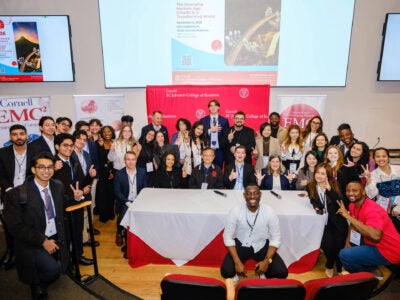
EMC case participants with Lourdes Casanova and other judges. Image credit: provided by author
By Ayobamigbe Teriba, MBA ’27
Four reasons why students are drawn to emerging markets at Cornell:
- Lourdes’ exceptional leadership as the center director;
- Emerging markets are at the center of growth and productivity
- Globalization has interconnected people and unlocked curiosity;
- The Emerging market story is cool to experience and learn.
Twenty-five years ago, a Goldman Sachs economist Lord Jim O’Neill, grouped Brazil, Russia, India and China into a single idea called BRIC. Together they made up less than 10% of the world’s output, and he argued they would grow much faster than Western economies. This April, Lord O’Neill joined Andrew Karolyi, Charles Field Knight Dean of the Cornell SC Johnson College of Business for a conversation at Cornell as the EMC 2026 Distinguished Fellow.
The world’s center of gravity has moved
His verdict on the first 25 years is a lesson in promise and humility. As he told Fortune, China and India outran his own projections. Since 2000, output per person has grown 554% in China and 246% in India, compared with 45% in the United States and 30% in continental Europe. Brazil and Russia, by contrast, now hold the same share of world output as when he named them. He jokes that the group should have been called just India and China.
The wider picture points the same way. According to S&P Global, the ten largest emerging economies produced about 13% of the world’s output in 2000 and 31% by 2023. The International Monetary Fund expects China and India alone to supply about 44 percent of global growth in 2026. By 2030, these ten economies are expected to hold half of the world’s population. O’Neill sees India enjoying a “clear 15 to 20 years” of young-population advantage, with growth of 7 – 8% a year.
Emerging markets are growing fast and steady
Most students can name a country they have lived in, worked in or whose family comes from there, and it carries the emerging label. That was the message when Wim Vandenhoeck spoke at a Leaders in Emerging Market class, as head of emerging market debt at the investment firm Invesco. He argued that emerging economies have rebuilt their foundations. The number of emerging countries with formal inflation targets rise from five in 2000 to 34 in 2022, and government debt in China, India and Brazil is 84-99% of annual output, versus 124% in the United States.
The results backed him up. From 2023 to 2025, emerging market government bonds issued in dollars returned about 10% per year, against 4% for the global bond market. In 2025, emerging market bonds gained 34%, ahead of U.S stocks at 18%. Through the pandemic, the war in Ukraine and this year’s Middle East conflict, these bonds took hits but kept recovering. While past results never guarantee future ones, but engaging classmates and contributions from class drawn from professional experiences underline that much of what is reported they comes from preparation and policy, not luck.
Americans are looking outwards for growth
Timing is also providing a tailwind for emerging markets as more Americans, in classrooms and boardrooms, are looking beyond their home market and asking where the next opportunities lie as the world becomes more integrated. A notable example is cited from article from the Cornell center described how India’s small neighborhood shops use phone apps to order goods exactly when they need them, a model larger retailer in wealthier economies could learn from. These economies are no longer only learning from the West. For students, that opens a door for original research and career paths that few people have explored.
Studying emerging markets is a practical preparation for the world we will work in. Students who understand how business operates in Lagos, Jakarta and Bogotá will be better managers, investors and colleagues wherever they end up. Emerging markets can be unpredictable, and progress is uneven. That is exactly why they deserve careful study. Risk and opportunity sit side by side here, and learning to weigh both is a skill any employer will value.
Emerging markets institute has given students a platform to lead
At Cornell, the Cañizares Center for Emerging Markets, led since 2014 by Professor Lourdes Casanova, a generous teacher who backs students when they want to lead. At the center’s annual conference in New York City students served as chairs of the case and pitch competitions. In the case competition, teams from business schools worldwide solve a real company’s challenge and at the just concluded edition more than 1,300 students from 21 countries registered with Fourward Thinking from Cornell (USA) winning the case competition, second place was Trinity from Sadar Padel Institute of Technology (India) in second place and third place was Andes Goats (Colombia).
Emerging markets is a practical preparation for the word we will work in and as Brazil and Russia reminds us-is that emerging market does not mean guaranteed, and Vandenhock says the same: policy credibility and careful choices separate winners from losers.
About the author

Ayobamigbe Teriba is a class of 2027 two-year residential MBA student at the Cornell Samuel Curtis Johnson Graduate School of Management, focused on emerging markets and sustainable global enterprise. He is interested in go-to-market strategy leading business expansion, revenue operations and growth that helps companies scale. Before the Johnson School, he worked across Nigeria, South Africa and the Netherlands, investing capital sourced using different instruments like syndicate financing, venture capital and sovereign backed impact.
In this article
Article Information
- Categories
-
- Blog Posts
- Schools & Departments
-
- Johnson School
-
- Cornell MBA