EIR Spotlight: Brandon Barton ’03
Hospitality tech entrepreneur Brandon Barton ’03, CEO of Bite, has devoted his career to making restaurants more successful.
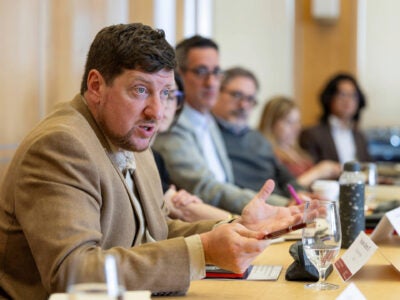
Brandon Barton ’03, an Entrepreneur in Residence from 2020 to 2026, participates alongside industry leaders and faculty in a Restaurant Technology roundtable discussion.
By Sandi Mulconry
Brandon Barton ’03, an Entrepreneur in Residence from 2020 to 2026, has used his experience working in operations at top hospitality groups to build and scale early-stage tech products that help restaurateurs.
His career has included stints at Patina Group, Union Square Hospitality Group, Avero and Resy. Today, he is CEO of Bite, the best-in-class digital ordering solution for restaurants,
Below, he discusses his journey.
Did you have entrepreneurial leanings as a student?
I’d like to think so. I started in the Duffield College of Engineering and then transferred into the Nolan School of Hotel Administration. My four years at Cornell, I parked cars at the Statler bell stand. And for two semesters, I was social chair of my fraternity. I always had the desire to spend my time wisely.
My senior year, the basketball team needed senior leadership, and I was invited to join based on my intramural play. That was a blast. It was so much fun to travel around to all the other Ivy League campuses and play Division One varsity basketball, which had been a dream of mine.
As I progressed through the Hotel School, like many others, I dreamed of owning my own restaurant.
Were there particular professors or classes that inspired you?
One of the classes I always refer back to is Professor [David] Sherwyn’s law class. There are so many things I recall from that class, particularly around employment law.
And Giuseppe [Pezzotti] had this wonderful Wine and Food Pairing class, which has been influential throughout my career. I went into the restaurant world as a beverage professional — the seeds of that interest were sown by his class.
Did you have internships?
The most influential was a food and beverage internship with Universal Studios in California. Four or five Hotelies got the internship, and we all moved out there and lived together for the summer.
It was an incredible experience to see the back side of their operation. Being in Los Angeles was just special. … It was a nice group and a great summer.
What did you do after graduating?
Immediately after graduating, I worked for Patina Group in the restaurants at Rockefeller Center. I was a manager of the Rink Bar, where we had the busy summer season and then the busier winter season. I spent two years with that organization.
And then you joined Danny Meyer’s Union Square Hospitality Group.
Yes. One of the best things about Cornell is its network. I had called two friends, who told me that Jeremy Adler ’03, whom I’d become friends with in the Wine and Food Pairing course, had positions open at Tabla. … And so, I went to work at Tabla under Floyd Cardoz, the late great Chef Floyd.
I have two books back here (pointing): “Setting the Table” by Danny Meyer, with all the lessons he taught us, and “Unreasonable Hospitality” by Will Guidara ’01, who built Eleven Madison Park into the world’s number one restaurant. What’s amazing is I didn’t just read those books; I lived through them.
How, then, did you get into tech?
As beverage director of Tabla, I had to be well-versed in technology and computers. I really loved working with spreadsheets and finance and so forth.
One day, when I knew my time there was up, Avero’s CEO came in for lunch. Tabla’s general manager, Terry Coughlin, suggested that he talk with me. I spoke with him and privately told Terry, “I don’t want to be part of the POS (point of sale) world.” And here I am 20 years later, and that’s all I’ve done and what I love; it’s the most passionate piece of this for me.
I didn’t strive to get into tech, but I spent about seven years at Avero [rising to senior regional sales manager] and learned to love it. Every year, I went back to Cornell to recruit — some of those recruits are still my closest friends. We brought in as many Cornell students and graduates as we could for internships and full-time positions. It was there that I learned to love sales and tech — and to teach restaurateurs how to use tech to make their businesses more profitable.
That’s the thread running through my career. I’ve always tried to make restaurants more successful — first when I operated them, and then giving them the tools to do that.
What led you to Resy?
While at Avero, I tried to start a business on the side with a friend. We had a concept, but it looked like Resy was already doing part of it. When I heard that Resy wanted to learn more about POS integration, I convinced their CTO to meet with me. And when I got there, I said, “Look, I want to be honest. I think I want to work for you.” I became Resy’s fourth employee and, over the next three and a half years, had an incredible run of learning how to start a company.
And now you’re CEO of Bite.
Bite was looking for a consultant when I interviewed with them. But when I saw they had a kiosk product that was way ahead of its time, I pitched them on joining full time. I became COO in 2018 and shortly thereafter — owing to my startup experience at Resy — was named CEO.
How did you get involved with the Pillsbury Institute for Hospitality Entrepreneurship?
I’ve always looked for ways to lift people up as I continue to grow my career. And so, when I learned there was an opportunity to become an Entrepreneur in Residence, I jumped on it.
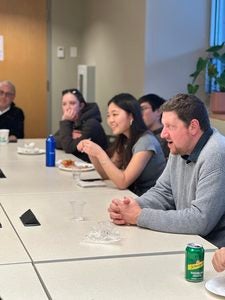
I’ve met with students virtually and in person and served as a judge for the Hospitality Pitch Deck Competition. Whenever I come to campus, I lecture in a class or two and give a version of my life story: how I came from humble beginnings and worked at a restaurant [busing tables] to now being CEO of a business. It was a twisty, windy road — it wasn’t a straight line. Students probably think that you go from point A to point B. But it’s really A to X to Z to Y to H. And then you get to B.
It’s been a pleasure interacting with students and learning how they think, and maybe helping them and influencing their careers. I love that there’s a place on campus to foster students’ entrepreneurial instincts.
What advice do you give them?
It varies, depending on what they’re trying to do. Often, it’s just listening, and then taking their thoughts and putting them into a structure that helps them connect the dots.
Why are student-industry interactions so important? As we learn more, if we don’t give back and teach others, then we’re interrupting the cycle of progress. I think students need mentorship. And mentors need that warm feeling that comes from giving back.
In this article
Article Information
- Categories
-
- Blog Posts
- Schools & Departments
-
- Nolan School