From campus energy to global systems: The Global Sustainability Challenge at Stanford
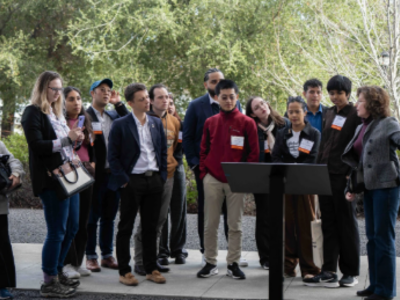
Participants tour the central energy facility at Stanford University. Photo credit: Will Carnahan.
With support from the Center for Sustainable Global Enterprise, I represented Cornell’s Samuel Curtis Johnson Graduate School of Management at the Americas regional finals of the Global Sustainability Challenge (GSC), a Doerr School of Sustainability initiative at Stanford University. The challenge brings students from leading universities to apply their coursework and design solutions to two of the most urgent climate priorities: sustainable energy and climate adaptation and resilience. The experience was both energizing and humbling. Teams presented ideas ranging from ocean-based renewable energy and flood resilience technologies to AI-enabled climate systems. Each project reflected the same underlying question: how do we move faster from climate ambition to implementation?
Our team presented Pendulum, a decision-support platform designed to help campuses and industrial facilities evaluate pathways to decarbonize energy systems. While technologies such as hydrogen and carbon capture are often discussed as solutions, decision-makers still struggle to compare them in a cost-efficient way. Pendulum accelerates this process by modeling tradeoffs between cost and emissions reduction. The feedback we received from judges and mentors was one of the most valuable parts of the experience. One key insight was the importance of feasibility before optimization. Climate technologies often appear interchangeable in theory, but in practice, their feasibility depends on local constraints such as geological storage availability for carbon capture or access to large volumes of renewable electricity for hydrogen production. A credible decision-support tool must account for these physical realities before comparing economic outcomes.
Key takeaways: Interdisciplinary climate solutions
We also learned the importance of interdisciplinary collaboration for sustainable solutions. Speakers emphasized that solving climate challenges requires more than engineering breakthroughs. Policy, behavioral science, finance and institutional leadership are all critical.
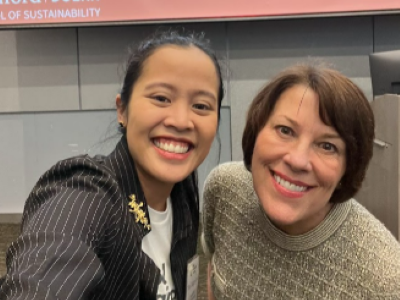
During the keynote conversations, leaders such as Ann Doerr and Stanford Graduate School of Business Dean Sarah Soule, who earned a doctorate from Cornell in 1995, highlighted how climate progress often emerges through collective action and institutional partnerships rather than individual technological inventions. Their message resonated strongly: Changing systems requires not only innovation, but also social movements, coalition building and long-term commitment.
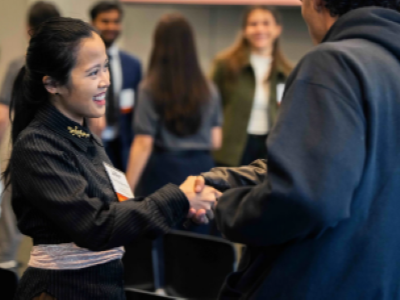
The experience at Stanford reinforced why I chose to pursue an MBA focused on sustainability and to get involved in the Sustainable Global Enterprise Club. Climate solutions do not move from laboratory to deployment automatically. They require leaders who can bridge disciplines, translate technical insights into strategic decisions and mobilize organizations to act. The Global Sustainability Challenge offered a glimpse of that future. Students from engineering, business, policy and environmental science tackled complex problems that no single discipline can solve alone.
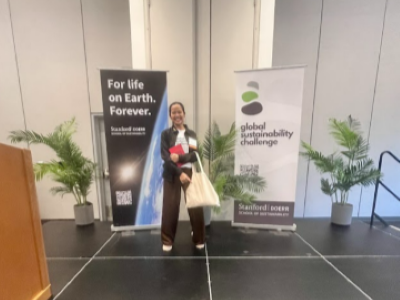
As climate challenges intensify, spaces like this matter. They help build the next generation of leaders who will turn ideas into implementation. The competition reminded us that innovation is not defined by a single outcome or award. It is defined by the willingness to test ideas, learn quickly and continue building solutions long after the competition ends. That work has never been more urgent.

Tika Diagnestya, MBA ’27, of Jakarta, Indonesia, is an MBA student in the Samuel Curtis Johnson Graduate School of Management. At the Johnson School, she focuses on embedding sustainability strategies in technology and innovation spaces. Prior to her MBA, she worked in the sustainability and consulting industry. She was a finalist for the Americas regional final of the Global Sustainability Challenge at Stanford University.
Article Information
- Categories
-
- Blog Posts