Power forward: Rethinking clean energy for emerging markets
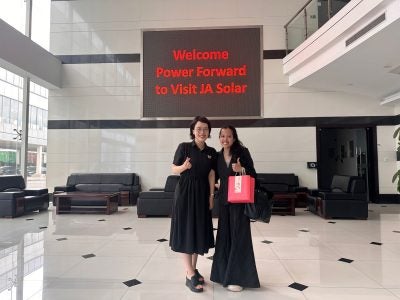
Tika Diagnestya (right) visits one of the four largest solar PV factories in China. Image credit: Tika Diagnestya.
By Tika Diagnestya, MBA ’27
On a small prototype in Indonesia, a screen displays three live measurements: electricity from a solar panel, electricity flowing through a battery and electricity going to an inverter. A few weeks earlier, I was standing inside clean-energy factories in China asking manufacturers a seemingly simple question: Could these technologies eventually work together to help communities in Indonesia access renewable energy more reliably?
Such is the question posed by PowerForward, a startup that explores how distributed renewable energy can become more accessible in emerging markets, beginning with Indonesia. China offered a unique environment to expand the venture because so much of the global solar, battery and energy-management ecosystem is concentrated there.
With support from the Cañizares Center for Emerging Markets (CCEM), I spent another part of the summer working full time on PowerForward through the Johnson Summer Startup Accelerator. My China internship focused on renewable-energy integration, pricing and dispatch structures, and developing relationships with potential technology partners.
Adoption starts with people, not technology
One of my first conversations was with Peggy Liu, chair of JUCCCE, a nongovernmental organization that has worked across clean energy, smart grids, sustainable cities and consumer behavior in China. Our conversation made me think beyond technology. Clean-energy adoption is also a human challenge. Technologies need to fit people’s lives, economic realities and communities.
That perspective followed me into China’s energy ecosystem. I started asking what would make it useful somewhere else. Across factory visits and supplier meetings, I saw that much of the physical infrastructure PowerForward would need already exists:
- Solar PV modules at massive manufacturing scale
- Lithium iron phosphate battery storage systems
- Hybrid inverters and automatic switching
Initially, I asked manufacturers questions such as:
- Can the system automatically switch between solar, battery and grid power?
- Can it continue operating when the internet goes down?
Repeatedly, the answer was yes, so I shifted the conversation from sourcing to partnerships. Instead of becoming another hardware company, perhaps our opportunity is to integrate existing technologies and focus on the layer that determines how energy is monitored, allocated and paid for.
The hardest question may be the business model
While I was developing our technology and partnership pipeline in China, other members of the PowerForward team were testing the business case. Ammara Hanna, a recent international business graduate of the University of Groningen in the Netherlands and the Bandung Institute of Technology in Indonesia, examined models for making distributed energy accessible without requiring every household to purchase expensive infrastructure. She also explored how we can make renewable energy more visible in public parks to build community awareness.
Audrey Kercher, a Cornell senior studying sustainable business and environmental economics, worked on profitability modeling and explored capital and operating expenses, customer payments and scalability.
At Shanghai Jiao Tong University, I met Mo-Yuen Chow, Ph.D. ’87 and his team and visited a laboratory researching resilient microgrids, distributed optimization and dynamic energy management. The laboratory showed how energy-management systems can dynamically allocate limited electricity across different resources and loads.
“I think at the end it’s the business model you are trying to do.”
— Mo-Yuen Chow, Ph.D. ’87, professor, Shanghai Jiao Tong University
I left thinking less about sophisticated algorithms and more about fundamental questions: Who owns the shared battery? Who should pay for the battery? How should electricity or savings be allocated? Those questions became more important than whether we could add artificial intelligence to the system.
From learning to growing: Building between emerging markets
The most exciting part of the summer was seeing these lessons begin to move from conversations into something impactful for others. Working with Marthen Beily, an assistant professor from Politeknik Negeri Kupang, a technical institute in Indonesia, we have begun developing the technical foundation for a community pilot. Beily’s students have developed a smart-grid prototype that measures electricity flows across a solar photovoltaic system, batteries and an inverter. The prototype can display power entering and leaving different parts of the system, creating the foundation for testing how electricity could eventually be monitored and allocated.
The next challenge is connectivity. If these systems eventually operate in communities where Wi-Fi is unreliable, they must be able to collect data and make basic decisions locally rather than depend continuously on the cloud. The work is also generating deeper academic inquiry. More than two master’s and doctoral research papers are now being developed around different aspects of the project.
For me, this is where the pieces of the internship come together. Questions raised in Indonesia informed what I asked partners in China. Chinese suppliers showed us what hardware and interfaces already exist. Chow’s research helped sharpen how we think about energy management. Our marketing and finance team tested whether the economics could work. Our technical team is now helping translate those insights into something we can test.
I returned from China with a pipeline of potential partners, a clearer technology architecture and several overturned assumptions. Our next step is not to immediately build a large microgrid. It is to use the prototype to collect data and understand electricity consumption, solar generation, battery behavior, connectivity, tariffs and eventually the economics of sharing energy.
I am deeply grateful to the Cañizares Center for Emerging Markets and to Gail and Roberto Cañizares ’71, MBA ’74, whose support of summer internships in emerging markets allowed me to expand PowerForward inside one of the world’s most important clean-energy ecosystems.
About PowerForward
PowerForward grew through the Johnson Summer Startup Accelerator and brings together a cross-disciplinary team working across technology, research and business development. Diagnestya leads venture strategy, customer discovery and partnerships, including supplier and academic partnerships developed through her internship in China. Marthen Beily and his university research team lead technical pilot development, including a smart-grid prototype for monitoring solar, battery and inverter power flows. Hanna supports business case development, while Kercher leads profitability and financial modeling. Noah Bolger leads the policy and science analysis behind the team, while two on-the-ground local consultants Tifani Lusiana and Widi Ginanjar lead the rural site research in Indonesia. The broader project has also engaged researchers and students developing four Ph.D. and master’s research papers related to the pilot.
About the author

Tika Diagnestya is a second-year MBA student at Cornell University’s Samuel Curtis Johnson Graduate School of Management, originally from Indonesia. Diagnestya completed her undergraduate degree in economics. She has built her career across sustainability, consulting, technology, and partnerships, working on climate and social impact initiatives in emerging markets.
Article Information
- Categories
-
- Blog Posts
- Schools & Departments
-
- Johnson School