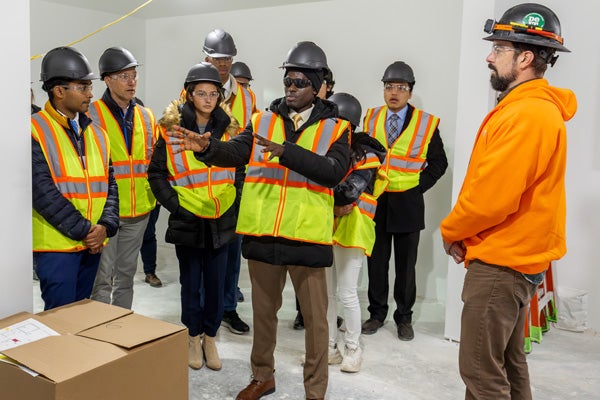
The Charles H. Dyson School of Applied Economics and Management established the Grand Challenges Program to provide experiential learning opportunities for undergraduates related to sustainable business. Students apply their skills to pressing societal challenges while strengthening their professional skills.
Each year, student teams complete approximately 50 semester-long projects with external partners. Non-profits, NGOs, startups, companies of all sizes and organizations from across the globe are encouraged to submit a project proposal.
All projects meet the following criteria:
Working with a real client or partner on an issue with direct human impact in the community where the work takes place
Well-defined scope and clear deliverables guided by a challenge question
Integration with relevant topical course content
Team-based work with a critical reflection component
Grand Challenges project teams have worked on topics that include corporate finance, market research, consumer discovery/behavior, decision-making, strategy, data analytics, innovation or new product development and operations. Students have also supported organizations in concept development, social media or website development, incorporation or tax status determinations, business plan development, competitive analysis, event planning or fundraising and community engagement.
For more project stories and updates, follow us on LinkedIn.
If approved, the project liaison for the organization will meet with a member of the Grand Challenges Program team and the faculty advisor before the semester begins for final scoping, introductions and an orientation to the program.
Post-approval process
Students receive a project prospectus based on the approved proposal and teams are formed.
Students spend the first several weeks of the semester developing professional skills to support the project and completing research to prepare for the project kick off meeting. This meeting is attended by the team, their MBA coach, a member of the Grand Challenges Program team, the faculty advisor, the project liaison and other relevant stakeholders at the client’s organization.
After the meeting students work on agreed-upon deliverables. The team meets with their project liaison at least four times during the semester to share project updates and seek feedback.
Teams deliver a final presentation and hand off deliverables to the client at the end of the semester.
“The Grand Challenges Program is an excellent way for students to connect and work with businesses to help solve some of the biggest issues facing our world today. From what we experienced, these students are going to change the world.”
Tommy Freeman Cleanwatts
“I was fortunate to work with four smart and capable students who asked good questions, challenged ideas and assumptions, and generally took an interest in the project as a whole. They were able to effectively dive into the deliverables of the project with little direction and divided the work amongst themselves in what seemed to be an equitable way…it was a great experience for our company.”
Mat Degan Mack Group
Learning outcomes
As part of the three credit course, students:
Develop professional skills in project management, leadership, communication and client relationship management
Work collaboratively with a team to produce deliverables that meet or exceed the client’s expectations
Practice consulting skills, such as listening and engaging with stakeholders
Reflect on individual and team learnings using the critical reflection framework “What? So What? and Now What?”
Translate learnings into stories and plans for future community engagement and work
As clients share knowledge about their business and industry-specific concepts, students deepen their understanding of topics relevant to their partner company’s particular project and industry.
Community-engaged learning principles
By combining diverse expertise and skills, faculty, staff, students, clients, and community members address global issues and help build a more sustainable, just and collaborative future. Projects can look very different, but they all share four standards.
Address a specific community interest, problem or public concern
Include working with, and learning from, a community partner
Connect and integrate community-engaged experiences with educational content
Include structured, documented, critical reflection
“The Grand Challenges Project was an experience unlike anything I have ever done before. The opportunity to work with a client in Africa and help them create new cultural tourism hubs was both new and meaningful. I’m truly grateful I got to be a part of it.” — Alexander Stiegerwald ’23
Frequently asked questions about projects & teams
I have a project idea. Who should I talk to?
Email the Grand Challenges Program Team. We’d be happy to schedule a meeting with you, hear your ideas and discuss ways that we might collaborate.
How do I submit a proposal?
We accept proposals via online form year-round. Fall semester proposals are due by July 31 and Spring semester proposals are due by December 31.
If you have questions about the form or need assistance completing it, please email our program team.
Challenge questions should be broad enough to spark discovery, but specific enough for a focused, semester-long project. The challenge question should be a starting point for students to begin their research and differs from the project title.
Some past challenge questions include:
What is the best strategy to expand our business into the Central New York region given the licensing requirements for mental health professionals, and what tax incentives we can take advantage of?
How can we create a system that will improve communication and information sharing with our suppliers?
Should our company expand into the grape producer market?
How might we expand our reach and provide entrepreneurship opportunities for as many youths as possible with our limited resources?
What U.S. cities in the New York and greater Northeast area will be early adopters of our clean energy products, and how can our company successfully enter these markets?
How can we develop authentic tourism and cultural engagement within linked community hubs in our region?
Students are presented a project prospectus for each client on the first day of class that includes basic details about your organization as well as your challenge question. They select projects after reviewing this information.
Does my project need to align with a United Nations Sustainable Development Goal?
Yes, all projects must align with at least one United Nations Sustainable Development Goal (SDG). The SDGs provide a framework that reinforces our mission of business for a better world while helping us quantify our impact toward a more prosperous, sustainable, and equitable future. A project can either directly relate to an SDG (e.g., addressing hunger by creating a food pantry in the Ithaca community) or the organization sponsoring the project can have a mission related to sustainable development (e.g., a solar company).
Who can submit project proposals?
We encourage startups, companies, non-profits, and organizations from across the globe to submit a project proposal. Before submitting a proposal, an organization needs to identify a project liaison who has capacity to engage with the student team and is committed to our learning goals.
How many project proposals can an organization submit?
We generally limit submissions to one per organization. Large organizations can submit one proposal per department or unit. In some cases, more than one team will be assigned to an organization with teams working on distinct challenge questions or the same challenge question.
Am I guaranteed a project team?
No. After the submission deadline (July 31 for Fall projects, December 31 for Spring projects), each proposal is reviewed internally. Some proposals will not move past this review stage, and some proposals will be declined because they do not align with our course offerings that semester. Within two weeks of the deadline, the Grand Challenges Program team will let you know the status of your submission and, if declined, give you feedback on your proposal.
Also note that through research, planning and discovery, student teams may pivot from an original idea to best address the challenge, or even reframe the project itself.
What is the relationship between the organization and the student teams?
Grand Challenges projects are not work for hire arrangements or internships, but real-world learning opportunities for academic credit. Project liaisons are not meant to supervise the team, but rather serve as domain experts and mentors.
Students in the project course are also honing their professional skills, so the project liaison should give constructive feedback when appropriate. Good feedback is grounded in specific situations, mentions a specific behavior and its impact and shares the result of that behavior. The project liaison should always feel free to surface issues or concerns with the supervising faculty member, the Grand Challenges Program team, or the team’s MBA coach.
What is the Cornell Master Project Agreement (CMPA), and what should I know about intellectual property (IP)?
The primary purpose of the project is the education of the student. Organizations should define projects that are learning experiences and expose students to real-world challenges and opportunities. All selected organizations are required to sign the Cornell Master Project Agreement (CMPA). The terms are “as is,” and the agreement is standard for all projects that are part of a student’s academic course of study across Cornell University.
As you scope a project and identify key deliverables, keep in mind that scholarly activities are governed by foundational principles of free and open dialogue. These principles protect academic freedoms as well as the sharing and discussion of research results for the greater good. You should not provide, and we will not accept, personally identifiable or proprietary information/data in connection with a project. All data must be de-identified prior to sharing with students or the Grand Challenges Program team.
You can request that members of your student team sign your organization’s standard IP Agreement, but Cornell does not have a role in this process, and it is your responsibility to distribute and collect signed forms. Students are never obligated to participate in project teams that require the assignment of IP, and if they decline, they will join a project team that does not require an assignment of IP. Students are strongly discouraged from signing Non-Disclosure Agreements (NDAs), but for certain projects, the Cornell NDA may be used.
Please review the CMPA prior to submitting a project proposal. Organizations that work with a team agree to use the CMPA without modifications or revisions, and the document should be signed by all parties before project work begins. Students will complete Appendix B (Student Participation Affirmation) and our Program Team will send you the signed documents.
What is the expected time commitment from clients?
If selected, you will attend an orientation session prior to the first day of class. You should expect to meet with your team several times during the semester (virtually or in person) and respond promptly to questions and emails from the team. In general, we suggest at least four meetings from September to early December (Fall semester) or February to early May (Spring semester). At the end of the semester, teams will present their work to you and any stakeholders that your organization would like to invite. We estimate that clients spend one hour per week supporting their student team.
Are all meetings over video conference, or can I meet with my team in person?
Most teams meet with their clients regularly over video conference, but for local partners, we encourage face-to-face meetings. If feasible and appropriate, you may consider hosting a site visit for the students.
What can I expect from my team?
Teams of 4-5 undergraduate students work under the close supervision of a faculty member, and students are expected to devote approximately eight hours per week to the project course. This time includes team meetings, client meetings, research, and work on class assignments or project deliverables. In general, a project team devotes approximately 500 hours to their project and course-related activities in a 15-week semester.
Final deliverables vary and are specific to an organization’s needs. Students may create a summary of findings, a risk assessment, a report or reading deck with recommendations, or a detailed data analysis.
Students may also support organizations in concept development, social media or website development, incorporation or tax status determinations, business plan development, competitive analysis, consumer discovery, event planning or fundraising, and any work that increases diversity, equity, inclusion, and community engagement.
Can I review sample past projects?
While we cannot share project results or final reports from past teams, you can click a pin on the interactive map above to see high-level information about past projects or review select projects on our students and teams page.
After the semester is over, can I work with another project team?
Since our students graduate and move on, we cannot guarantee ongoing support for deliverables developed by the student team. Organizations need to submit a new project proposal if they would like to continue with a new team the following semester.
Can I share or post information about this collaboration?
Yes, and we encourage you to do so. Before posting information to your website or social media channels, tagging students in LinkedIn posts or discussing the project in your own internal communications, please reach out to the Grand Challenges Program team. Some student information is protected by FERPA and Cornell has brand guidelines, so our team would like the opportunity to review information before it is shared with your network.
Similarly, we will seek your approval before communicating information about the project or collaboration.
Is there any cost to participate?
No, but some expenses such as industry-specific software licenses, market research with paid participants, or required travel are the responsibility of the client. For non-profit organizations who meet certain criteria, we may be able to provide you with funds to defray staff time for supporting and mentoring a student project team.
Can I hire or recruit students on my project team?
Yes, and we would be happy to connect you with Career Services to discuss recruitment or employment opportunities at your organization.