
Renovated food lab goes fully electric, embracing induction technology
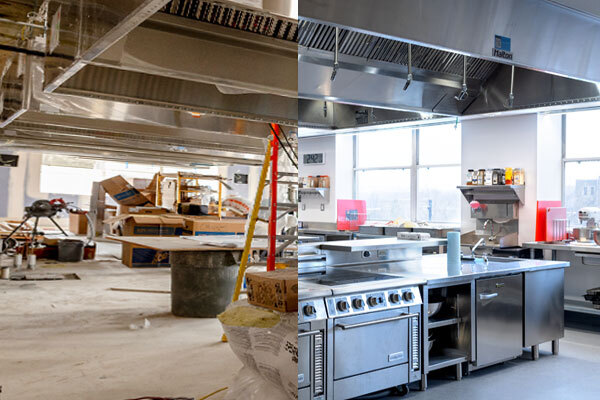
The Grailer Food Lab before and after completing renovations. (Devin Flores/Cornell University)
The renovated Cornell Peter and Stephanie Nolan School of Hospitality Grailer Food Lab is one of the country’s first fully electric teaching kitchens, marking the Cornell SC Johnson College of Business’ investment in a sustainable future for the hospitality industry. New cookware was donated by Jake Kalick ‘10, president and co-founder of Made In Cookware, and will enable students to cook with greater precision.
“The best thing is to be at the cutting edge of technology,” said Alex Susskind, the Banfi Vintners Professor of Wine Education and Management in the Nolan School within SC Johnson College. “We need to use what’s in the top restaurants and companies across the globe and teach our students what the future holds.”
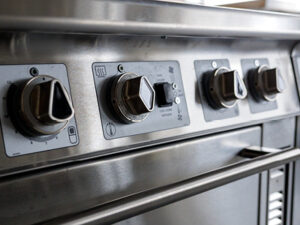
The updated appliances include induction stoves, which harness electromagnetic fields to cook with less energy and without directly emitting greenhouse gases. This technology gives students hands-on experience with an emerging industry standard: Installation of induction hobs in professional kitchens increased by 155% from 2022 to 2024.
New York State’s All-Electric Buildings Act went into effect Jan. 1, 2026, prohibiting fossil-fuel powered equipment in new buildings under seven stories. Enforcement for taller buildings will come in 2029. Other pro-electric legislation has passed in California and 10 municipalities of Massachusetts, phasing out the sale of gas-powered water and space heaters and restricting fossil-fuel hookups respectively.
“The game is changing, and it’s a matter of making sure people understand that it’s more powerful, it’s more precise and a better model to have overall,” Susskind said.
Sustainability isn’t the only benefit of switching: induction ranges offer several technical advantages as well. The majority of heat generated from gas ranges escapes into the air, but induction cooktops transfer heat directly into the cooking implement. This leads to faster cooking times: on average, induction boils water 20% to 40% faster than gas.
Induction cooking also protects chefs from adverse health effects associated with gas cooking. Gas stoves emit nitrogen dioxide while burning, a gas that irritates airways, triggers asthma and increases risk of chronic respiratory disease in children. Additionally, unburned natural gas containing benzene, a known carcinogen, leaks from gas stoves at rest. Prolonged inhalation has been linked to a higher risk of leukemia.
“There are a lot of opportunities here to make things safer, faster and less wasteful,” said Lilly Jan, a food and beverage lecturer in the Nolan School. “You can be very nuanced about cooking in ways that gas just can’t provide.”
Jan leads Establishment, a well-known restaurant management course cherished by Hotelies. Her students begin the semester learning core concepts like menu systems, market analysis and financial management. Then, they put knowledge into practice by managing Establishment — a student-run restaurant within the Statler Hotel — for one night.
“What’s wonderful about Establishment is we get to see what is trending in the industry for that generation,” Jan said. “With the new equipment, it will be really interesting to see how the students change their menus, how they think about production, holding and composition of dishes moving forward.”
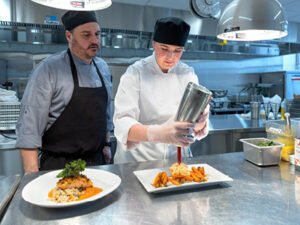
Establishment students will use the restaurant-style kitchen near the entrance of the food lab. The other section of the lab, separated by a wall to accommodate concurrent classes, features 14 fully-equipped culinary stations serving two students each. An identical teaching station is at the head of the room, outfitted with cameras and a microphone. Monitors on the wall give students a clear view of the instructor’s technique as they follow along.
The lab’s gas-based infrastructure needed remediation to support the new appliances. “This food lab has been the most challenging project to get off the ground,” said Danny Disidoro, executive director of facilities for SC Johnson College. “I was here when we built [Statler] tower, and now that feels like a walk in the park.”
Steel beams in the ceiling suspend the new, heavier equipment. The construction team had to cut through sections of these beams to route new ventilation ducts and utilities, which required complex calculations to preserve the lab’s structural integrity.
Further difficulties cropped up during construction, prompting creative problem solving. For one, the lab’s hood fans were expected to arrive in multiple pieces but were delivered fully assembled. Because of this, they wouldn’t fit through Statler Hall’s front entrance. But when a door closes, a window opens: after temporarily removing the lab’s windowpanes, the team lifted fans through the windows instead.
“Even though we spent an incredible amount of time going over our construction and engineering documents, you don’t know what might happen until you get into the space,” Disidoro said.
The renovated lab is now open to Nolan School faculty and students, providing new opportunities for culinary education, experimentation and research. Reinvestment in this facility reflects the belief that culinary training is valuable for every Hotelie, no matter their career aim.
“We don’t train chefs. What we do is we train hospitality professionals, and part of being a hospitality professional is understanding how restaurants work,” Susskind said. “If you understand how to run a restaurant, there are very few businesses in the world more complicated than that.”