
Students design a reusable bottle system for local wineries
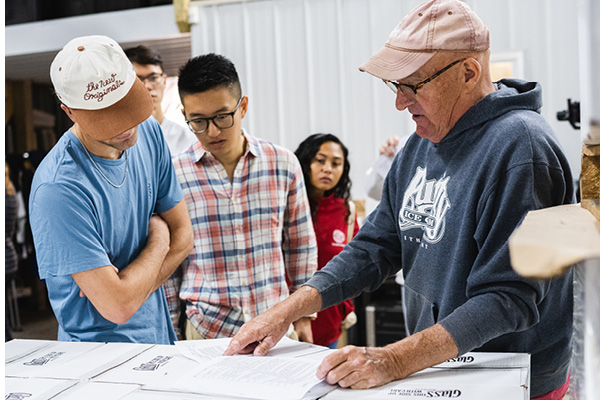
Previous Dyson students, class of '24, were given a tour of Treleaven Wines by co-owner Pete Saltonstall.
Single-use wine bottles inflate a winery’s carbon footprint and operating costs, but a reusable bottle system designed by undergraduate students at the Charles H. Dyson School of Applied Economics and Management in the Cornell SC Johnson College of Business offers a sustainable path forward.
In 2023, New York state produced more than 33 million gallons of wine, equal to about 167 million standard 750-milliliter wine bottles. Creating these bottles would have generated about 213,000 metric tons of carbon dioxide, equivalent to driving 46,300 passenger cars for one year.
There is no widely used alternative to manufacturing new bottles. “Our bottles go to a materials recovery facility, and unfortunately, I don’t believe that there’s a market for the glass that we generate,” said Pete Saltonstall, co-owner and president of Treleaven Wines. “So, it’s crushed and goes to line the landfills. I started thinking: Is there a way to reuse this glass?”
Three teams of SC Johnson College students were tasked with answering this question as part of their Grand Challenges coursework. Grand Challenges is a four-year program related to the United Nations’ 17 Sustainable Development Goals, and this final course was taught by Denise Ramzy. The problem was multifaceted: An effective system would need to address food safety concerns, bottle breakage and the upfront costs of equipment, transport and labor.
“It takes a lot of initial capital to get the whole project started, and it’s not something you start easily,” said Michael Abaseber ’26, primary lead for his team. “It does sound simple — you collect bottles and wash them — but you have to understand the life cycle of each bottle.”
Over the course of the semester, the students conducted site visits, spoke with winery representatives and fine-tuned their reusable bottle systems. Then, on Dec. 10, they presented their findings to local stakeholders, including Saltonstall.
Abaseber’s team proposed a cooperative pilot program that would span multiple Finger Lakes wineries. A centralized hub would host shared bottle-washing machines, but equipment and labor costs would be split across all participants, making the initial investment more feasible for small businesses.
The proposal also called for thicker standardized bottles to reduce breakage and water-soluble labels to simplify washing. To limit transportation costs and emissions, all participants needed to be located near the washing hub. After a few reuse cycles, wineries would be able to recoup their expenses and start saving money.
“Single-use bottles cost around 70 cents to $1.10 right now, and the cost of reusing one is around 15 to 35 cents. That looks small, but when you’re operating on a bigger scale, like 100, 1,000, 2,000 bottles, then your cost is going to be offset,” Abaseber said.
Adopting reusable bottles may also have a positive impact on the brand perception of a winery. Saltonstall learned that some vendors at the Ithaca Farmers Market serve their dishes on reusable plates. Customers bring dirty plates to a washing hub on site, then they’re cleaned and reused. He thinks that customers are becoming more conscious of single-use food items, and sustainable practices could make a winery like Treleaven stand out in an increasingly crowded industry.
“At the time we started, there were maybe 70 wineries in New York state total. Now there are over 445,” Saltonstall said. “So, you have to figure out some way of making your wine, your products stand out the most, and I think we would get a very positive marketing boost. There really is an interest in sustainability.”
This presentation was part of an ongoing partnership between Grand Challenges and local wineries to explore the feasibility of reusing their bottles. Both previous and current students aimed to hit the sweet spot between sustainability and profitability with their proposals. Although wineries have not yet decided whether to move forward, some expressed interest in reusable bottle systems as an eco-friendly solution to rising cost pressures.
Working on this project has also prompted Abaseber to consider how businesses should handle environmental responsibility. He plans to start his own company in the future and intends to implement sustainable processes from day one.
“I think companies have a big role because they employ multiple people. They have a larger scale; they have a larger impact on communities and the world they’re in,” he said. “By leading on sustainability goals, they show the general public that if a big company is doing it, they can do it on a smaller scale from home.”