
Nolan School alumni reinvest in culinary education
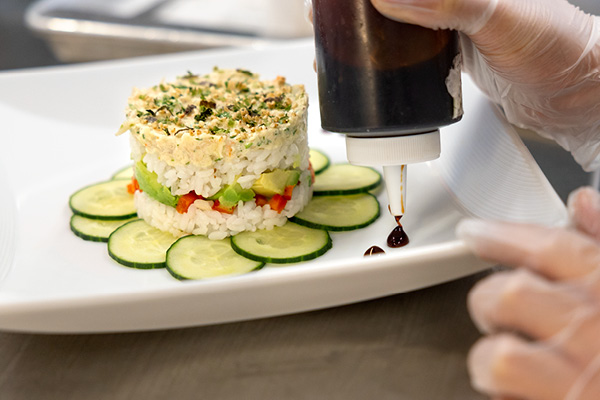
A chef's assistant finishes a dish from Establishment, Cornell's student-run restaurant. (Devin Flores/Cornell University)
While patrons relax and enjoy panoramic views of The Ithaca Campus at Establishment, Cornell’s student-run restaurant, the undergraduate head chef leading service in the Grailer Food Lab faces one of the toughest challenges of their education. They call out directions over the clatter of pans and sizzling food, responsible for ensuring quick service, food safety standards and beautiful presentation.
This is known as a student’s Establishment evening, the one night they’re responsible for managing an entire restaurant. It’s a rite of passage for students in the Cornell Peter and Stephanie Nolan School of Hotel Administration within the Cornell SC Johnson College of Business and is designed to build strong kitchen and people management skills.
For many years, Establishment and other food lab courses were taught on equipment installed in 1988. These appliances were reliable for decades, but in 2024, Nolan School faculty and alumni decided a refresh was in order. United by their belief that culinary training is vital, Alan Kanders ’87, Alan Rosen ’91, Susan (Guerin) Harrison ’83 and C. Kenneth Grailer ’53 contributed financially to the facility’s modernization.

“I’m a second-generation student, and my children went to Cornell as well as my nephew and niece. All of us still talk about our Establishment evening,” said Kanders, managing member and founder of Three Wall Capital, a hospitality investment and asset management firm. “It’s a great part of the hotel school experience, and we have to continue to foster that.”
Renovations were completed in early 2026, turning the Grailer Food Lab into one of the country’s first teaching kitchens to feature fully electric appliances. Establishment will reopen on Feb. 25, 2026 under the faculty leadership of Christopher Gaulke, Lilly Jan, Ravinder Kingra and Soojin Ha.
“A lot of the reason I’m successful at what I do is because I know how to cook,” said Rosen, owner of Junior’s Restaurants and Bakery, a restaurant chain serving cheesecake and American comfort food. “Any student at Cornell, whether they’re going into finance, real estate or hotel operations, is going to need to cook … even the CEO of a restaurant company will want to be comfortable walking into a kitchen.”

During his time at the Nolan School, Rosen gained a ground-up understanding of his business, learning everything from knife skills to financial strategy. “I can pretty much do every job in my business, whether I have to or not. It’s nice to have the skills,” he said. “I’m very appreciative of this part of my education, the same way I’m appreciative of learning about real estate and finance at Cornell, because I’ve used all those skills.”
Kanders felt the same way. He also emphasized the importance of students utilizing updated technology. Thanks to an extensive career in hospitality property development, he has a keen understanding of infrastructure and wants students to develop the same instincts.
“Being forward thinking is the most important thing,” he said. “Some of these students will eventually be in a position to design kitchens or the back of a house. When they are, they’ll have experience in utilizing the latest equipment themselves and recognize the value of it.”
The renovated food lab features induction stoves, an emerging industry standard, prioritizing climate-friendly and energy-efficient cooking.

“The [Nolan] School is great at asking: How do you work in a team? Managing your peers is probably the most difficult thing you can do,” said Susan Harrison, retired CEO and advisory board chair of World Finer Foods, a food brand management, sales and marketing company. “Learning how to work across an organization, up and down, is really important. I think there’s no better way to learn these competencies, and that’s why it’s so important that we continue in a much more modern way.”
Harrison observed that working together in kitchen production settings builds a unique bond between Nolan School classmates. “When you’re cooking together, you create a relationship that’s different from studying together.”
She recounted a time her peers in Hotel Ezra Cornell, a student-run conference for hospitality industry leaders, supported each other. The team needed sorrel, a leafy green herb, but couldn’t find it in local grocery stores. A few days before it was needed in a dish, her classmates took an impromptu road trip to hunt some down.
“The team drove all the way down to the Bronx to buy it from the market because we couldn’t get it here! The fun students have and the mistakes they make create lasting memories and warmth towards the Nolan School,” she said.
Strong student bonds are the basis of the Nolan School alumni network, which Kanders, Rosen and Harrison have found ongoing value in.
“Our relationships that started as freshmen can continue today,” Kanders said. “I have colleagues, friends and cohorts that I started at Cornell in 1983 and are still a part of my life today. When you’re able to go to an industry event and be among friends and peers that you’ve known for 40 years, it’s incredibly difficult to duplicate that.”
Along with these three alumni, C. Kenneth Grailer ‘53, food and beverage entrepreneur, made a significant gift to the renovated Grailer Food Lab, named for him. These contributions have ensured that Nolan’s food & beverage curriculum remains robust and forward looking.
“We have a saying in the hotel school, which is ‘pay it forward,’” Harrison said. “To pay it forward means I’ve helped you, and you need to help the next person.”