Cornell’s Dyson School earns No. 3 place in Poets and Quants ranking
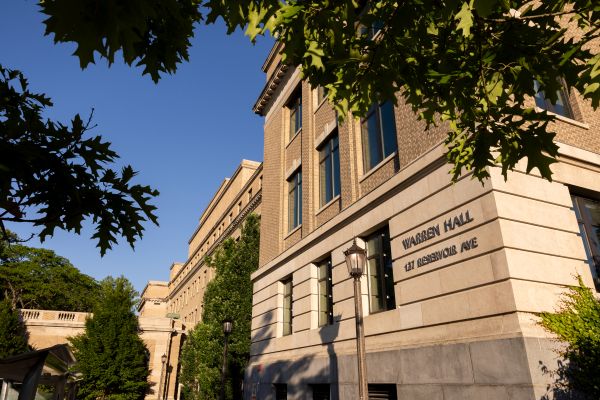
The Charles H. Dyson School of Applied Economics and Management, part of the Cornell SC Johnson College of Business, is now ranked No. 3 among the top U.S. undergraduate business programs in Poets & Quants’ Business Undergraduate Ranking 2026.
“Earning the No. 3 spot is wonderful news for the Dyson School’s undergraduate business program,” said Andrew Karolyi, Charles Field Knight Dean of the Cornell SC Johnson College of Business. “This achievement reflects Dyson’s unwavering commitment to excellence, made possible by the dedication of our faculty, staff, students and alumni, all of whom contribute to an exceptional undergraduate business education and experience.”
With a long-standing focus on sustainability and global impact, the Dyson School fosters multi-disciplinary knowledge, innovation and entrepreneurial spirit, preparing students to lead in an interconnected world. All students participate in the Grand Challenges Program; a multi-year program embedded in the curriculum that culminates in a team-based capstone project focused on a pressing societal issue.
“We are continually elevating the educational experience for our students through a forward-looking curriculum, innovative teaching methods and strong student support, all of which are reflected in our ranking,” said Jinhua Zhao, David J. Nolan Dean of the Dyson School. “Our guiding principle, ‘Our Business is a Better World,’ shapes how we prepare future business leaders to understand the meaningful impact their decisions can have in driving positive change for society.”
The Dyson School, which is shared between the SC Johnson College and Cornell CALS, enrolls more than 900 students, offering them the ability to integrate business education with diverse fields such as biological sciences, sustainability and technology.
This year, the Dyson School’s composite score awarded by the Poets & Quants Business Undergraduate Ranking 2026 is 95.38 out of 100, ranking in the top five for both career outcomes and admissions standards. This ranking is based on data provided by participating schools and alumni, with career outcomes, admissions and academic experience each accounting for one-third of the final score.
There were minimal changes to this year’s methodology, including replacing the High School Class metric with a new Cumulative Average College GPA metric. In addition, Poets & Quants consolidated the individual diversity metrics into a single metric.
The ranking reflects survey data from the class of 2023, 2022, and 2021. This year’s rankings overall showed significant movement, with only nine schools maintaining their previous positions.