H-1B for graduates: Does a business master’s degree help?


Pursuing a U.S. business master’s degree can expand your professional and relocation opportunities — regardless of whether your focus is analytics, accounting or a management-centered MBA. While no degree guarantees H-1B approval or selection, graduate study in the U.S. can strengthen your professional eligibility profile, open new timing options and offer access to employers who are well-versed in the process.
Recent headlines have raised questions about new rules for H-1B costs and policy changes, including a new $100,000 fee announced in late 2025. The White House later clarified that the changes would not apply to existing H-1B holders or those currently on a F-1 (foreign students) or J-1 (exchange students/visitors) visa who are switching to an H-1B visa. However, this potential confusion underscores an important reality: immigration policies evolve. That’s why it’s essential to consult official sources like U.S. Citizenship and Immigration Services (USCIS) and verify any next steps with your prospective employer’s immigration counsel.
Professionals from around the globe who are weighing graduate programs are increasingly planning their futures with this in mind. In 2024, individuals born in South or East Asia accounted for the vast majority of all H-1B approvals, reflecting the high demand and level of talent pursuing advanced education in the U.S.
Review our practical guide about how a business master’s degree can align with your long-term career goals and help you confidently navigate the evolving H-1B landscape.
 How H-1B works for business grads
The H-1B is an employer-sponsored visa for individuals who have demonstrated exceptional skill in specialized occupations. For most applicants, it includes an annual selection process tied to a national cap. While earning a U.S. business degree can strengthen your job candidacy, securing an H-1B visa involves a combination of factors, including employer readiness, role alignment, degree eligibility and timing.
The key elements that most often influence H-1B outcomes for business master’s graduates are:

A business master’s degree, including an MBA, doesn’t guarantee H-1B approval. However, it can increase eligibility, strengthen your candidacy and expand your timing options. A master’s degree becomes a strategic tool that supports broader career planning, particularly when it aligns with in-demand roles and is paired with an intentional recruiting approach.
Understanding how and where employers sponsor is also a critical part of the equation. In 2024, the National Foundation for American Policy reported that in its most recent year, Amazon had 3,871 approved H-1B petitions for initial employment. Other major employers (including Tesla, Microsoft, IBM and Meta) also had approved petitions, highlighting how some Fortune 50 and Fortune 100 companies continue to sponsor at scale. Targeting organizations with established sponsorship pipelines can make a big difference in both access and outcomes.
“The companies that came to campus or gave briefings always brought the most up-to-date content on sponsorship for that year since it could change on a year-to-year basis. I really appreciated Johnson’s help in giving me my best chance to get my dream role. I was able to secure my interview and internship offer because of their push, so I am grateful for their support.”
— Surbhi Inani, MBA ’25, Amazon
Several factors work together to improve the odds of securing an H-1B visa:
For instance, international students on an F-1 visa enrolled in the Johnson Cornell Tech MBA are eligible for a STEM OPT extension, enabling them to work in their field for up to 36 months in the U.S. This increased runway not only affords them extended professional training and an opportunity to contribute meaningfully in a U.S.-based role, but also gives them additional chances in the annual lottery for limited U.S. H-1B skilled worker visas.
A business master’s degree — particularly one with a STEM designation — can expand your H-1B visa eligibility and your timeline. However, the combination of degree, role, employer and timing have the greatest impact on the outcome.

Optional practical training (OPT) provides post-graduation work authorization for many students on an F-1 visa. STEM OPT offers an extension for those with eligible degrees in science, technology, engineering or mathematics. These pathways don’t replace the H-1B, but they offer critical time that allows students to explore professional options.
As of March 2026, here are key timeline scenarios to understand:

For international students, career decisions often come with an extra layer of complexity, especially when future visa outcomes aren’t guaranteed. However, the long-term value of a U.S. business master’s degree extends far beyond any single policy in effect. At Cornell, students build technical expertise, leadership experience and a professional network that extends across industries and geographic boundaries.
Cornell’s community reflects that global outlook. In the Two-Year MBA Class of 2027, 42% of students are of international origin, representing 34 countries. That diversity shapes more informed classroom discussions and forges lasting relationships that support personal and professional growth. A Cornell MBA makes you part of a larger community of professionals who are making an impact on the world around them.
Students also benefit from career support and a global alumni network that spans more than 250,000 Cornellians worldwide. The Johnson School international alumni network has a strong presence in major hubs of commerce, including London; Hong Kong; Singapore; Dubai, United Arab Emirates; Mexico City; Beijing; Shanghai; Delhi and Mumbai, India; and many more. Together, these resources help prepare you for your next opportunity in the U.S. or abroad.

International students bring diverse experience, global perspective and a strong sense of purpose to the job market. Many pursue a U.S. business master’s with the goal of gaining professional experience in the U.S. Some hope to build a long-term career in the U.S., while others want to expand their reach and lead on the world stage.
“The three-year work authorization after graduation allows students to gain meaningful experience in the U.S. Beyond that, an Ivy League MBA offers global credibility and a strong alumni network that opens doors to opportunities anywhere in the world.”
— Akshitha Duddala, MBA ‘26
Success in the recruiting process often comes down to preparation, timing and focus. These strategies can help you approach the search strategically. Please note that this content is intended for informational purposes only and is not legal advice. Students are strongly encouraged to consult their prospective employer and/or immigration counsel for guidance specific to their visa and work authorization options.
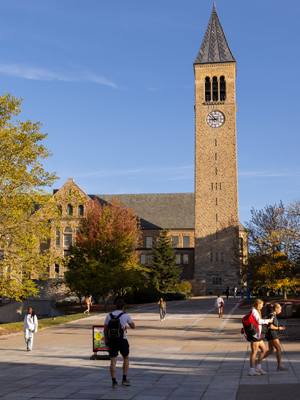
Cornell SC Johnson College of Business brings together three renowned schools. Much like Cornell’s worldwide network of students and alumni, they’re united by purpose and a commitment to developing principled leaders. A Cornell education connects you to a community built to help you move forward with momentum and support.
For international students, that support encompasses rigorous academics; experiential learning that mirrors real business challenges; and early conversations with employers about sponsorship and role fit. It’s all backed by a global alumni network that spans industries, continents and career stages.
If you’re considering a STEM-designated graduate degree program, the Two-Year MBA is STEM-certified, qualifying graduates for the 24-month STEM OPT extension.
Explore how a graduate degree program can help you build the skills, career strategy and global alumni network to plan your next steps.