The murky business of clean air: Creating a transparent carbon market
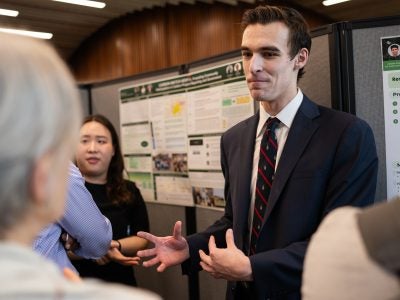
Douglas Lauricella ’27 presents CarbonWatch to a SMART symposium attendee. (Keaghlan Bradley/Keaghlan Bradley Photography)
Carbon credits are a valuable but confusing source of income for Kenyan farmers, who often don’t know who buys their credits or how payments arrive. After days of traveling across Kenya to hear from communities firsthand, a team of Cornell students created a platform to change that.
CarbonWatch Kenya, a public data dashboard and communication system, was designed by six students in the Student Multidisciplinary Applied Research Teams (SMART) program, part of the Charles H. Dyson School of Applied Economics and Management in the Cornell SC Johnson College of Business. The platform was presented to the Cornell community on April 15 at the 25th annual SMART symposium.
“I’m a Kenyan citizen studying at Cornell as an international student,” said Griffins Kiptanui Lelgut ’28, a project contributor and sophomore studying information science. “The carbon market has been a politically charged issue in Kenya, so I was interested in the chance to become an ambassador of change in my country.”
Carbon credits represent the reduction or removal of one metric ton of atmospheric carbon dioxide and have been hailed as an innovative measure against climate change. Governments or corporations can buy credits that support carbon sequestration projects like conservation tillage and crop rotation, offsetting their carbon emissions.
Carbon markets have also raised concerns. Some think that carbon markets perpetuate postcolonial dynamics and incentivize organizations to offset emissions instead of eliminating them.
Regardless of one’s perception of the carbon market, it remains an important opportunity for Kenyan farmers. Kenya is a leading provider of African carbon credits, but the Kenyan carbon market’s regulatory framework is complex and still emerging, which has caused inconsistent data reporting and distribution of payment.
“Beforehand, we thought there was a well-regulated system, because there are big companies like Meta and Netflix in the marketplace,” said Kushal Kumar, M.S. ’24, an applied economics PhD student in the Dyson School and project contributor. “But when we spoke with pastoral farmers, we realized that while they knew where carbon credits were coming from, they did not know how it was monetized, who was getting paid or how funds were processed.”
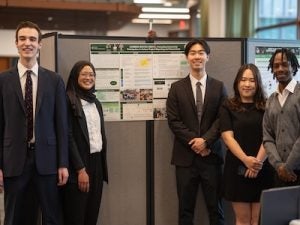
Lelgut, Kumar, Yurim Nam ’27, Herlina Oktavianti, MPA ’26, and Ian Kung, M.S. ’27, traveled to Kenya to speak with local stakeholders and assess their needs directly. They traveled for hours at a time over hot, dusty roads in the central highlands of Kenya, visiting people in community centers, schools and houses.
“There are so many actors involved. Conservancies in Kenya, conservancy management organizations, local governance groups and pseudo-governance groups,” said Kumar. “In the end, pastoral community members are left out in the decision-making process.”
The CarbonWatch team discovered that it was difficult for farmers to communicate directly with project proponents who manage and oversee their work, so they set out to establish communication channels as well. Because smartphone and internet access can be limited in Kenya, the team linked SMS messaging and USSD codes to the dashboard, allowing community members in low-bandwidth areas to send messages and receive specific carbon market data upon request.
The team also found that women were routinely left out of conversations around the carbon market, despite providing much of the labor.
“They told us that leadership positions in the community were held by men, but in some instances where no woman was elected, they had to force some re-elections so that women will have fair representation,” Lelgut said.
This led the team to build SCOUT, a social survey integrated into the CarbonWatch dashboard. It provides an anonymous space for community members to share their interactions with the carbon market, mapping demographic trends of inclusion and exclusion. This information is intended to inform policy and motivate groups towards collective engagement.
The dashboard has been completed, but the team still needs to determine which Kenyan organization will manage the platform long term. In consultation with their community advisory partners, the Kenya Wildlife Conservancies Association and AIID-Africa, they’re debating which aspects of carbon market data management should be public, governmental functions and which should be the responsibility of a private entity. Once they identify appropriate data stewards, the team says they are on track for a soft launch in the summer.

At the SMART symposium, the late Diane Conneman was honored for her longstanding generosity and recent significant bequest supporting the SMART project teams. Her bequest will help ensure the long-term viability of student engagement and facilitate program expansion. Seven other projects were displayed by student groups, and Janet McCue, an award-winning author who was a Cornell librarian for three decades, won the 2026 Clifton R. Wharton, Jr. Emerging Markets Award.
“I encourage the people who are visiting to take note of the idea behind SMART,” Lelgut said. “We try to help other people because we are at a point of privilege. We extend a hand to help others and solve other problems in the world.”
Article Information
- Categories
-
- Energy & Sustainability
- Global Development & International Business
- Tags
-
- Data Analytics & Big Data
- Environment & Climate
- Globalization
- Schools & Departments
-
- Dyson School
-
- Specialized Master's
- PhD in Applied Economics and Management
- MS in Applied Economics and Management
- Doctorate