
Student delivers equipment to Peruvian volunteer firefighters
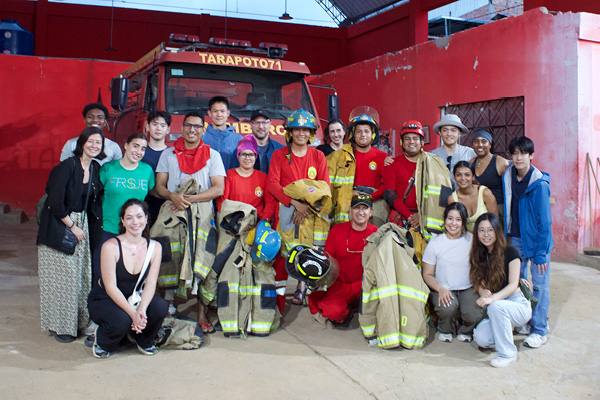
Grand Challenges students deliver equipment to Bomberos Tarapoto 71. (Provided, Pablo Esteves)
The largest volunteer fire station in the San Martin region of Peru, Bomberos Tarapoto 71, faced a dangerous shortage of equipment: One protective suit was shared between two or three firefighters. A Cornell student set out to change that.
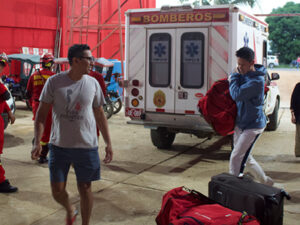
Kiran O’Kelly ’26, a senior in the Charles H. Dyson School of Applied Economics and Management, part of the Cornell SC Johnson College of Business, organized the donation of eight fire jackets, four helmets, five pairs of pants and one protective hood from the Cayuga Heights Fire Department, which were delivered on March 29 by a group of Dyson School students.
Last spring, O’Kelly participated in a Dyson School Grand Challenges project in partnership with Siendo Naturaleza, a learning center in the Amazon Rainforest that brings people and nature together to promote a regenerative future, helping rural Peruvians market turmeric. There, he bonded with the on-site paramedic and volunteer firefighter, Roberth José Pinedo Chujandama.
Because Pinedo spoke only Spanish, O’Kelly often translated his words to peers who weren’t bilingual.
“He was a very friendly guy. At first, my Spanish was rusty, and he was very patient. If the other students wanted to engage with him, I could be an intermediary,” O’Kelly said.
Despite the language barrier, Pinedo instantly connected with the group, especially O’Kelly, bonding about sports and swapping stories of daily life in Peru and the United States. After the group left, he stayed in touch with the students on WhatsApp and began telling them about Bomberos Tarapoto 71’s struggles with limited gear.
“The inability to provide protective equipment for every individual is our primary operational constraint, and modernized equipment offers superior protection and comfort,” said Pinedo.
He’d heard that American fire stations cycled out equipment every few years and asked if his station could receive the discarded gear. Due to strict regulatory guidelines in the United States, fire equipment is often phased out while still functional, and Pinedo knew his station could put it to use.
O’Kelly took on the project — separate from his coursework, not done for class credit or pay — and began to research possibilities. He soon found out that Sarah Wolfolds, Grand Challenges academic director and Dyson director of undergraduate studies, knew the fire chief of the Cayuga Heights Fire Department, George Tamborelle. Wolfolds reached out on O’Kelly’s behalf, and Tamborelle was eager to help.
“In the top of a fire helmet, there’s a warning sticker that says, ‘firefighting is inherently dangerous.’ These people in Peru are doing a dangerous job knowing they don’t have the proper equipment. Yet, they’re still doing it,” Tamborelle said.
This wasn’t the first time he’d tried to help lesser-equipped fire departments. Fifteen years ago, on a trip to Guatemala, Tamborelle found similar conditions in the fire stations he visited.
“There were a lot of people doing really great things with very outdated equipment. They had fire jackets with flannel lining, which predates me, and I’ve been doing this since 1992. They also had the tall boots we used to use in the 50s and 60s,” he said.
Tamborelle and his crew boxed equipment to send to them but found that shipping expenses would be cost prohibitive. O’Kelly encountered the same problem, but through the Dyson School, he found another solution.
The Grand Challenges program has an ongoing relationship with Siendo Naturaleza, so O’Kelly knew future classes would be traveling to San Martin to work with them. He met with the next class traveling there and asked three of the students to carry bags of equipment into Peru. O’Kelly split up the equipment, dropped it off to the students and secured funding through the Dyson School to check the bags on their flight.
“It taught me that the Dyson School wants you to go above and beyond,” O’Kelly said. “If you just ask people, they’ll pitch in. It was difficult to accomplish this, but at the same time, easy since everyone wants to help.”
On March 29, the next class of Grand Challenges students arrived in Peru for a community-engaged learning class led by Trent Preszler, professor of practice and academic director of the Dyson leadership development program, and delivered the equipment to the station.
“By enabling more firefighters to become fully operational — and thereby enhancing the overall effectiveness of our emergency response capabilities — we improve our emergency response metrics, which ultimately benefits our entire community. The Dyson students aspire to create a better world,” Pinedo said.
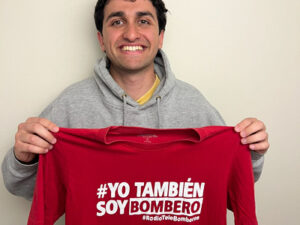
Pinedo sent O’Kelly his own piece of equipment from the station: a Bomberos Tarapoto T-shirt.
“When we came to do field work in Peru, it wasn’t a transactional thing where we go for one week then leave,” O’Kelly said. “The relationship exists beyond that, and this donation deepened it. Hopefully, the equipment will help them stop fires, but I also hope it returns the time and effort they gave to support our class projects.”