Where tech meets tradition: Cornell MBAs graduate
Three Cornell MBA grads share one vision: business meets tech. Two campuses, two cities, one transformative SC Johnson experience.

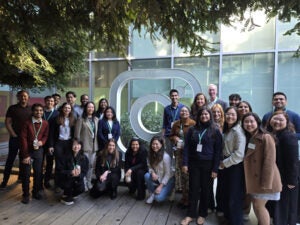
Johnson Cornell Tech MBA Class 2026 (Provided)
At this year’s Cornell Commencement, three Cornell MBA students will be carrying more than their diplomas. They will also carry a transformative experience shaped by two distinct campuses, two cities and a shared commitment to innovation where business and technology intersect.
Graduating from the Cornell SC Johnson College of Business are Nghi Tran and Jordi Sabria, both students in the Johnson Cornell Tech MBA program at the Cornell Tech campus, and Alicia Pettis, a student in the Samuel Curtis Johnson Graduate School of Management’s Cornell MBA program. Together, their stories illustrate how Cornell’s dual‑campus MBA ecosystem prepares students for leadership roles in an increasingly tech‑driven economy.
SC Johnson College offers distinct yet interconnected MBA pathways: the traditional two‑year program at Ithaca’s residential campus and the immersive one‑year tech MBA in New York City on Roosevelt Island. Both programs are linked through dual‑campus opportunities that allow students to take classes across locations, collaborate on projects and access Cornell’s academic and alumni community, as well as New York’s innovation ecosystem.
“These programs are intentionally designed to align with where the future of business is heading,” said Vishal Gaur, dean of the Samuel Curtis Johnson Graduate School of Management. “Whether students study in Ithaca or Manhattan, they are learning in very dynamic settings to lead across industries, technologies and cultures.”
For Pettis, the two-year MBA experience blended leadership training in Ithaca with targeted weekend courses at Cornell Tech, including tech-focused electives such as Women in Leadership in Tech and SMARTech: Strategy for Media, Art and Retail Tech.
Her coursework exposed her to new ways of thinking about value creation. In Johnson Professor or Practice Mukti Khaire’s class, Pettis learned the “four C’s” model of commerce, consumption, culture and commentary, which reframed traditional economic thinking through the lens of digital and cultural products. Classes with Johnson Associate Professor Elizabeth McClean deepened her understanding of navigating the tech space as a woman and reinforced the importance of women helping shape the future of technology and AI.
“These classes pushed me to think beyond spreadsheets and strategy decks,” Pettis said. “They emphasized emotional intelligence, storytelling and cultural intuition, skills that are essential for leading in an AI and tech-forward world.”
As co‑president of the student council, Pettis also refined her collaborative leadership style, helping foster community and connection across the program. Through a summer internship with the company SC Johnson, along with on-campus projects with Procter & Gamble, Nestlé and CVS Health, she applied classroom concepts to real-world brand challenges, strengthening her goal of pursuing brand management roles in emerging technology companies.
“The dual‑campus experience allowed me to test new ideas in Ithaca and then pressure‑test them in New York through a technology lens,” she said. “That combination of leadership, creativity and innovation has been incredibly valuable.”
Tran’s journey to graduation is marked by resilience and ambition. After emigrating from Vietnam at 17, Tran built her career in property technology and chose the Johnson Cornell Tech MBA to sharpen her entrepreneurial skills and build a network.
At Cornell Tech, Tran immersed herself in startup projects, including an educational transcription app, a wellness platform called Sangha and a hackathon‑born venture focused on end‑of‑life planning and estate management. The third, inspired by personal experience, aims to help families navigate complex legal and emotional processes following the death of a loved one.
“Cornell Tech gives you a chance to discover who you are,” Tran said. “By spending dedicated time around ambitious people from around the world, you eventually start asking yourself not just what you want to build, but who you want to become while building it.”
Beyond the classroom, Tran served as the class representative for the Class of 2026 and as a fund manager with Big Red Ventures, a Cornell student‑led venture capital fund that scouts early‑stage startups.
Living on Roosevelt Island also shaped Tran’s Cornell experience. With its self-sustaining design and close-knit community, the island felt like a rare oasis within New York City. “That contrast mirrors the program itself, which is intense, innovative and intimate all at the same time,” Tran said.
With an engineering background from Georgia Tech, Sabria entered the Cornell Tech MBA program to transition into a business leadership role in the tech industry. The program’s fast pace and New York City location created a stimulating environment.
“The intensity forces you to prioritize, adapt and grow quickly,” Sabria said. “You learn how to operate under pressure, and that’s exactly what a leadership position demands.”
As vice president of operations for Big Red Tech Club, a professional club he helped establish, Sabria expanded networking opportunities for MBA students through fireside chats with alumni, case competitions and company visits in New York City.
“Being in Manhattan means the learning doesn’t stop when class ends,” Sabria said. “Every conversation, event, networking opportunity and interaction becomes part of your education.”
He credits Johnson professors Mani Sethuraman, Gautam Ahuja, and Khaire for their outstanding teaching, their passion for their expertise and their ability to make complex subjects engaging.
For Manoj Thomas, associate dean overseeing Cornell’s New York City programs, the success of students like Pettis, Tran and Sabria highlights the purpose of the dual‑campus model.
“Our goal is to educate leaders who are fluent in business fundamentals and technological change,” Thomas said. “These students leave Cornell ready to lead teams, build companies and navigate uncertainty with confidence.”
As graduation approaches, each student reflects on an experience defined by flexibility, experimentation and connection. From Ithaca’s collaborative academic setting to New York City’s innovation hub, Cornell’s dual‑campus MBA programs equip students with a range of relevant skills and a perspective to influence and shape the future of business.
Article Information
- Categories
-
- Management, HR & Leadership
- Schools & Departments
-
- Johnson School
-
- Cornell MBA
- Executive MBA (EMBA)