How a tech MBA redefines AI leadership for business innovators

(Image credit: Alexandra Bayer/Cornell University)
AI isn’t just changing how we live. This seismic shift also raises the bar for business leadership. In an AI-enabled world, the advantage shifts toward high-agency entrepreneurs and intrapreneurs who move quickly, test ideas with real users and iterate relentlessly. Whether you’re launching a startup, driving innovation inside a global enterprise or building a public-interest venture, AI-first leadership has become the operating system for modern venture-building.
Today’s leaders need to hone AI fluency to make better decisions, set responsible guardrails and turn emerging technology into market impact. To prepare them for that, AI-leading universities such as Cornell are fostering universitywide approaches to AI, emphasizing interdisciplinary collaboration, responsible use and real-world outcomes — a mindset that maps directly to how founders and builders lead in practice.
Tech entrepreneur and Cornell faculty member Lutz Finger observes that:
“Winners operationalize AI. They use it to accelerate workflows and decision speed while keeping judgment human. Laggards outsource judgment. They let AI replace thinking and craft. AI can draft the slides but not the meaning, the trade‑offs, the stakeholder alignment or the executive‑level selection of what matters. That’s where leadership (and strong MBAs) become more valuable, not less.”
The one-year Johnson Cornell Tech MBA is designed for people who want to shape markets and not simply navigate them. The program equips candidates with the tools to build the judgment, momentum and venture mindset to lead in an AI-transformed economy. At Cornell, AI-first leadership is grounded in management theory and direct access to engineering expertise through the university’s dual-campus model connecting Cornell Tech in New York City to the Cornell SC Johnson College of Business and the Cornell Duffield College of Engineering in Ithaca, New York.
What does it mean to be an AI-first leader when it comes to innovation?
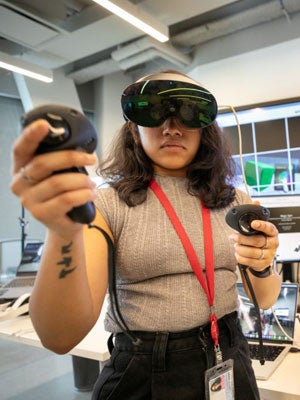
Being an AI-first leader doesn’t mean chasing every new tool or delegating your thinking to algorithms. It means recognizing that AI has become a core component for strategy, ventures and organizations — and leading accordingly. An AI-first leader uses AI to accelerate innovation and venture creation, reduce the cost and risk of experimentation and redesign sustainable systems that factor in accountability, efficiency, governance and human behavior.
These individuals view AI as a force multiplier for venture creation and organizational change, whether inside a startup or at a large company. AI-first leaders understand the importance of moving quickly but not carelessly. Structuring experiments, measuring impact and adjusting course in response to evidence — not ego — are pillars of sound leadership in the era of AI and beyond.
Here are four qualities that define AI-first leadership in practice:
- AI fluency AI-first leaders speak the language of AI well enough to lead with it. They understand how to use AI to rapidly prototype products, services and business models, turning ideas into testable realities in days instead of months. They can communicate effectively with technical teams by probing assumptions, clarifying requirements and aligning efforts with customer and market needs. Most importantly, they translate AI capabilities into business value, asking not, “What can this model do?” but, “What problem does this solve, and for whom?”
- Strategic integration For AI-first leaders, AI is not a side project. It’s woven into how the venture competes. They use AI to build sustainable advantage, whether by sharpening pricing, personalizing experiences or opening new ways to serve a market. They make informed assumptions about markets, platforms and ecosystems. This involves strategic decisions around where to partner, where to build and where to differentiate. Over time, they design ventures and innovations that scale intelligently, with AI embedded in processes, decision flows and operating models rather than bolted on as an afterthought.
- Human-AI collaboration AI-first leaders design teams where humans and AI systems genuinely co-create. They are intentional about which tasks AI agents or systems should handle and where human judgment, empathy and creativity remain central. They augment algorithmic AI systems with intangible human elements that position brands as tastemakers instead of trend followers. As noted by Justin W. Yu, MBA ‘26, executive creative director at Arthouse, a digital-first agency of TodayTix:
“AI is, by design, average. It’s spectacular at pattern recognition and synthesis, but it produces what is likely, not what is intentional. The work that people remember, quote, share and carry into culture rarely sits at the center of the distribution. It tends to live on the edges: the emotionally precise, the strategically brave. That edge is where taste lives. Taste is the ability to choose what resonates before you can prove it will.”
AI-first leaders embrace constant change, treating experimentation and feedback as normal parts of the work rather than as outliers. In periods of ambiguity, they use AI to illuminate options and scenarios while keeping accountability, ethics and long-term trust firmly in human hands. - Leading AI-enabled teams An AI-first leader’s style of leadership changes as the tools change. They create “studio-style” environments where business, engineering and design work side by side, iterating quickly on ideas with shared ownership of outcomes. They develop cross-functional fluency and move seamlessly between product reviews, technical discussions and financial decisions. These leaders prepare their teams to operate in startup contexts and large organizations, giving people the mindset and structure to bring AI-enabled initiatives from early concept to scaled, enterprise-grade reality.
How future leaders apply AI concepts to real-world challenges

Emerging leaders and entrepreneurs, especially MBA candidates, build confidence not by reading about use cases, but by working through them using all the tools at their disposal, including AI. They use AI to complement critical thinking skills – not replace them, especially in scenarios where leaders are faced with concrete problems and high stakes.
“AI-first leadership is treating AI like a new operating system,” notes Finger. “They don’t just ‘use AI tools,’ but redesign workflows, define permissions and manage with evals and audit trails. The future focuses on value creation in new workflows, not vibe coding or cost reduction alone.”
Leaders in an AI-empowered landscape fine-tune their skills by testing hypotheses, pressure-testing assumptions and learning in tight feedback loops with peers, faculty and users. Collaborative, cross-functional environments give them space to connect AI tools to strategy, governance and the behavior of customers, patients and employees.
Here are five arenas where AI-first leaders are already redefining what’s possible:
- Finance: AI can help leaders accelerate risk assessment, detect fraud patterns and personalize financial products at scale. For venture-minded executives, the opportunity extends beyond efficiency into designing new revenue models, embedded financial services and data-driven advisory offerings that can compete in highly regulated markets. Within larger institutions, AI strategy becomes a lever for modernizing portfolios, improving capital allocation and launching new digital businesses.
- Health care: AI-enabled ventures can improve triage, streamline workflows and support earlier detection through advanced intelligent analytics. Leaders who adopt an AI-first mindset in health care focus on pairing innovation with accountability, ensuring that new tools align with clinical standards, privacy requirements and patient trust. They use AI to enhance outcomes and operational resilience, not to bypass the human judgment at the core of care.
- Education: AI can expand access to personalized learning and adaptive assessments while also raising questions about equity, integrity and outcomes. Entrepreneurial leaders in this space treat AI as a path to build on the instruction of subject matter experts rather than replace them. Inside established institutions, AI can also offer more precise insight into what drives student success.
- Marketing: AI can accelerate audience insights, experimentation and creative iteration, giving time-strapped teams a means to test messages, refine positioning and optimize customer journeys. For founders and intrapreneurs, the advantage comes from using these faster cycles to understand what customers actually value, then translating that insight into sharper brands and better products. In larger organizations, AI-first marketing leaders help connect data, creativity and segmentation into a coherent growth strategy.
- Operations: AI can be used to evaluate large quantities of data to better forecast demand, inform supply chain decisions and automate routine processes so teams can focus on higher-impact work. Leaders with a venture mindset use AI to pilot new operating models, keeping teams lean when needed while scaling what works to build more resilient systems in the face of volatility. For established enterprises, operational AI becomes a foundation for continuous improvement, new service lines and more strategic use of talent.
In the New York City-based Johnson Cornell Tech MBA program, students work on studio-based, cross-functional projects that mirror how modern ventures are built, applying AI concepts to real-world challenges and learning to lead with innovation and responsibility.
That experience is shaped by Cornell Tech’s interdisciplinary model, where business, engineering and law perspectives come together. Students build strategic fluency through courses like Data Analytics and Modeling with AI and Designing Products with AI, while also engaging with more technical topics such as reinforcement learning and natural language modeling. They explore the broader implications of AI through courses like AI Law and Policy, helping them understand not just what AI can do, but how it should be applied responsibly in practice.
Explore the Johnson Cornell Tech MBA: Building leaders for the AI era

AI is a core focus of advanced management education across the Cornell SC Johnson College of Business. The Johnson Cornell Tech MBA draws on that broader expertise through an entrepreneurial and innovative lens, complemented by exposure to courses taught by engineering faculty — from Cybersecurity and Adversarial Thinking to Entrepreneurial Finance. This multidisciplinary approach influences how business leaders think about AI viability, the governance of AI and where human skill and expertise can best complement the use of AI to accelerate innovation and business momentum.
The MBA program develops leaders who combine a bias for action with a scientific temperament, grounded in the understanding that entrepreneurship is a mindset that can be taught and built upon. Students put learning into practice with entrepreneurial tracks in startup creation or innovation inside larger organizations or within the Public Interest Tech Impact Studio, which leverages technology for the advancement of public good.
Based in New York City, the program treats the city as a living laboratory, giving students proximity to ventures and established organizations in finance, media, health care, fashion, urban systems and the future of work. MBA candidates also have daily access to founders, investors and captains of industry. Leaders emerge from the one-year Johnson Cornell Tech MBA program prepared to lead in organizations where AI, technology and strategy intersect.
Learn how the Johnson Cornell Tech MBA equips you to lead in an AI-powered world.
Article Information
- Categories
-
- AI & Technology
- Inside SC Johnson
- Schools & Departments
-
- Johnson School
-
- Cornell MBA
- Johnson Cornell Tech MBA