
Wellness bar proposal wins hospitality pitch deck competition
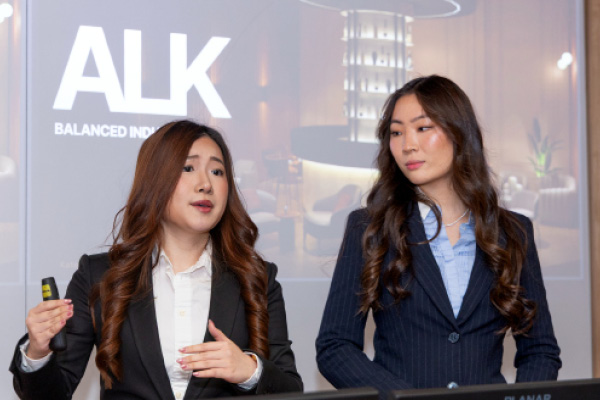
A proposal to reimagine the traditional hotel bar by introducing cocktails infused with kava, CBD and other natural ingredients took the top prize of $3,000 in the Cornell Hospitality Pitch Deck Competition Nov. 18.
The Statler Hall event, sponsored by the Leland C. and Mary M. Pillsbury Institute for Hospitality Entrepreneurship, attracted students from six schools across campus.
Katelynn Wiseman and Miya Deng, seniors in the Cornell Peter and Stephanie Nolan School of Hotel Administration within the Cornell SC Johnson College of Business, developed the startup based on personal experiences with drinking: Wiseman, a self-described “health nut and wellness junkie,” refrains from alcohol, and Deng’s best friend is allergic to it.
“When I go out with friends, what are my options?” Wiseman asked during her presentation. “It’s Shirley Temples and mocktails, which are honestly just dressed-up sugar water … so they’re not necessarily appealing when you care about health and longevity.”
ALK, their startup, plans to partner with hotels to offer both traditional cocktails and signature nonalcoholic drinks that produce what they call “functional highs.” Their proposed makeover of hotel bars would leverage the growing wellness tourism industry, valued at about $300 billion, Wiseman said.
ALK was one of 22 teams in the 10th annual pitch deck competition, which evaluates proposals based on business concept, slide deck presentation, argument structure and message delivery.
“This is one of the closest competitions we’ve had in the 10 years of the competition,” said Andrew Quagliata, a senior lecturer in management communication at the Nolan School, who created the competition in 2016. “This was not easy for the judges to decide.”
Focus on presentation skills
Each team gave a 10-minute presentation before answering questions from the judges. While the judges praised the presentations of the four finalists, they agreed that the ALK team stood out because of their high-quality slides and impactful message delivery.

“They represented their brand very, very well, and they also personalized it,” said Ellen Yui, P’14 and ’16, founding principal of Yui+Company, a communications consulting firm. “They took it from the personal to this is how we can disrupt the market and bring an offering that we know is needed personally.”
The other judges said ALK’s proposal filled a need in the hotel market that is not currently met. “Their presentation was very applicable to what’s going on in the industry right now,” said Jason Spillerman ’92, P’25, managing partner and co-founder of Vibrant Development Group, which creates retail, dining and entertainment programs. “People seem to be looking for alternatives to alcohol.”
Adam Falcheck, MPS ’14, vice president of DLJ Real Estate Capital Partners, a real estate investment and development firm working in the hospitality industry, noted that alcohol sales are down in hotels. “People just aren’t drinking as much alcohol, and because you don’t have the right substitution, they’re not getting that second drink,” he said.
Other winners:
- Amedeo Tafuri, MPS ’27 received the second-place $1,500 prize for Alfred.AI, which uses agentic AI to automate guest experiences and host operations for short-term rentals.
- Charles H. Dyson School of Applied Economics and Management students Evan Ye ’27 and Sukin Yang ’26 won the third-place $500 prize for Memento, a hospitality platform that uses AI to create dining and local experiences for travelers.
- Michael Llodra, MPS ’27 took fourth place for VerdiFI, which offers energy expertise with innovative financing to independent hotel operators.
Next steps for ALK
For finalists, one of the benefits of the pitch deck competition is receiving advice on their proposed startups from judges who work in the hospitality industry.
The ALK team said they plan to refine their proposal based on suggestions from the judges. Though they had already approached hotel owners about their business concept, they decided to modify their startup before bringing it to market.

“We got really good feedback on our idea,” Wiseman said. “So, we’re going to have a chat to deliberate and finalize our proposal.”
Wiseman said the next step is to submit the proposal to the Cornell Hospitality Business Plan Competition, which opened pitch submissions in November. The winners in that competition will be announced after the finalists’ presentations in April.
Quagliata said he originally created the pitch deck competition to offer an alternative to the business plan competition but noted that the two events are now connected. “I wanted something that felt more accessible to people who just had an idea that they wanted to try out,” he said, “and it turns out that this is a nice feeder for the business plan competition.”